Zavedení
The transition from Euro 6 to Euro 7 marks a major shift in European emission-control regulations. These new rules reshape catalyst design, durability expectations, and real-world performance requirements. They also increase the technical burden on třícestné katalyzátory, diesel aftertreatment systems, and particulate-control technologies. To comply with Euro 7, manufacturers must improve catalyst activity, reduce ultrafine particles, manage new pollutants, and ensure long-term system stability.
Euro 7 expands pollutant categories, tightens durability limits, and adds new test conditions that capture real-world driving more accurately than Euro 6. This pushes catalyst engineering toward faster light-off performance, better thermal resistance, and enhanced monitoring strategies.
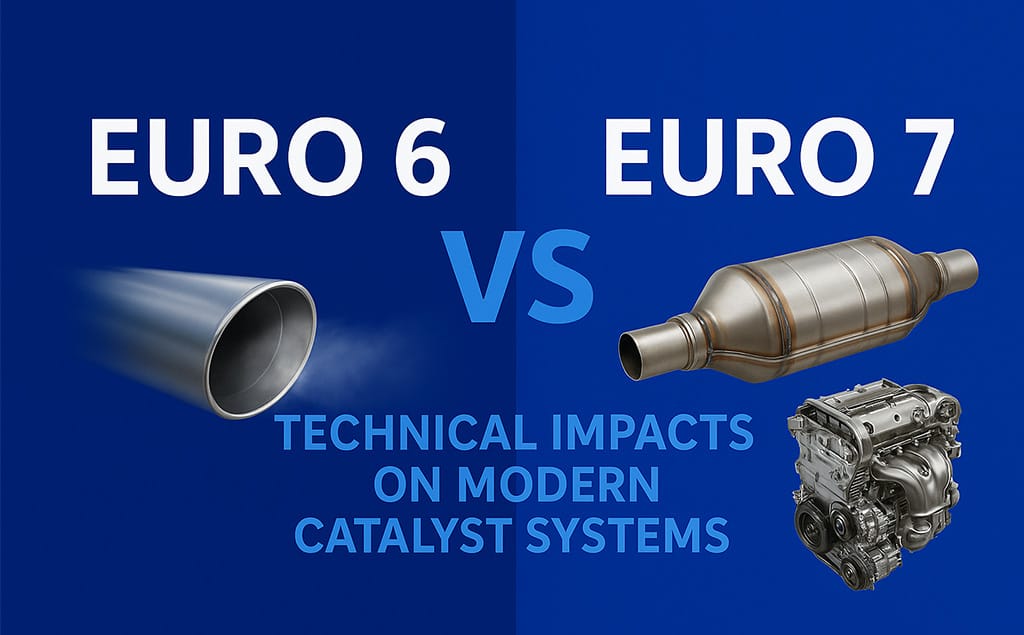
Euro 7 Represents a Major Step Beyond Euro 6
Euro 6 regulations have controlled NOx, CO, PM, and hydrocarbon emissions since 2014. Euro 7 builds on this foundation but broadens the scope. It adds ammonia and nitrous oxide limits, regulates particles from 10 nm, and introduces standards for brakes and tires.
Euro 7 differs from Euro 6 in several ways:
- Wider pollutant coverage
- Longer durability requirements
- Stricter Real Driving Emissions tests
- New particle-number thresholds (PN10)
- Lower-temperature and lower-load evaluations
- Regulation of non-exhaust emissions
- Battery performance requirements for electric vehicles
These changes require more advanced catalyst chemistry and stronger system integration.
Catalyst Durability Requirements Increase
Euro 7 requires catalytic converters and filters to remain effective for 200,000 km or 10 years, which doubles Euro 6’s 100,000-km requirement. Manufacturers need stronger substrates, more stable washcoat formulations, and optimized PGM distribution.
To meet durability goals, catalyst engineers focus on:
- Thermal-resistant substrate materials
- High-stability oxygen-storage components
- Strong washcoat adhesion
- Optimized precious-metal loading
- Improved flow-channel design
Euro 7’s OBD rules also require earlier detection of catalyst degradation, which demands more sensitive monitoring sensors and software.
Ultrafine Particle Regulation (PN10)
Euro 7 regulates particles down to 10 nm (PN10), while Euro 6 covered only 23 nm (PN23). This forces the adoption of higher-efficiency gasoline particulate filters and more advanced diesel particulate filters.
To meet PN10, engineers improve:
- GPF coating uniformity
- Filter pore structure
- Catalyst heat-up behavior
- Regeneration strategies
This impacts gasoline, diesel, and hybrid powertrains.
New Pollutant Categories
Euro 7 introduces new emission limits that influence catalyst chemistry.
Ammonia (NH₃)
Euro 7 restricts ammonia slip from SCR systems. Manufacturers must use:
- Optimized urea dosing
- Higher-capacity SCR catalysts
- Ammonia-slip catalysts (ASC)
Nitrous Oxide (N₂O)
N₂O becomes a regulated pollutant. Catalyst choices shift toward:
- Vanadium-based SCR systems (lower N₂O) over copper-zeolite SCR
This change reduces greenhouse-gas emissions and improves real-world performance.
Real-World Driving Emissions Testing
Euro 7 expands RDE test coverage. Catalyst systems must work at:
- Lower speeds
- Lower engine load
- Lower exhaust temperatures
- Wider ambient-temperature ranges
Manufacturers must implement faster light-off for třícestné katalyzátory using:
- Higher-activity PGM formulations
- Thin-wall substrates
- Electrically heated catalysts
- Improved thermal insulation
- Optimized placement closer to the engine
Table 1. Euro 6 vs Euro 7 Key Technical Differences
| Parametr | Euro 6 | Euro 7 | Dopad |
|---|---|---|---|
| Trvanlivost | 100 000 km | 200,000 km | Requires stronger catalysts |
| Particle Size | 23 nm | 10 nm | Higher filter efficiency |
| NOx | Mírný | Stricter | Advanced SCR/TWC designs |
| Ammonia | Not regulated | Regulated | Needs ASC catalyst |
| N₂O | Not regulated | Regulated | Vanadium SCR trend |
| RDE thresholds | Limited | Expanded | Cold-start optimization |
| Brake/tire particles | Žádný | Ano | Applies to EVs too |
Euro 7 Requirements for Diesel Engines
Diesel systems must integrate:
- Larger DPF volume
- More efficient SCR catalysts
- Vanadium-based systems for lower N₂O
- Improved urea-injection control
- Better heating and mixing strategies
These enhancements ensure stable NOx conversion during low-speed, low-load city driving.
Euro 7 Requirements for Gasoline Engines
Gasoline vehicles depend on the třícestný katalyzátor. Euro 7 raises expectations for:
- Snížení CO2
- Hydrocarbon control
- Redukce NOx
- N₂O suppression
Gasoline direct-injection engines also require improved GPF performance to meet PN10 standards.
Non-Exhaust Particles
Euro 7 introduces limits for particles from:
- Brake pads
- Brake rotors
- Tires
This applies to internal-combustion vehicles and electric vehicles. Manufacturers respond with low-wear materials and dust-collection systems.
Broader Climate Policy Context
Euro 7 supports the European Green Deal and Climate Law. These policies target:
- 55% GHG reduction by 2030
- Net-zero emissions by 2050
Euro 7 drives real-world emission reduction instead of laboratory-only compliance.
Euro 6 Pollutant Limits (Reference)
| Typ motoru | Pollutant | Limit |
|---|---|---|
| Benzín | CO | 1.0 g/km |
| Benzín | THC | 0.10 g/km |
| Benzín | NMHC | 0.068 g/km |
| Benzín | NOx | 0.06 g/km |
| Gasoline DI | PM | 0.005 g/km |
| Nafta | CO | 0.50 g/km |
| Nafta | HC+NOx | 0.17 g/km |
| Nafta | NOx | 0.08 g/km |
| Nafta | PM | 0.005 g/km |
Euro 7 will introduce stricter limits, broader testing scenarios, and longer durability requirements.
Euro 7 Implementation Timeline
- 1 July 2025: Cars and light vans (M1, N1)
- 1 July 2027: Buses and heavy-duty vehicles (M2, M3, N2, N3)
- 1 July 2030: Small-volume manufacturers
Vehicles that do not meet Euro 7 cannot enter the market after these dates.
Závěr
Euro 7 represents one of the most significant regulatory upgrades since Euro standards were first introduced. It raises durability expectations, adds new pollutants, regulates ultrafine particles, and expands real-world driving requirements. Trojcestné katalyzátory must deliver faster light-off and more efficient NOx control while lasting 200,000 km. Diesel systems must handle ammonia slip, N₂O formation, and low-temperature NOx conversion with greater accuracy.
Euro 7 pushes catalyst engineers, manufacturers, and material scientists to innovate. Its implementation accelerates Europe’s progress toward cleaner air and aligns transportation with long-term climate goals.