In catalytic converter design, the substrate material plays a crucial role in determining performance, durability, and cost. The two most common types are keramický a metallic substrates. This article compares them in terms of structure, thermal performance, backpressure, durability, cost, and applications — helping you decide which is the better fit for your needs.
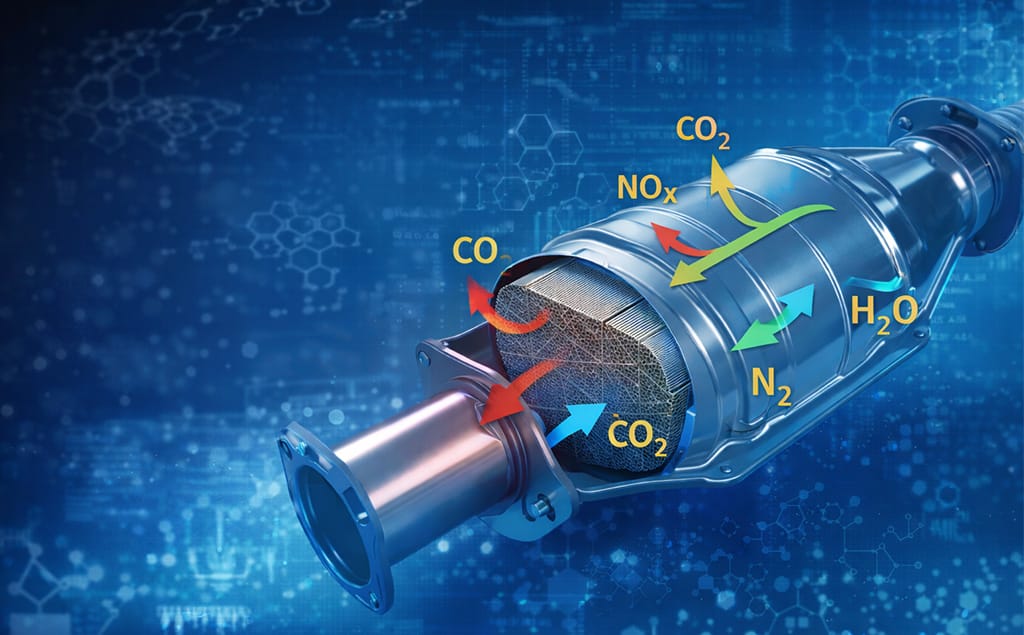
1. Structure and Working Principle
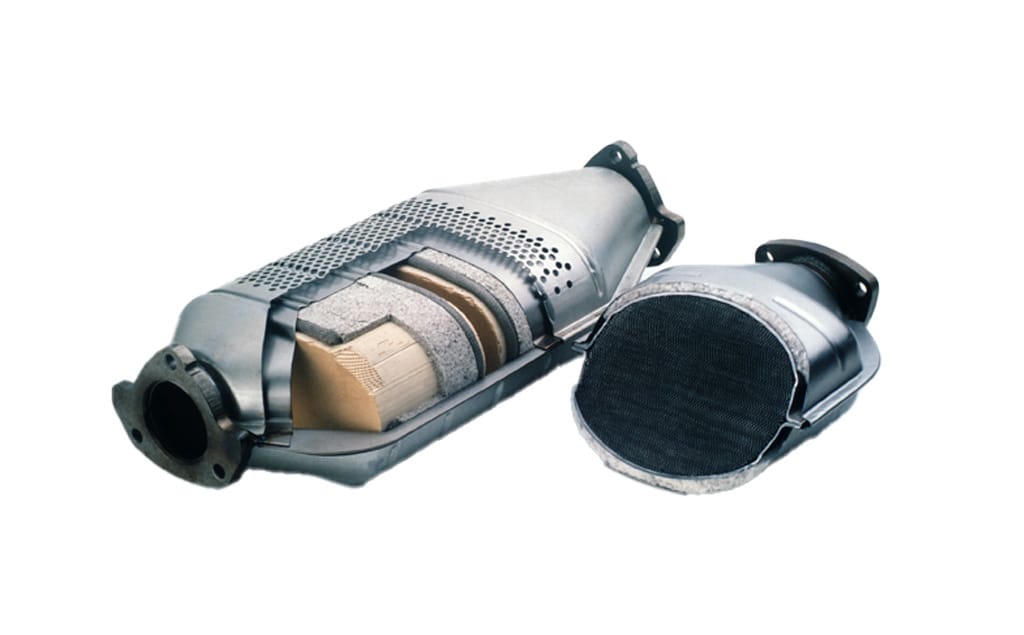
- Ceramic substrates are typically made from cordierite, a low-expansion ceramic material, shaped into a honeycomb structure. The surface is coated with a plášť layer and impregnated with precious metals (Pt, Pd, Rh).
- Metallic substrates, on the other hand, are constructed from thin sheets of heat-resistant metal alloys (often FeCrAl). These foils are corrugated and rolled into a honeycomb shape, sometimes welded or brazed for added strength.
Both designs aim to provide a large surface area for catalytic reactions while maintaining optimal exhaust gas flow.

2. Thermal Response and Light-Off Performance
The catalytic converter only becomes fully effective once it reaches its teplota při zhasnutí světla — the point where emissions are efficiently converted.
- Metal substrates heat up faster due to higher thermal conductivity and lower heat capacity. They achieve light-off sooner, making them ideal for cold-start emission control.
- Ceramic substrates have higher thermal mass and slower heat transfer, so they take slightly longer to reach operating temperature.In short: for faster heat-up and early emissions reduction, metallic substrates have the upper hand.
3. Exhaust Flow and Backpressure
Low backpressure means better exhaust flow and improved engine performance.
- Metallic converters can be made with thinner walls and higher cell densities, allowing more open area for gas flow and lower backpressure.
- Ceramic converters usually have slightly thicker walls due to material strength limitations, resulting in marginally higher backpressure.
However, in real-world driving, the difference in flow resistance is often minimal for properly designed converters.
4. Durability and Thermal Shock Resistance
Durability under high temperatures and thermal cycling is a key performance factor.
- Ceramic substrates are highly resistant to corrosion and high heat but are brittle and prone to cracking under mechanical or thermal shock (rapid temperature changes).
- Metallic substrates are more flexible, better at handling vibration and thermal expansion, and have excellent shock resistance.
- However, metals may suffer from oxidace nebo material fatigue over long periods if not made from premium alloys.
Verdict: metallic substrates are generally more durable in harsh conditions, while ceramic ones are more stable under steady high-heat operation.
5. Cost and Manufacturing
- Ceramic converters are cheaper to manufacture. The material and forming processes are well-established and cost-efficient, which is why most OEMs still prefer ceramic for standard vehicles.
- Metallic converters are more expensive due to the cost of metal foils, precision forming, and brazing processes. However, they offer superior performance for demanding or performance-oriented applications.
6. Typical Applications
| Application Scenario | Recommended Type | Key Advantage |
|---|---|---|
| Close-coupled (near-engine) converter | Kov | Fast light-off, withstands high temperature |
| Underfloor main converter | Ceramic | Cost-effective, stable long-term performance |
| Performance / racing vehicles | Kov | Low backpressure, quick response |
| Standard mass-production vehicles | Ceramic | Proven technology, affordable production |
7. Future Trends and Hybrid Designs
Modern emission systems are moving toward hybrid or composite substrates to balance cost and performance. Examples include:
- Combining metallic pre-converters (for quick light-off) with ceramic main converters (for durability).
- Using pokročilé nátěry a thin-wall ceramics for better heat response.
- Research into nanostructured materials a new alloys continues to enhance efficiency and longevity.
8. Conclusion: Which One Is Better?
There’s no universal winner — the “better” catalytic converter depends on your priorities:
- For quick light-off, low backpressurea vibration resistance, go with metallic.
- For cost efficiency, high-temperature stabilitya mass production, choose keramický.
In general, ceramic substrates dominate OEM use, zatímco metallic converters are favored in performance and high-temperature environments.