Zavedení
In the automotive industry, the třícestný katalyzátor plays an essential role in reducing harmful emissions from internal combustion engines. For businesses involved in manufacturing, trading, or recycling catalytic converters, understanding the correct HS (Harmonized System) codes is vital for compliance, tariff determination, and customs clearance. HS codes act as a global language for goods classification, ensuring that products are properly categorized during international trade. However, due to the converter’s composition—including precious metals like platinum, palladium, and rhodium—its classification can vary depending on whether it is new, used, or recycled.
This article provides a comprehensive explanation of HS codes for catalytic converters, highlighting their importance, classification rules, and practical examples for exporters and importers. It also includes a comparison table and expert tips for selecting the right code.
1. What Are HS Codes and Why They Matter
HS codes (Harmonized Commodity Description and Coding System) are internationally standardized numerical identifiers for traded goods. Managed by the World Customs Organization (WCO), these six-digit codes help customs authorities worldwide classify and regulate products. For catalytic converters, the HS code determines the applicable tariffs, import/export requirements, and even environmental compliance.
Incorrect HS code classification can lead to serious issues—delayed shipments, customs penalties, or even product seizures. Therefore, understanding and using the proper code ensures smooth trade operations and regulatory alignment.
2. Primary HS Codes for Three Way Catalytic Converters
The HS code for a new třícestný katalyzátor typically falls under 8421.32. This category covers devices designed for filtering or purifying exhaust gases from internal combustion engines.
Below is a summary of the most relevant HS codes and their applications:
| Kód HS | Popis | Application Example |
|---|---|---|
| 8421.32 | Air purification and exhaust gas treatment systems | New three way catalytic converters for vehicles |
| 8421.39.xx | Subheadings for gas filtering/purification machinery | Includes converters with advanced filtration functions |
| 8708.92 | Parts of exhaust systems, silencers, and pipes | Used for housings or external parts of catalytic converters |
| 8708.99 | Other vehicle parts not classified elsewhere | May include mounting or support components |
| 7112.92 | Waste and scrap of precious metals | Used converters or metal recovered from spent converters |
| 99022572 | Ceramic fiber catalytic mats or substrates | Internal materials for converter manufacturing |
Each code applies to different stages in the product’s life cycle, from production to recycling.
3. How to Determine the Correct HS Code
Choosing the right HS code requires understanding both the form and function of the catalytic converter:
- New or Complete Converters: Použití 8421.32 or the more specific 8421.39.4000 for advanced filtering systems.
- Converter Parts: Použití 8708.92 for exhaust housings or 8708.99 for other structural elements.
- Used or Scrap Converters: Apply 7112.92 when dealing with converters intended for metal recovery.
- Raw Materials or Components: Použití 99022572 for ceramic mats or substrates used in manufacturing.
For accuracy, always confirm with your local customs authority or a certified customs broker. This ensures that your goods comply with national and international regulations.
4. The Structure of HS Codes
HS codes are structured hierarchically:
- First 2 digits: Chapter (e.g., 84 for machinery and mechanical appliances)
- Next 2 digits: Heading (21 for filtering or purifying apparatus)
- Next 2 digits: Subheading (e.g., 32 for gas filtering machinery)
For example, 8421.32 indicates a filtering apparatus specifically used for exhaust gases. Further local subheadings, like 8421.39.4000 in the U.S., offer additional specificity.
5. Importance of ARB and Manufacturer Codes
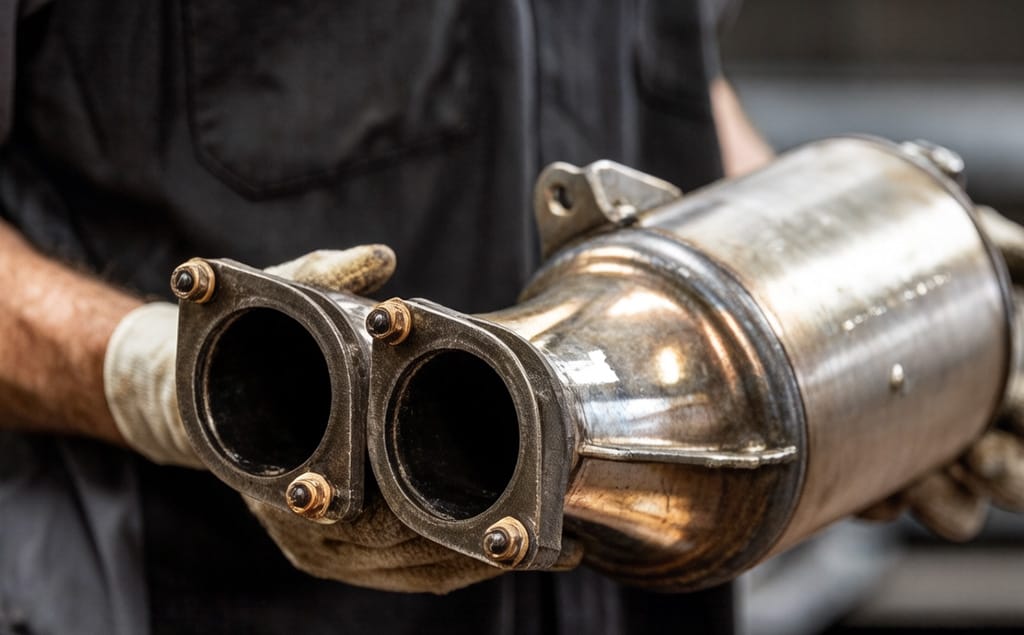
Some catalytic converters also carry additional identification markings:
- ARB Approval Code: Confirms compliance with Air Resources Board (ARB) emissions standards.
- MC: A two-character manufacturer code identifying the converter producer.
- XXXX: The converter’s series or part number (may exceed four digits).
- YYYY: The manufacturing date, where the first two digits indicate the month and the last two the year.
These markings are critical for authenticity verification and traceability.
6. Real-World Example: U.S. vs. EU HS Code Classification
Although HS codes are globally harmonized, each country may apply additional digits for local classification. The table below compares the typical coding structures for new catalytic converters:
| Kraj | Base HS Code | Extended Subheading Example | Notes |
|---|---|---|---|
| United States | 8421.32 | 8421.39.4000 | Used for complete catalytic converters and DPFs |
| European Union | 8421.32 | 8421.32.0000 | Similar coverage, minor differences in duty rates |
| Čína | 8421.39 | 8421.39.9000 | May include additional filtering equipment |
This comparison highlights the importance of checking local tariff schedules before exporting.
7. Common Mistakes in HS Code Classification
- Using the wrong category for scrap materials: Many traders mistakenly classify used converters under 8421.32 instead of 7112.92.
- Neglecting subheadings: Subcodes like 8421.39.4000 often provide more accuracy.
- Ignoring updates: The WCO revises the HS system every five years. Staying updated ensures compliance.
- Overlooking mixed-use products: Hybrid converters or combined filtration systems may fall under separate codes.
Avoiding these errors helps reduce customs risks and financial penalties.
8. The Role of HS Codes in Environmental Compliance
Trojcestné katalyzátory are directly linked to environmental standards. Correct HS coding ensures regulators can track imports and exports of emission-control devices. Misclassification can result in environmental violations, especially if used converters are imported without recycling certification.
Manufacturers and traders should maintain proper documentation—including material safety data sheets (MSDS) a compliance certificates—to prove that the converters meet emission control standards.
9. Emerging Trends in Catalytic Converter Trade
With global sustainability goals driving tighter emission standards, the demand for třícestné katalyzátory continues to rise. Simultaneously, scrap converters have become a significant source of precious metals. As recycling networks expand, more countries now regulate converter trade under environmental protection laws.
Moreover, digital customs platforms are integrating AI-driven classification tools, reducing manual HS code errors. These technologies help companies identify the correct codes faster and maintain transparency in global trade.
10. Practical Tips for Businesses
- Always verify HS codes before shipping.
- Keep an internal product classification database.
- Use customs brokers or trade compliance software for automation.
- Document every code decision for audit purposes.
- Monitor regulatory updates from the World Customs Organization a local customs authorities.
Závěr
Correctly classifying a třícestný katalyzátor under the appropriate HS code is crucial for legal trade, cost efficiency, and environmental compliance. Understanding the distinctions among codes like 8421.32, 8708.92a 7112.92 enables manufacturers, exporters, and recyclers to operate confidently across global markets. By combining accurate classification with sustainable trade practices, the automotive industry can continue to reduce emissions while maintaining regulatory integrity.