Zavedení
The automotive industry hits a vital technical turning point in 2026. Global drives toward carbon neutrality change the market landscape. These efforts transform the třícestný katalyzátor from a simple exhaust part into a strategic high-tech asset. This article breaks down the essential role of Platinum Group Metals (PGMs) in a circular economy. We analyze how a 95% recovery rate mitigates supply risks and supports the most stringent emission standards in history. By transitioning from a linear “extract-use-dispose” model to a closed-loop system, the industry secures the materials necessary for a cleaner future.
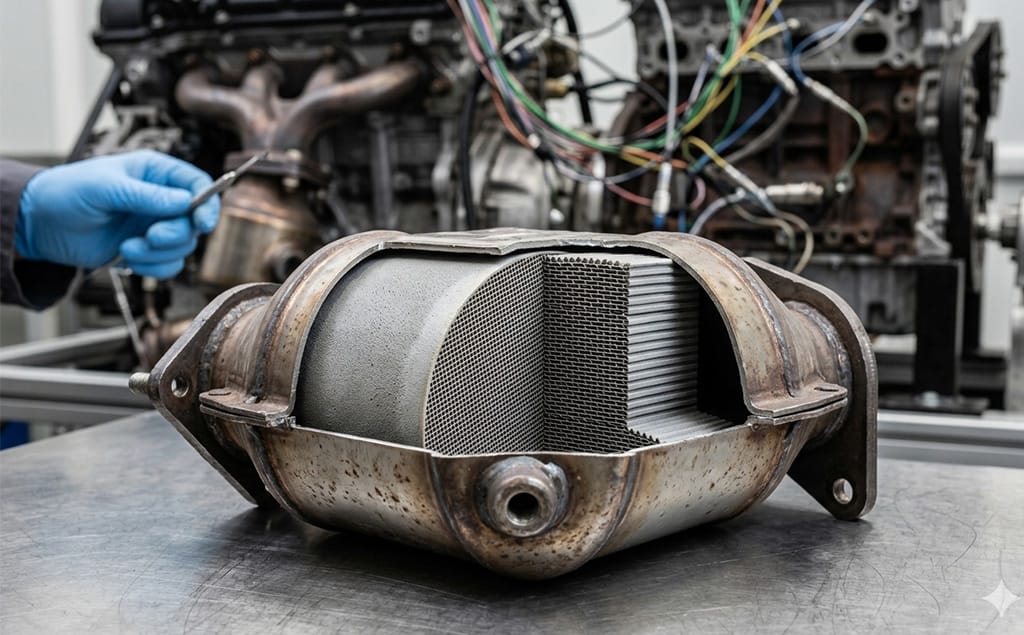
The Technical Backbone: Mechanism of the Three Way Catalytic Converter
A třícestný katalyzátor creates a high-tech chemical reaction site right under the vehicle. This system deploys platinum (Pt), palladium (Pd), and rhodium (Rh) to strip toxic pollutants from engine exhaust. This technology earns its name by targeting three major toxic gases all at once:
- Redukce oxidů dusíku (NOx): Rhodium acts as the primary reducing agent, stripping oxygen from nitrogen atoms to release harmless $N_2$.
- Oxidace oxidu uhelnatého (CO): Palladium and platinum facilitate the addition of oxygen to CO, creating $CO_2$.
- Oxidation of Unburned Hydrocarbons (HC): The catalysts break down complex fuel fragments into water vapor ($H_2O$) and $CO_2$.
2026 marks a shift toward advanced 600 cpsi substrates in catalyst manufacturing. By expanding the contact zone, this structure mandates a total reaction between the exhaust and the PGM coatings. The result is an almost perfect conversion rate, even when the vehicle operates at top speeds.
Strategic Drivers: Euro 7 and China VII Regulations
Strict regulatory frameworks provide the primary momentum for market growth. The implementation of Euro 7 standards in Europe and the proposed China VII (CN7) guidelines have forced a massive upgrade in catalyst technology.
- Cold Start Performance: Over 80% of total emissions occur during the first 60 seconds of engine operation. 2026 regulations mandate “close-coupled” třícestný katalyzátor designs that sit closer to the engine manifold to heat up faster.
- Particulate Number (PN10) Limits: New standards now target particles as small as 10 nanometers. This requires the integration of Gasoline Particulate Filters (GPF) directly into the three-way catalyst structure.
- Extended Durability: Legislation now requires emission systems to remain effective for up to 200,000 kilometers, nearly double the previous requirements.
PGM Loading and Market Value Comparison
The following table highlights the shifting intensity of PGM usage and market projections for 2026:
| Metal Type | Primary Role in Converter | 2026 Market Share | Avg. Loading (g/unit) | Recovery Target |
|---|---|---|---|---|
| Palladium (Pd) | Oxidace HC/CO | 34.2% | 3.0 – 6.5 | 96% |
| Platina (Pt) | Stability & Oxidation | 29.6% | 1.5 – 4.0 | 95% |
| Rhodium (Rh) | Redukce NOx | 17.3% | 0.2 – 0.6 | 98% |
| Iridium/Other | High-Temp Durability | 18.9% | < 0.1 | 90% |

Innovation in Recycling: The “Recovery Revolution”
The industry now views spent třícestný katalyzátor units as “urban mines.” Recycled materials currently account for 32% of global PGM intake. By 2034, experts believe this contribution will expand to 44%.
- Hydrometallurgical Dominance:Pyrometallurgy maintains its 56% market grip, yet hydrometallurgical leaching is the real standout. Clocking an 8.6% CAGR, it has become the sector’s most aggressive growth engine. By dissolving PGMs under low-heat conditions, this technique achieves superior extraction efficiency. It generates a 95% smaller carbon footprint than raw ore mining, effectively decoupling metal supply from heavy environmental tolls.
- Sibanye-Stillwater Case Study: In 2025, major players commissioned automated recycling units that utilize AI-driven sorting. These systems achieve a 15% increase in recovery efficiency by precisely identifying the ceramic substrate grade before processing.
- Economic Impact: Recycled PGMs currently account for 73% of the total critical material recovery market value. This high value-to-volume ratio makes converter recycling the most profitable segment of the circular economy.
Synergies with Hybrid and Hydrogen Technologies
Misconceptions abound regarding EVs immediately displacing the catalyst market. In reality, hard data refutes this assumption.
- Hybrid Resilience: Hybrid vehicles (PHEVs and HEVs) will dominate 2026 sales. These vehicles require a třícestný katalyzátor that can handle frequent engine restarts. Because hybrid engines often run “cool,” they actually require 10-15% more PGM loading to maintain catalyst activity.
- The Hydrogen Economy: Platinum serves as the catalytic engine within PEM fuel cells. In the world of heavy-duty transport, hydrogen technology is gaining massive ground. This move will keep platinum catalyst demand climbing. By 2030, the market should expect a yearly growth of 20 to 30 metric tons.
Regional Leadership: Asia-Pacific at the Forefront
The Asia-Pacific region, led by China and India, maintains its position as the global growth engine. China produces over 27 million vehicles annually, each requiring advanced třícestný katalyzátor systems. Furthermore, India’s transition to BS-VI (Phase 2) standards has intensified the focus on rhodium-rich catalysts to combat urban NOx levels.
Závěr
By 2026, the třícestný katalyzátor industry moves beyond simple legal compliance. It now prioritizes resource security and technical innovation. Achieving 95% recovery for platinum, palladium, and rhodium protects the automotive sector. This high efficiency buffers the market against supply shocks and price swings.
Multiple forces will merge by 2030. Digital tracking and blockchain transparency will join hands with advanced chemical recycling. Together, these tools will lock the catalyst’s role into a truly sustainable circular economy.