Introduction
The global convertidor catalítico de tres vías industry enters 2026 with strong momentum. Governments tighten emission laws. Automakers continue producing internal combustion engine (ICE) vehicles and hybrids at scale. Fleet operators demand durable aftertreatment systems. These forces sustain growth across OEM and aftermarket channels.
Recent industry assessments estimate that the broader catalytic converter market will reach between USD 80 billion and USD 120 billion in 2026, depending on scope definition. Analysts confirm a steady expansion trajectory. Within this ecosystem, the convertidor catalítico de tres vías segment dominates gasoline applications and captures the majority of total revenue.
This article analyzes the 2026 market size, growth outlook, segmentation patterns, regional performance, regulatory drivers, and strategic implications for stakeholders. It adopts a scientific and technology-focused writing style. It emphasizes active voice and highlights the keyword convertidor catalítico de tres vías throughout the discussion.
2026 Market Size and Growth Outlook
Industry data shows measurable expansion from 2025 to 2026. The global catalytic converter market grew from approximately USD 85.94 billion in 2025 to about USD 96.06 billion in 2026. Analysts expect continued acceleration through 2032. Forecast compound annual growth rates (CAGR) range from 8.12% to 13.68%. Under optimistic scenarios, the market could exceed USD 210 billion by 2032.
However, not all studies define the market identically. Some include wider automotive exhaust components. Others focus strictly on converter cores and coating systems.
Market Size Comparison (2026 Estimates)
| Scope Definition | Estimated Value (2026) | Notas |
|---|---|---|
| Core catalytic converter components | USD 80.53–96.06 billion | Focus on converter assemblies and substrates |
| Broader exhaust & ancillary systems | Up to USD 205.96 billion | Includes extended exhaust architecture |
| CAGR 2026–2032 | 8.12%–13.68% | Driven by regulation and hybrid growth |
El convertidor catalítico de tres vías remains the leading product type. It accounts for roughly 66% of total converter revenue. Gasoline passenger vehicles rely on this configuration to reduce carbon monoxide (CO), hydrocarbons (HC), and nitrogen oxides (NOx) simultaneously.
Core Technology and Engineering Logic
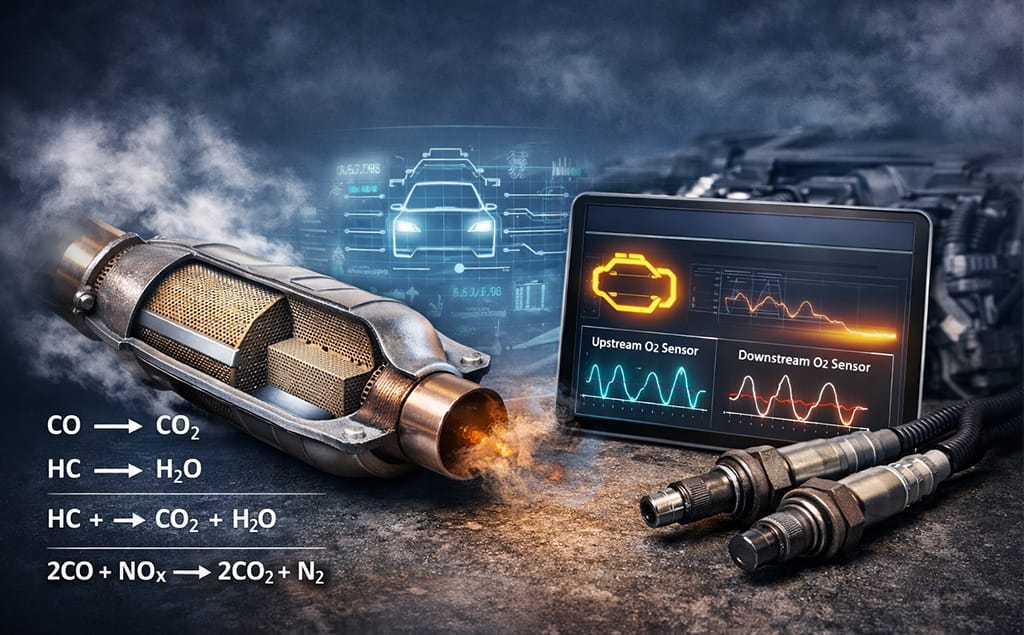
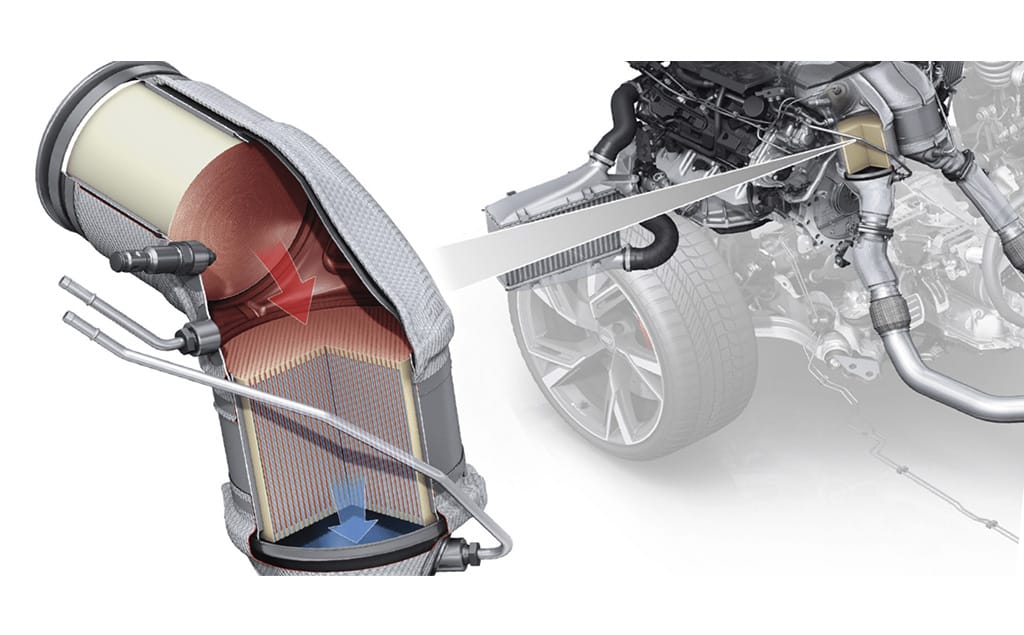
El convertidor catalítico de tres vías integrates oxidation and reduction reactions within a single monolithic substrate. Engineers coat the ceramic or metallic substrate with platinum group metals (PGMs), including platinum, palladium, and rhodium. The converter performs three essential reactions:
- Oxidation of carbon monoxide into carbon dioxide.
- Oxidation of unburned hydrocarbons into carbon dioxide and water.
- Reduction of nitrogen oxides into nitrogen and oxygen.
Gasoline engines operate near stoichiometric air-fuel ratios. This condition enables the convertidor catalítico de tres vías to achieve high conversion efficiency. Automakers refine washcoat formulations and PGM distribution. They reduce metal loading while maintaining light-off performance. They optimize cell density and wall thickness to improve durability and thermal stability.
Regulatory Pressure as a Primary Growth Driver
Governments worldwide implement near-zero emission standards. Regulators demand lower NOx and particulate emissions. They require longer durability thresholds. Automakers respond by upgrading the convertidor catalítico de tres vías architecture. They integrate close-coupled positioning. They increase thermal resilience. They improve oxygen storage capacity.
Stricter regulation directly expands demand for high-performance converters. Manufacturers must supply more advanced systems per vehicle. This dynamic sustains revenue growth even if total vehicle production fluctuates.
Hybrid Vehicles Extend Market Relevance
Battery electric vehicles do not require catalytic converters. However, hybrids still depend on gasoline engines. Many countries promote hybrid adoption as a transitional technology. This trend supports the convertidor catalítico de tres vías market.
Hybrid systems introduce new engineering challenges. Engines cycle on and off frequently. Cold-start frequency increases. Exhaust temperature profiles vary. Engineers must design converters that light off quickly and maintain performance during intermittent operation. Hybrid growth therefore strengthens demand for advanced washcoat chemistry and optimized substrate design.
Precious Metal Volatility and Material Innovation
Platinum, palladium, and rhodium prices fluctuate sharply. Supply constraints amplify volatility. Converter manufacturers respond through innovation.
They pursue:
- Low-PGM loading strategies
- Palladium-to-platinum substitution in gasoline systems
- Enhanced rhodium efficiency in NOx reduction layers
- Closed-loop recycling programs
Recyclers recover metals from end-of-life converters. Refiners reintroduce these metals into new production. This circular approach reduces reliance on primary mining and stabilizes supply.
Key PGM Functions in a Three Way Catalytic Converter
| Metal | Función primaria | Strategic Consideration |
|---|---|---|
| Platino | Oxidation catalyst | Durable but historically high cost |
| Paladio | Oxidation in gasoline engines | Widely used in TWC systems |
| Rodio | NOx reduction | Scarce and expensive |
Material science now shapes competitive advantage. Companies that optimize metal dispersion and recovery protect margins and secure supply continuity.

Regional Performance and Strategic Shifts
Asia-Pacific
Asia-Pacific holds the largest market share. India and China produce massive vehicle volumes. Strict emission rules elevate demand for the convertidor catalítico de tres vías. Manufacturers invest heavily in localized production and recycling capacity.
Europa
Europe historically commanded a strong share of the market. The region now shifts focus toward sustainability and traceability. Policymakers emphasize ethical sourcing and recycling compliance. Suppliers must document PGM origin and lifecycle.
Americas
The Americas combine regulatory enforcement with supply chain realignment. Tariff adjustments influenced sourcing decisions. Some manufacturers increased domestic refining and recycling to mitigate trade risk. This move strengthens resilience in the convertidor catalítico de tres vías supply chain.
Segmentation by Vehicle Type and Placement
By Vehicle Type
- Passenger cars
- Light commercial vehicles
- Heavy commercial vehicles
- Hybrid vehicles
Passenger cars account for the largest share. They rely heavily on gasoline engines. They require the convertidor catalítico de tres vías as a core emissions solution.
By Placement
- Close-coupled converters
- Underfloor converters
- Secondary downstream units
Close-coupled systems sit near the engine. They heat rapidly and improve cold-start performance. Underfloor units prioritize durability and long-term stability. Placement strategy directly influences substrate choice and coating formulation.
Supply Chain Adaptation and Trade Policy Effects
Recent tariff shifts altered procurement strategies. Companies reassessed imported substrates and coated components. Some increased domestic manufacturing. Others diversified suppliers across regions.
Firms also expanded recycling operations within national borders. They refined recovered metals locally. They reduced exposure to customs delays and cross-border restrictions. This adaptation enhances transparency and strengthens vertical integration across the three way catalytic converter ecosystem.
Strategic Recommendations for Industry Leaders
Industry leaders should implement proactive strategies:
- Diversify PGM sourcing.
- Expand closed-loop recycling partnerships.
- Invest in low-metal loading research and development.
- Strengthen hybrid-compatible converter designs.
- Enhance digital traceability across supply chains.
These actions reduce exposure to volatility. They improve regulatory compliance. They preserve long-term competitiveness in the convertidor catalítico de tres vías market.
Conclusion
The global convertidor catalítico de tres vías market demonstrates strong resilience in 2026. Regulatory pressure intensifies worldwide. Hybrid vehicle adoption sustains gasoline engine relevance. Material volatility accelerates innovation in washcoat chemistry and recycling systems.
Asia-Pacific leads in volume and growth. Europe emphasizes sustainability and traceability. The Americas adjust supply chains in response to trade policy shifts.
Companies that integrate material efficiency, recycling capability, and regulatory alignment will secure competitive advantage. The convertidor catalítico de tres vías remains central to emission control strategies during the transition toward electrification. Its technological evolution will define market dynamics through 2032 and beyond.