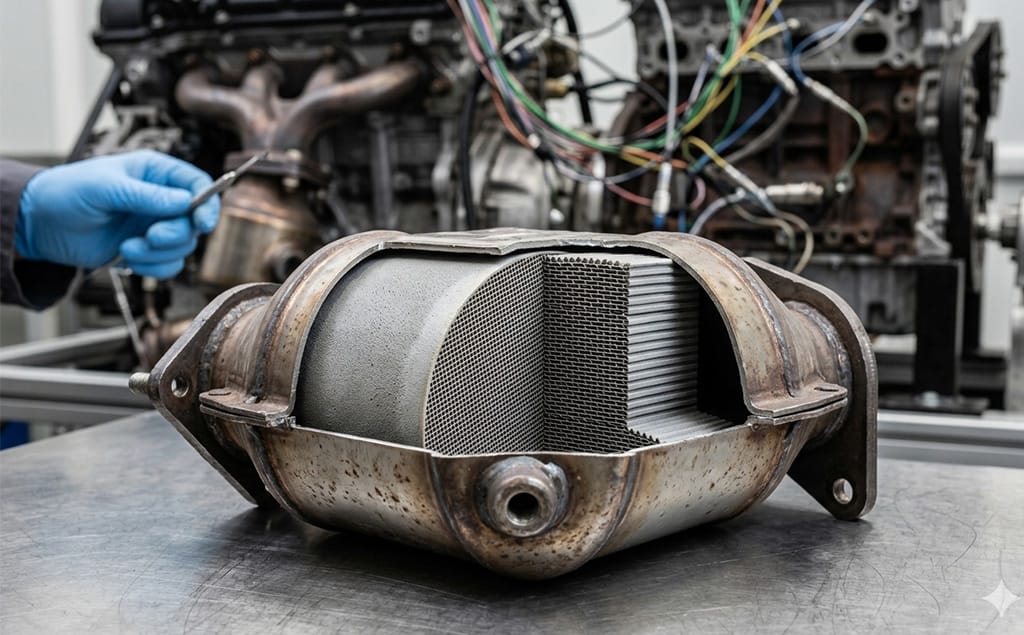
Rhodium (Rh) is one of the rarest and most valuable precious metals found inside catalytic converters. Though it’s only present in very small amounts, it plays a huge role in cleaning vehicle exhaust gases — and it’s a big reason why catalytic converters are often targeted for theft. In this article, we’ll explore how much rhodium is in a catalytic converter, what affects its quantity, and why it’s so important.
1. What Is Rhodium?
Rhodium is a platinum group metal (PGM), along with platinum (Pt) and palladium (Pd). It’s known for its exceptional ability to reduce nitrogen oxides (NOₓ) — one of the most harmful pollutants emitted by internal combustion engines.
- Symbol: Rh-arvo
- Melting Point: 1,964°C (3,567°F)
- Color: Silvery-white
- Main Use: Automotive catalysts (over 80% of global demand)
Rhodium is extremely rare — found in just 0.000037 parts per million in the Earth’s crust — making it about 100 times rarer than gold.
2. The Role of Rhodium in a Catalytic Converter
In a kolmitiekatalysaattori (TWC), rhodium works with platinum and palladium to perform critical chemical reactions:
| Toiminto | Gas Treated | Reaction |
|---|---|---|
| Vähennys | Nitrogen Oxides (NOₓ) | NOₓ → N₂ + O₂ |
Rhodium specifically targets NO and NO₂, converting them into harmless nitrogen (N₂) and oxygen (O₂). Without rhodium, vehicles would emit large amounts of nitrogen oxides — major contributors to smog and acid rain.
3. How Much Rhodium Is Actually Inside a Catalytic Converter?
The exact amount of rhodium in a catalytic converter varies depending on:
- Vehicle type (small car vs. truck)
- Päästöstandardit (Euro 3, Euro 6, EPA Tier 3)
- Manufacturer and model
| Vehicle Type | Estimated Rhodium Content |
|---|---|
| Small Car | 0.05 – 0.10 grams |
| Medium Vehicle | 0.10 – 0.20 grams |
| Large SUV or Truck | 0.20 – 0.30 grams |
| Industrial or Diesel Applications | 0.30 – 0.50 grams |
Even at just 0.1 gram per unit, the value can be substantial. With rhodium prices exceeding $400 per gram (and having peaked above $25,000 per ounce in recent years), it’s easy to see why converters are valuable.
4. Rhodium Content vs. Other Precious Metals
| Metal | Typical Amount (per converter) | Average Price (USD/g) | Main Function |
|---|---|---|---|
| Platina (Pt) | 1–2 grams | $30–40 | Oxidation (CO, HC) |
| Palladium (Pd) | 2–7 grams | $25–35 | Oxidation (CO, HC) |
| Rodium (Rh) | 0.05–0.3 grams | $400–500 | Reduction (NOₓ) |
While rhodium content is much lower, it contributes the highest value percentage of the total precious metal load.
5. Factors Affecting Rhodium Quantity
- Emission Regulations: Stricter standards (e.g., Euro 6, EPA Tier 3) require more rhodium for NOₓ reduction.
- Vehicle Type: Larger engines need more catalyst surface area and thus more rhodium.
- Converter Design: Modern converters often use optimized ratios (Pd:Rh or Pt:Rh) to balance cost and performance.
- Manufacturer Strategy: Some automakers use more palladium or platinum to reduce rhodium costs.
6. Why Rhodium Is So Valuable
Rhodium’s price is driven by extreme rarity, high demand in emission control, ja limited mining supply — mostly from South Africa and Russia.
- It’s not mined directly; it’s a byproduct of platinum and nickel extraction.
- Global annual production is less than 30 tons, compared to over 3,000 tons of gold.
- Industrial demand (automotive + chemical catalysts) keeps prices volatile.
7. Rhodium Recovery and Recycling
When old converters are recycled, specialized refiners extract precious metals through smelting and chemical separation. A single ton of spent catalytic converters can yield:
- Platinum: ~1,500–2,000 grams
- Palladium: ~2,000–3,000 grams
- Rhodium: ~200–300 grams
Because of this, recycling is an essential source of rhodium — helping reduce the need for new mining.

8. Real-World Value Example
Let’s assume an average catalytic converter contains 0.15 g of rhodium ja rhodium is $450 per gram:
0.15 g × $450 = $67.50 in rhodium value (just from rhodium alone!)
Add in platinum and palladium, and the total metal value could easily exceed $150–$300 per converter.
9. Future Trends in Rhodium Usage
To reduce costs, manufacturers are:
- Increasing the use of palladium as a substitute.
- Developing rhodium-free catalysts using base metals or perovskite materials.
- Optimizing catalyst layer designs to achieve higher efficiency with less Rh.
Still, rhodium remains indispensable for high-performance and low-emission engines.
Johtopäätös
Rhodium may only make up a fraction of a catalytic converter by weight, but its impact — both environmentally and economically — is massive. With less than a quarter gram of rhodium, each converter helps reduce harmful NOₓ emissions and contributes to cleaner air. Understanding rhodium’s role and value highlights why catalytic converters are both technological marvels ja high-value assets.