Introduction
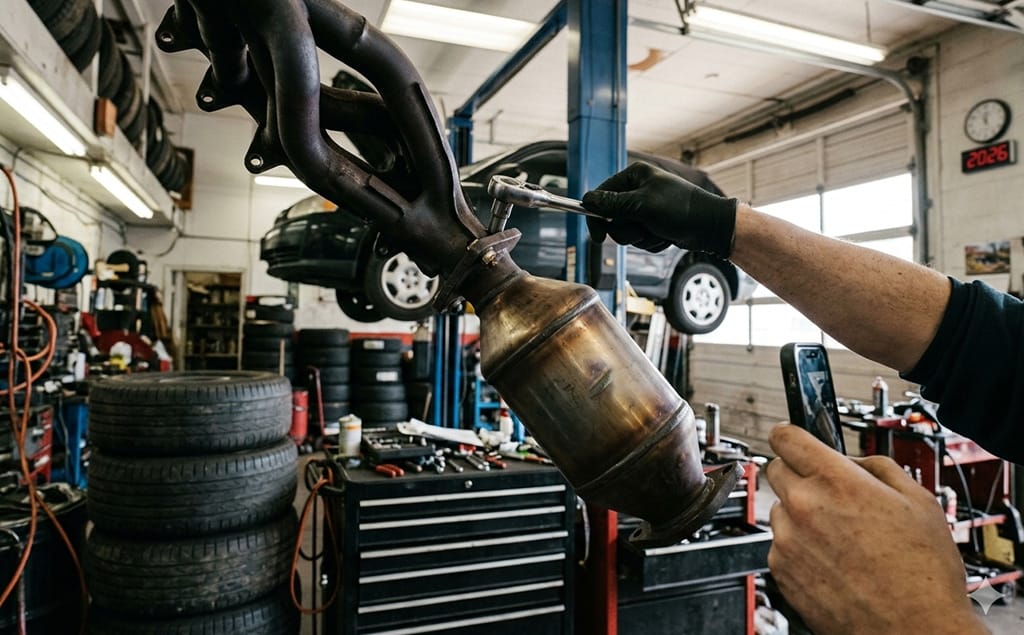
A vehicle’s emission strategy hinges entirely on the performance of the convertisseur catalytique à trois voies, making it the non-negotiable heart of the exhaust system.Owning a 2010–2022 Prius means balancing high-tech efficiency with high-stakes maintenance. That converter represents a sophisticated feat of design, but its price tag is a heavy reality for most owners.A high-quality convertisseur catalytique à trois voies must reduce toxic gases effectively while enduring the unique stop-and-go thermal cycles of a hybrid engine.This guide breaks down the top-performing replacements on the market, the sophisticated engineering powering these units, and the strict regulatory landscape governing their installation.
La science du convertisseur catalytique à trois voies
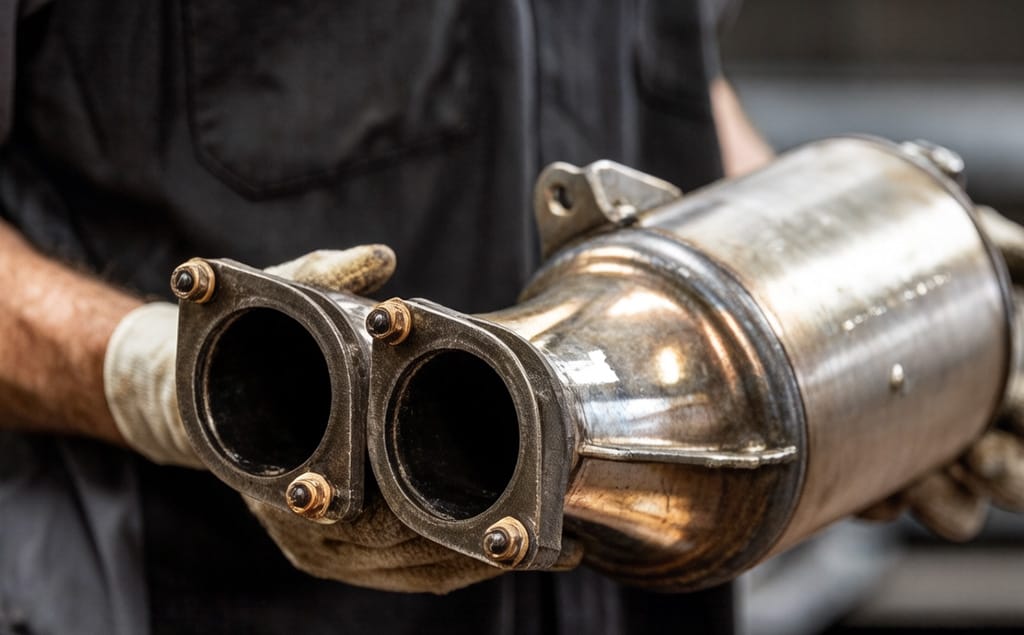
Designed to tackle $NO_x$, $CO$, and unburnt hydrocarbons simultaneously, this three catalytic converter utilizes a ceramic honeycomb core housed in stainless steel.
Platinum and palladium drive the oxidation process, stripping the toxicity from $CO$ and $HC$ to form $CO_2$ and $H_2O$. Simultaneously, rhodium functions as the reduction specialist, breaking down $NO_x$ molecules to liberate clean nitrogen gas ($N_2$).
Hybrid duty cycles present a specific dilemma for the Prius’s exhaust system. Constant engine shutdowns in electric mode lead to a significant cooling effect, forcing the three way catalytic converter to operate far below its ideal heat range. A standard convertisseur catalytique à trois voies often fails to stay “lit” at these lower temperatures. Therefore, Prius-specific converters must contain a higher density of precious metals to maintain chemical activity during cooler operating windows.

Why Hybrid Exhaust Systems Demand Premium Quality
The 2010–2022 Prius runs a tight ship when it comes to emissions. Its ECU keeps a constant, high-precision watch over the convertisseur catalytique à trois voies, leveraging dual $O_2$ sensors to benchmark the catalyst’s oxygen storage capacity (OSC). A high-quality convertisseur catalytique à trois voies stores oxygen during lean cycles and releases it during rich cycles. Cheap aftermarket units often skimp on the cerium and zirconium oxides that facilitate this storage. When the ECU detects insufficient oxygen buffering, it immediately triggers the P0420 fault code. This “Check Engine” light prevents the vehicle from passing emissions tests and may even reduce fuel economy.
Detailed Comparison of Top Replacement Brands
Picking the right brand really comes down to two things: your current budget and how much longer you plan to keep that Prius on the road.
| Nom de marque | Construction Material | Target Compliance | Idéal pour |
|---|---|---|---|
| MagnaFlow | Heavy-Duty Stainless | CARB / EPA | Long-term reliability and performance. |
| Échappement Walker | Aluminized Steel / SS | EPA / Ultra-EPA | Direct-fit convenience for 46 states. |
| AP Exhaust | Standard Grade | EPA | Budget-conscious owners in non-CARB states. |
| Eastern Catalytic | High-Flow Ceramic | EPA | High-mileage vehicles near end-of-life. |
MagnaFlow: The Gold Standard
MagnaFlow engineers their convertisseur catalytique à trois voies units with thicker manifolds and more robust internal structures. They focus on the “Direct-Fit” market. This means the unit bolts directly to the engine’s exhaust studs without any welding. For a Prius, this prevents leaks that could confuse the sensitive $O_2$ sensors.
Walker Exhaust: The OEM Mirror
Walker’s “Ultra” series provides an internal coating that closely mimics the original Toyota catalyst. Many mechanics prefer Walker because the pipe bends are 100% accurate. This ensures that the convertisseur catalytique à trois voies does not rattle against the chassis or heat shields.
The Legal Landscape: CARB vs. Federal EPA Standards
The legal requirements for a convertisseur catalytique à trois voies vary by state. This creates significant confusion for owners.
California, Colorado, New York, and Maine follow CARB standards. These laws require that an aftermarket convertisseur catalytique à trois voies be tested and certified for a specific engine family. The manufacturer must stamp an Executive Order (EO) number on the shell.
Installing a Federal EPA-approved unit in a CARB state is illegal. Even if the car runs perfectly, an inspector will reject it during a visual check. Furthermore, Federal units often contain 50% less precious metal. In a Prius, this leads to a premature “Catalyst Efficiency” failure within 12 to 18 months. Always verify your state’s requirements before purchasing.
Advanced Engineering: The HCAC System and Beyond
Earlier Prius models used a Hydrocarbon Adsorber and Catalyst (HCAC) system. This system included a complex vacuum-actuated valve to trap pollutants during the first 30 seconds of a cold start.
While the 2010–2022 models have moved away from this specific “Air Valve” design, the underlying principle remains. The convertisseur catalytique à trois voies must achieve “light-off” temperature as quickly as possible. Modern aftermarket units for the Gen 3 and Gen 4 Prius use thinner ceramic walls. This reduces thermal mass and allows the catalyst to reach operating temperature faster.
Theft Prevention and Security Hardware
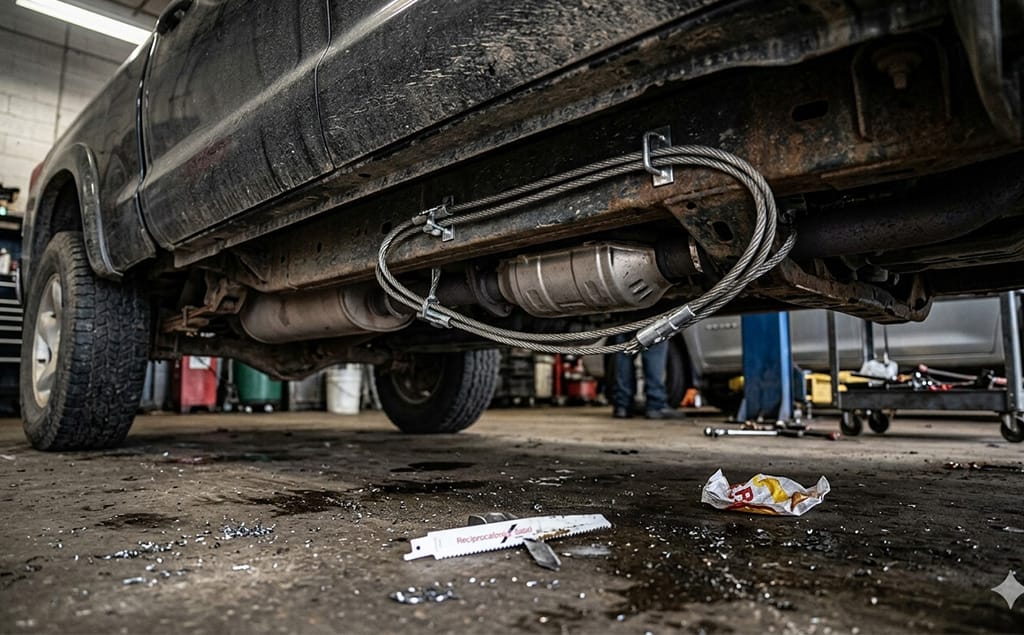
The high concentration of rhodium and palladium makes the Prius convertisseur catalytique à trois voies a prime target for thieves. A thief can remove an unprotected converter in less than 60 seconds using a cordless saw.
Owners should consider the following security upgrades:
- CatClamp: A cage of stainless steel cables that makes cutting difficult.
- Shield Plates:Custom-fit chassis armor—available in aluminum or steel—that mounts onto the subframe to shield the entire exhaust cavity from tampering or damage.
- Motion Sensors: Alarms that go off instantly if your car gets jacked up or if someone starts sawing at your pipes. It’s early-warning tech for your catalytic converter.
Troubleshooting the P0420 Code
Don’t pull the trigger on a new cat until you’ve double-checked every diagnostic. You want to be 100% sure the converter is the actual culprit before spending the cash.A P0420 error doesn’t automatically mean a failed cat—it could be a leak or a lazy sensor saving you a thousand-dollar mistake.
- Exhaust Leaks: Even a pinhole leak near the $O_2$ sensor allows air into the system. This tricks the sensor into reporting a lean condition.
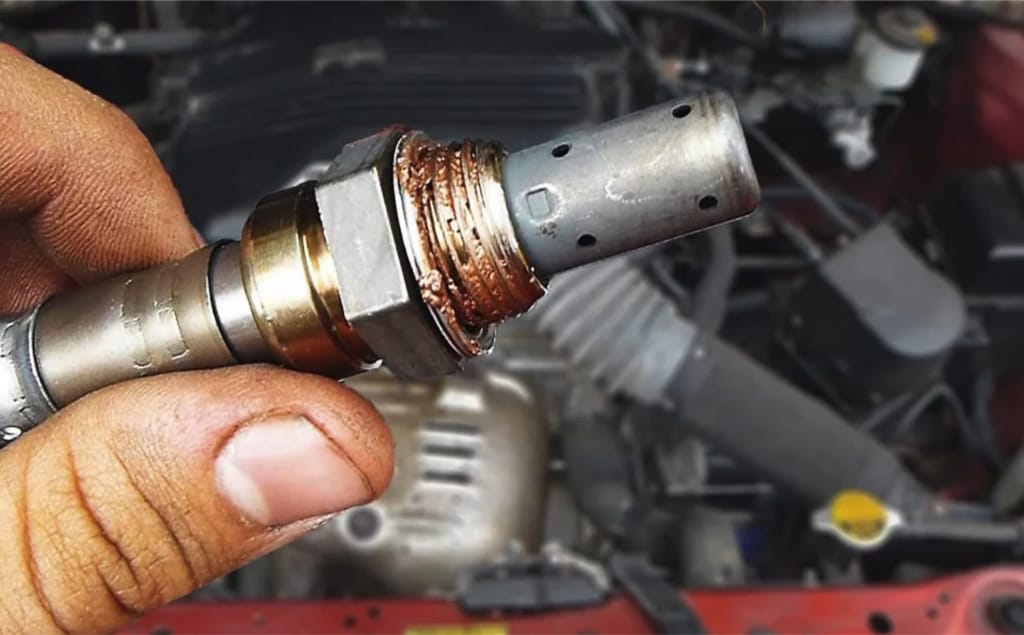
- Bad Oxygen Sensors: Sensors wear out over 100,000 miles. A “lazy” sensor provides slow readings, which the ECU interprets as a failing catalyst.
- Engine Misfires: If your engine burns oil or has a misfire, unburned fuel enters the convertisseur catalytique à trois voies. This creates extreme heat and melts the internal ceramic core.
Conclusion
Le convertisseur catalytique à trois voies is the most vital part of your Toyota Prius’s environmental defense system. Reliable hybrid performance starts with top-tier components.If a genuine Toyota converter isn’t in the budget, premium alternatives from MagnaFlow and Walker offer a zero-compromise solution. You get the same strict emissions compliance and peak performance at a much more manageable price point. Pro tip: install a security shield to ward off thieves, and make sure your engine is running in peak condition to avoid early catalyst failure. Don’t let a poorly tuned engine kill your new investment.