Introduction
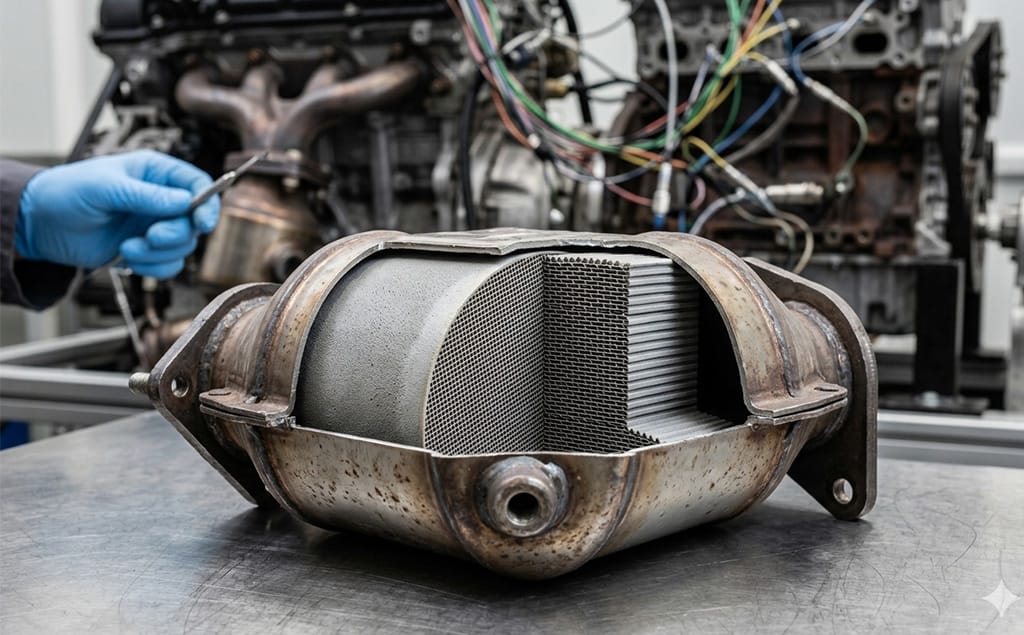
The modern automotive industry faces strict environmental regulations regarding tailpipe emissions. The convertisseur catalytique à trois voies stands as the primary defense against harmful pollutants. This device converts carbon monoxide, hydrocarbons, and nitrogen oxides into less harmful substances. Engine performance and environmental compliance depend heavily on the efficiency of this component. Specifically, the thickness of the catalyst washcoat layer determines how effectively the device processes exhaust gases. Engineers must balance the amount of precious metal loading with the physical thickness of the coating. A layer that is too thick restricts gas flow and increases backpressure. Conversely, a layer that is too thin lacks the surface area necessary for complete chemical reactions.
The Fundamental Role of Layer Thickness in Efficiency
The catalyst layer within a convertisseur catalytique à trois voies functions as a complex reaction zone. It consists of precious metals like platinum, palladium, and rhodium supported on a high-surface-area ceramic washcoat. Thickness directly influences the “triple-phase boundary” where the exhaust gas, the solid catalyst, and the heat of the reaction meet.
Research indicates an optimal thickness range for these layers. While the specific requirements vary by engine type, a range of 2 to 4 μm often provides the best balance. In this zone, the system achieves maximum reaction rates without suffering from significant transport limitations.
Active sites reside throughout the porous structure of the washcoat. If the layer is too thin, the exhaust gases pass through the converter too quickly. This results in “slip,” where unreacted pollutants exit the tailpipe. If the layer is excessively thick, the inner parts of the coating remain unused. The exhaust gas cannot penetrate deep enough into the structure before the gas flow pushes it out. Therefore, thickness optimization maximizes the utilization of expensive precious metals.
Technical Comparison of Coating Characteristics
The following table summarizes how different thickness levels impact the operational parameters of a convertisseur catalytique à trois voies.
| Thickness Level | Gas Diffusion Rate | Precious Metal Utilization | Durabilité | Backpressure Impact |
|---|---|---|---|---|
| Ultra-Thin ( | Excellent | Low (Lack of sites) | Poor (Fast aging) | Négligeable |
| Optimal (2–4 μm) | Balanced | Haut | Bien | Modéré |
| Thick (> 5 μm) | Restricted | Diminishing returns | Excellent | Haut |
| Excessive (> 10 μm) | Poor (Flooding) | Very Low | Maximum | Severe |
Mass Transfer Resistance and Gas Diffusivity
Gas transport represents a significant hurdle in catalyst design. A convertisseur catalytique à trois voies must process high volumes of exhaust gas in milliseconds. As the washcoat thickness increases, the mass transfer resistance also rises.
Short sentences help clarify this process. The gas enters the porous washcoat. It moves toward the active metal sites. Thicker layers create a longer path for these gas molecules. This longer path increases the likelihood of diffusion overpotential. In simple terms, the gas cannot reach the catalyst fast enough to react.
Engineers use the “Thiele Modulus” to describe this relationship. A high modulus indicates that the reaction rate is much faster than the diffusion rate. In such cases, only the outer shell of the catalyst coating participates in the reaction. By reducing thickness, manufacturers lower the diffusion resistance. This ensures that the entire volume of the precious metal contributes to the cleaning process.
New Perspectives: Oxygen Storage Capacity and Washcoat Stability
One critical aspect of the convertisseur catalytique à trois voies involves Oxygen Storage Capacity (OSC). Components like Ceria (CeO2) within the washcoat store oxygen during lean engine cycles and release it during rich cycles. The thickness of the coating influences the speed of this oxygen exchange.
A thicker washcoat can hold more oxygen. However, the internal resistance of a thick layer slows down the release of that oxygen. This lag can cause the converter to fail during rapid acceleration or deceleration. Modern designs focus on “high-porosity” thick layers. These layers provide high storage capacity while maintaining open channels for gas movement.
Furthermore, thermal stability remains a concern. The convertisseur catalytique à trois voies operates at extremely high temperatures. Thick layers often withstand thermal shocks better than thin ones. They act as a thermal buffer for the ceramic substrate. However, if the coating is too thick, the different expansion rates between the ceramic and the washcoat can cause “delamination.” This leads to the catalyst peeling off the substrate, resulting in immediate failure.
Impact of Application Methods on Coating Quality
The method of applying the catalyst affects the final efficiency. Manufacturers often use a slurry-dipping process or precision inkjet printing. Increasing the number of coating cycles allows for precise thickness control.
Each additional layer adds to the diffusion overpotential. Studies on inkjet-printed catalysts show a direct correlation between layer count and reduced gas diffusivity. Sophisticated application techniques aim to create a gradient. In a gradient design, the outer layer has high porosity for fast gas access. The inner layer contains high concentrations of active metals for deep-cleansing reactions.
Active voice clarifies the manufacturer’s role. Manufacturers optimize the “slurry rheology” to ensure even distribution. They monitor the drying process to prevent cracks in the washcoat. They test the adhesion strength to ensure long-term durability in real-world driving conditions.
Degradation Mechanisms in Three Way Catalytic Converters
Chaque convertisseur catalytique à trois voies undergoes degradation over time. High temperatures cause the precious metal nanoparticles to “sinter.” Sintering occurs when small metal particles merge into larger ones. This reduces the available surface area for reactions.
The thickness of the layer plays a defensive role here. Thicker layers provide more “room” for the catalyst to age gracefully. Even if the outer sites sinter, the inner sites remain active. However, chemical poisoning also occurs. Substances like phosphorus or sulfur from engine oil can coat the catalyst.
In a thin layer, a small amount of poison can deactivate the entire system. A thicker layer offers a “sacrificial” zone. The poisons often stay near the surface of the washcoat. This leaves the deeper catalyst sites protected and functional. Therefore, durability requirements often push engineers toward the thicker end of the optimal 2–4 μm range.
Performance Analysis: Anode vs. Cathode Logic in Catalysis
While the provided text discusses fuel cells, similar logic applies to the convertisseur catalytique à trois voies. We can view the oxidation and reduction zones of a converter as functional opposites.
The reduction of NOx (Nitrogen Oxides) usually requires specific Rhodium-based sites. These reactions are often slower and more sensitive to temperature. The oxidation of CO (Carbon Monoxide) and HC (Hydrocarbons) relies on Platinum or Palladium.
Engineers often layer these metals. They might place the Rhodium in a thinner, more accessible top layer. They might place the Palladium in a thicker base layer. This “zonal” or “layered” approach ensures that each chemical reaction occurs under its own ideal conditions. By manipulating thickness at each level, the convertisseur catalytique à trois voies achieves near-perfect efficiency across a wide range of exhaust temperatures.
Conclusion
Optimizing the convertisseur catalytique à trois voies requires a delicate balance of physical and chemical properties. Coating thickness serves as the primary lever for this optimization. A thickness of 2 to 4 μm generally provides the best results for most automotive applications. It maximizes the utilization of precious metals while minimizing mass transfer resistance.
We have seen that excessively thick layers lead to high backpressure and poor gas diffusion. Conversely, ultra-thin layers fail to provide the durability needed for the 100,000-mile lifespan of a modern vehicle. The “triple-phase boundary” remains the key focus for future research. By improving washcoat porosity and application precision, manufacturers can continue to reduce emissions. The convertisseur catalytique à trois voies will remain the cornerstone of automotive environmental protection for years to come.