Introduction
Catalytic converter theft has become one of the most common crimes targeting vehicles around the world. Thieves often look for quick opportunities to cut out these valuable parts, sell them for precious metals, and disappear in minutes. But what happens when a thief tries — and fails — to steal one?
This article explores the possible reasons why a thief might attempt to remove a catalytic converter but abandon the job halfway through. By combining real-life scenarios with technical explanations, we’ll uncover how vehicle design, material conditions, installation methods, and human behavior all contribute to this unexpected outcome.
1. The Increasing Threat of Catalytic Converter Theft
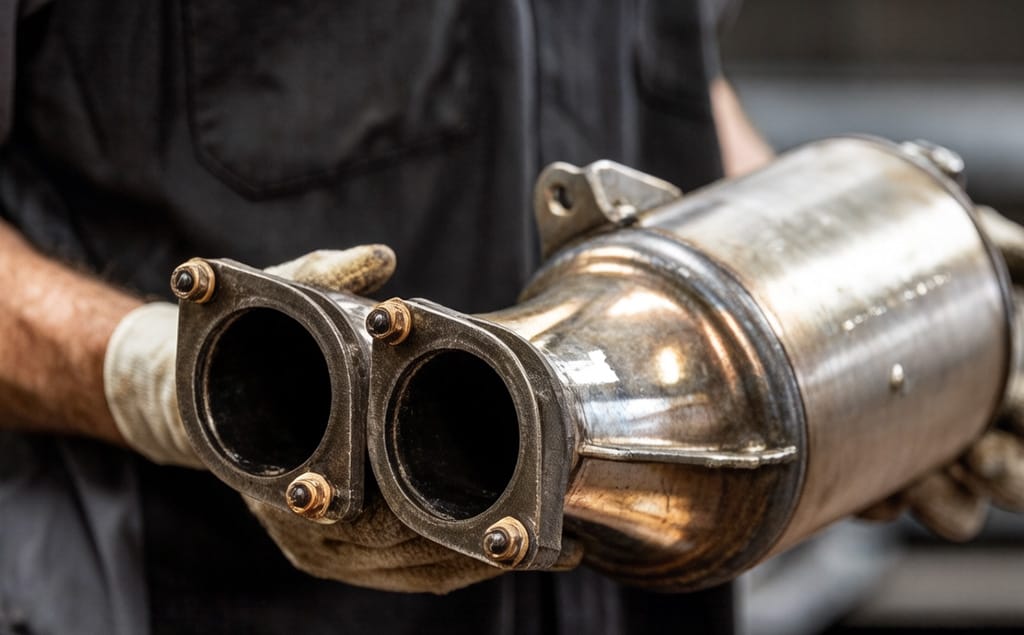
UN convertisseur catalytique à trois voies is an essential component of a car’s exhaust system. It converts harmful emissions — carbon monoxide (CO), hydrocarbons (HC), and nitrogen oxides (NOx) — into less toxic gases such as carbon dioxide, nitrogen, and water vapor. The converter contains valuable metals such as platinum, palladium, and rhodium. These metals make it a lucrative target for thieves.
Over the past decade, catalytic converter thefts have surged globally. High metal prices, easy access underneath certain vehicles, and insufficient law enforcement deterrents have fueled the rise. Many drivers discover the theft only when they start the car and hear the loud roar of an open exhaust system.
However, not every attempt ends in success. Some thieves are interrupted, some misjudge the difficulty, and others encounter unexpected resistance — both mechanical and environmental.

2. Why the Theft Attempt Failed in This Case
The story begins with a car owner noticing an unusual exhaust smell. After inspection, they discovered that the converter shield had been cut — a clear sign of an attempted theft. Surprisingly, the catalytic converter itself remained intact.
So, what prevented the thief from completing the job? Several technical and situational factors could explain this.
2.1 Rusted Bolts and Old Exhaust Components
Aging exhaust systems often develop heavy rust, especially in regions with snow, rain, or humidity. Rusted bolts can fuse to the surrounding metal, making removal extremely difficult without specialized tools.
In this case, rust may have acted as a natural defense system. A thief using a battery-powered reciprocating saw could easily start cutting but quickly realize that the corroded fasteners or hardened shield edges would take too long to finish. Time pressure is the thief’s greatest enemy — they prefer quick, silent jobs that take less than two minutes.
| Condition | Effect on Theft Attempt | Difficulty Level |
|---|---|---|
| New, clean bolts | Easy to remove | Low |
| Moderate rust | Slows cutting and increases noise | Moyen |
| Heavy corrosion | Can jam saw blades or break teeth | Haut |
Thus, rusted bolts may have been one of the key reasons the converter remained safe.
2.2 Blade Pinching and Saw Damage
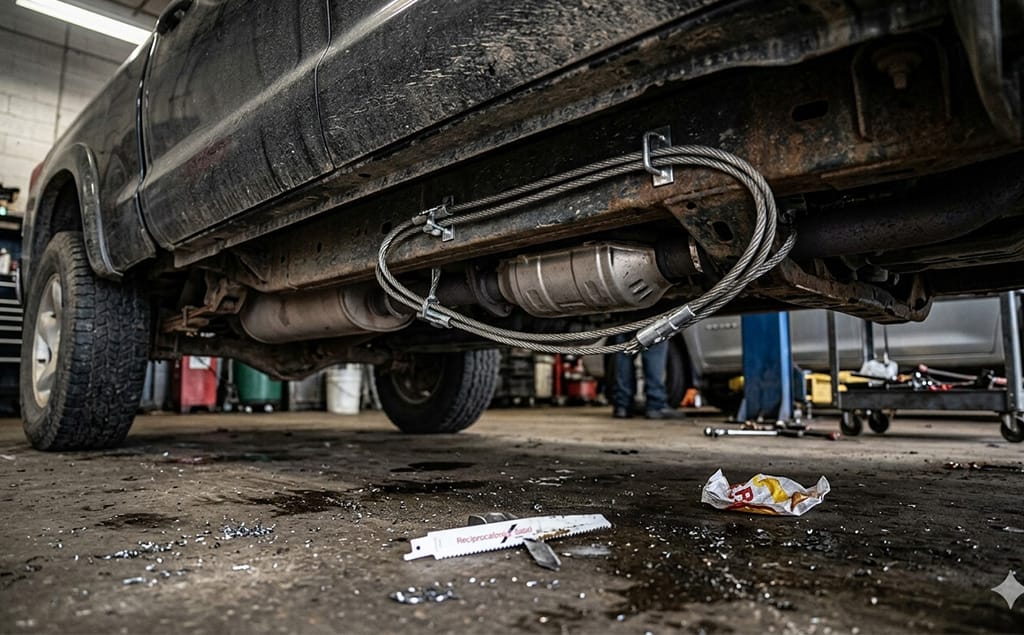
The report mentioned that the thief sliced through the shield but stopped midway. That suggests a saw blade jam. Thin reciprocating saw blades can easily bend or break if they pinch between metal layers, especially when cutting at an awkward angle.
When the blade binds, friction generates heat and smoke, making noise that attracts attention. A spooked thief might drop the attempt immediately.
In many theft cases, investigators find broken blades or partial cuts underneath the car — physical proof of a failed attempt.
2.3 The Human Factor: Thieves Spooked by Movement or Noise
Another likely reason is psychological: fear of being caught.
Even though lights, motion sensors, and cameras rarely stop thefts entirely, they can still make a thief nervous. The hum of an approaching car, a barking dog, or a flashlight beam can cause them to flee. Thieves work in teams, but sometimes they act alone. If one hears a sound or sees a light flicker, they might panic and run.
The owner in this story parked near a public park. It’s entirely possible a passing pedestrian or security patrol appeared at the wrong moment, forcing the thief to retreat.
2.4 Rain, Humidity, and Metal Heating
The next day, the owner drove through heavy rain and noticed a strange smell from the exhaust. Moisture can alter metal hardness and electrical conductivity. When a saw blade gets hot, sudden contact with rainwater may “cook” or warp the metal surface, creating additional resistance.
High humidity (80–95%) can also corrode thin metal layers overnight, further complicating any second attempt. Essentially, nature added an extra layer of protection.
2.5 Incomplete Cutting Strategy
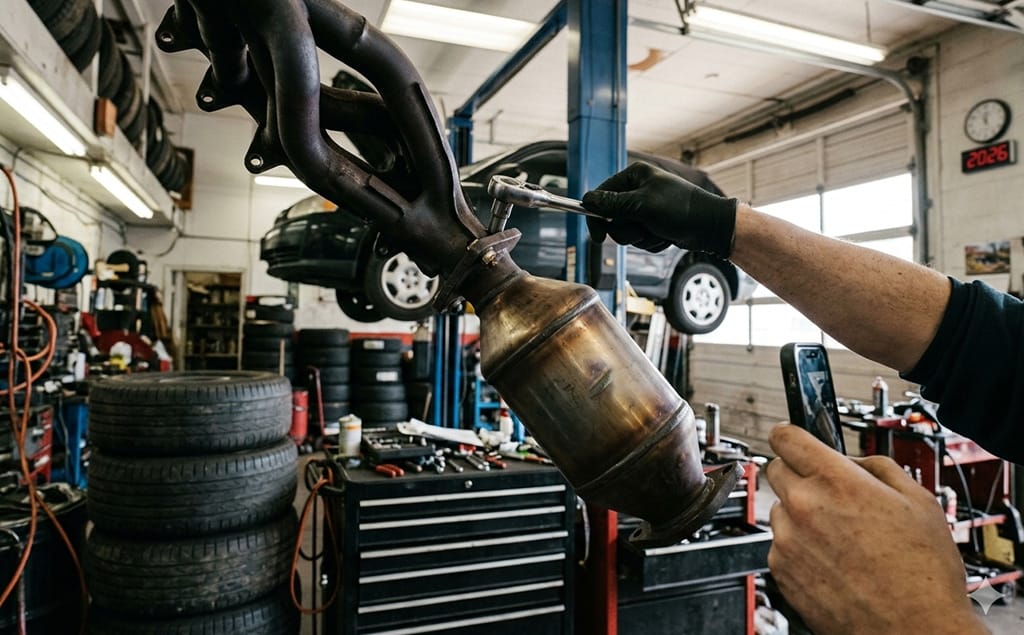
Professional catalytic converter thieves usually know exactly where to cut: two precise sections on the exhaust pipe, often before and after the converter, and a quick snip of the O₂ sensor wire.
However, inexperienced thieves often attack the shield ou heat cover, wasting time and energy. If they don’t have a proper jack or access angle, cutting becomes slower and noisier.
The thief in this case likely lacked skill or preparation. Without the correct approach, removing a converter becomes nearly impossible.
3. The Science Behind Three-Way Catalytic Converter Design
UN convertisseur catalytique à trois voies (TWC) consists of:
- Outer Shell: Stainless steel housing that resists corrosion and extreme heat.
- Substrate: A honeycomb or ceramic monolith coated with precious metals.
- Washcoat: A layer that increases surface area for chemical reactions.
- Capteurs d'oxygène : Appareils électroniques qui surveillent la composition des gaz d’échappement.
| Composant | Matériel | But | Impact sur la difficulté de vol |
|---|---|---|---|
| Coque extérieure | Acier inoxydable | Protéger le catalyseur interne | Haut |
| Substrate | Céramique/nid d'abeille | Revêtement de catalyseur de support | Moyen |
| Bouclier | Aluminium ou acier | Dévier la chaleur et les débris | Faible–Moyen |
| Boulons de montage | Acier (souvent rouillé) | Fixer le convertisseur | Haut |
D'après ce tableau, il est clair que les matériaux robustes du convertisseur jouent un rôle défensif clé, en particulier lorsqu’ils sont associés à la corrosion liée à l’âge.
4. Why SUVs and Trucks Are Easier Targets
La garde au sol est un facteur crucial. La plupart des voleurs privilégient les SUV, les pick-up et les fourgonnettes, car ils peuvent se glisser en dessous sans cric. Moins ils auront besoin de temps et d'équipement, plus leur travail sera sécurisé.
Les berlines et les voitures compactes sont beaucoup plus basses. L'accès au convertisseur nécessite de soulever la voiture, ce qui crée du bruit et prend du temps. Cela les rend cibles moins attractives, en particulier dans les allées résidentielles.
5. Preventive Measures: How to Protect Your Converter
Voici quelques moyens pratiques pour réduire le risque :
| Méthode de protection | Description | Efficacité |
|---|---|---|
| Bouclier de convertisseur catalytique | Une plaque métallique recouvrant le convertisseur | ⭐⭐⭐⭐☆ |
| Cages ou pinces antivol | Cage en acier renforcée autour du convertisseur | ⭐⭐⭐⭐☆ |
| Gravure du VIN ou de l'ID | Marque le convertisseur comme traçable | ⭐⭐⭐☆☆ |
| Stationnement dans des zones sécurisées | Garages ou terrains surveillés | ⭐⭐⭐⭐☆ |
| Alarme de mouvement ou capteur d'inclinaison | Détecte les coupures ou les mouvements | ⭐⭐⭐⭐⭐ |
| Assurance tous risques | Couvre le vol et les dommages | ⭐⭐⭐⭐☆ |
Ajout d'un convertisseur catalytique à trois voies shield C'est l'une des méthodes les plus efficaces et les plus rentables. Associée à des stratégies de stationnement et à des alarmes, elle augmente considérablement le temps et les risques pour les voleurs.
6. The Scrap Metal Problem
Certains parcs à ferraille et recycleurs de métaux achètent encore des convertisseurs sans en vérifier la propriété. Cependant, de nouvelles réglementations aux États-Unis, au Royaume-Uni et en Australie exigent désormais l'identification, les transactions électroniques et la documentation afin de lutter contre le commerce illégal.
Malgré ces lois, les marchés clandestins continuent de fonctionner, souvent en ligne ou via des revendeurs temporaires. Le recyclage responsable reste essentiel à la durabilité, mais son application doit être renforcée pour enrayer le marché noir.
7. Environmental and Human Factors in Theft Prevention
Le froid favorise la rouille, ralentissant la coupe. La pluie et l'humidité déforment les lames de scie et réduisent l'activité des voleurs. Le bruit urbain contribue à dissimuler la coupe, tandis que le calme rural peut la révéler. Comprendre ces facteurs aide les propriétaires à planifier des stratégies de stationnement plus judicieuses.
Les études sur le comportement criminel montrent que le vol se produit lorsque motivation, opportunité et manque de tutelle aligner. La perturbation d'une seule de ces conditions peut arrêter un vol en cours.
8. Modern Technology Against Converter Theft
Les technologies modernes de prévention comprennent :
- Capteurs de mouvement compatibles GPS.
- Caméras IA détectant les modèles de coupe.
- Alarmes de reconnaissance du bruit liées aux smartphones.
Certains fabricants développent des capteurs intégrés dans convertisseurs catalytiques à trois voies eux-mêmes, qui avertissent les propriétaires lorsque la falsification commence.
9. Economic Impact of Catalytic Converter Theft
Le remplacement d'un convertisseur volé peut coûter entre 800 $ et 2 500 $, parfois jusqu'à $3,500 Pour les véhicules hybrides. Les dommages aux capteurs, aux conduites et aux supports de fixation augmentent les coûts. Une protection préventive est bien plus économique et permet de réduire les coûts de réparation à long terme.
10. Conclusion
Dans ce cas, le vol raté n'était pas dû à la chance. Il résultait d'une combinaison de facteurs. résistance mécanique, effets environnementaux et hésitation humaineDes boulons rouillés, des boucliers épais, des lames coincées, de l'humidité et la peur d'être détecté ont tous travaillé ensemble pour arrêter le voleur.
UN convertisseur catalytique à trois voies Un véhicule est précieux, mais vulnérable. Comprendre sa conception, ses risques et ses mécanismes de défense permet aux conducteurs de le protéger efficacement. La clé est d'allier protection mécanique, vigilance et technologie intelligente pour garantir la sécurité face à la hausse des vols de pots catalytiques.