Perkenalan
The automotive exhaust landscape undergoes a seismic shift in 2026. Global emissions targets demand perfection from every konverter katalitik tiga arah. Specifically, mechanics and owners must now navigate complex Badan Perlindungan Lingkungan (EPA) vs CARB catalytic converter requirements. These regulations dictate the chemical loading inside your exhaust system. They split the American market into two distinct compliance zones. One zone follows federal baseline rules. The other adopts the strict mandates of the California Air Resources Board (KARBOHIDRAT). This guide deconstructs these two regulatory paths. We analyze the engineering gap within the konverter katalitik tiga arah and help you identify the correct parts for your region. Understanding EPA vs CARB catalytic converter requirements prevents expensive inspection failures and ensures your engine operates legally.
The Atomic Laboratory: Inside the Three Way Catalytic Converter
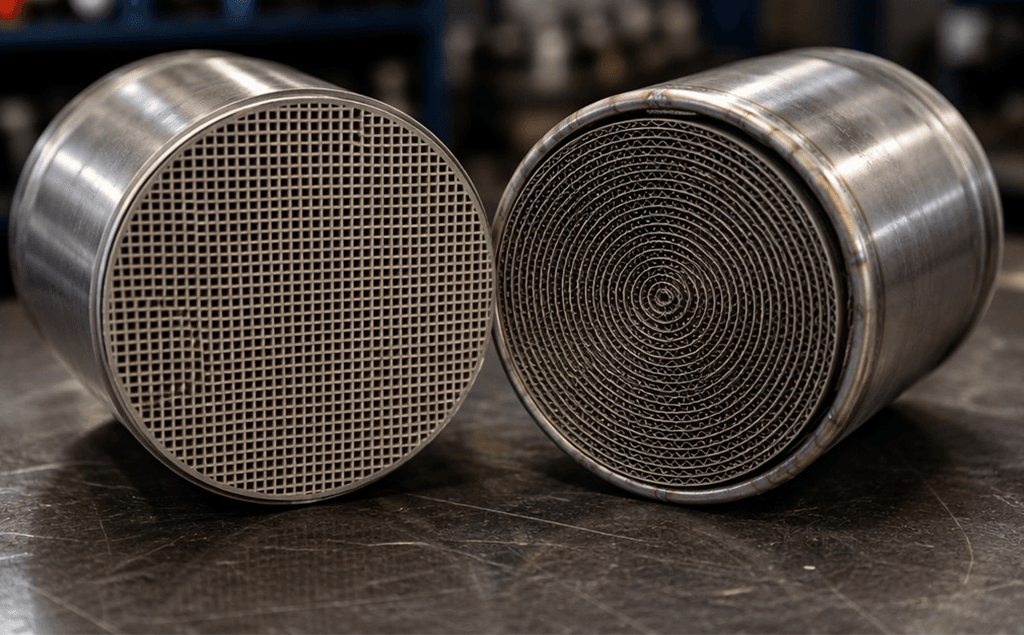
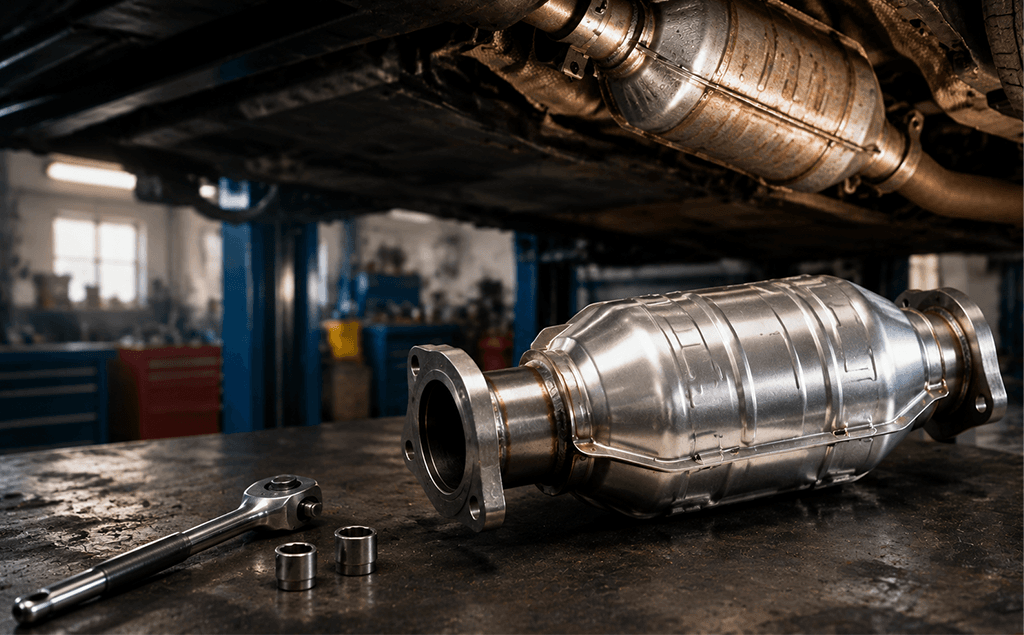
Think of the konverter katalitik tiga arah as a high-speed chemical reactor. It does not simply “filter” gas. It rewrites molecular structures at 800 degrees Celsius. Inside the stainless steel shell lies a ceramic monolith. This monolith features thousands of microscopic channels. A specialized washcoat blankets these channels. This is where EPA vs CARB catalytic converter requirements create the first technical divide.
Itu konverter katalitik tiga arah hosts a trio of precious metals: Platinum, Palladium, and Rhodium. Each metal occupies a specific reactive site. Platinum and Palladium grab Carbon Monoxide (CO) and Hydrocarbons (HC). They force a rapid oxidation reaction. This process creates water vapor and CO2. Simultaneously, Rhodium attacks Nitrogen Oxides (NOx). It strips away the oxygen and leaves pure Nitrogen. If the konverter katalitik tiga arah fails, these poisons escape into the atmosphere. The difference in metal loading defines the core of EPA vs CARB catalytic converter requirements.
The EPA Standard: The Federal Baseline
The EPA manages the minimum performance floor for the United States. Federal law requires every engine to carry an emission control strategy. EPA-compliant versions of the konverter katalitik tiga arah satisfy this federal baseline. They provide adequate purification for states with standard air quality profiles.
When we analyze EPA vs CARB catalytic converter requirements, we see that EPA regulations focus on functional longevity. These parts must survive for five years or 50,000 miles under normal driving conditions. Manufacturers design the federal konverter katalitik tiga arah for cost-efficiency. They use enough precious metal to clear federal hurdles. However, they lack the “chemical overkill” found in premium units. In most states, an EPA-certified konverter katalitik tiga arah remains the standard choice for aftermarket repairs. It keeps the vehicle legal while minimizing the financial burden on the owner.
The CARB Mandate: Engineering for Extremes
California faces a unique geography problem. Mountains trap smog in the Central Valley and Los Angeles basin. Therefore, the California Air Resources Board (CARB) enforces the world’s harshest standards. A CARB-compliant konverter katalitik tiga arah represents the pinnacle of exhaust technology. These EPA vs CARB catalytic converter requirements ensure maximum protection.
CARB standards demand extreme conversion rates. The konverter katalitik tiga arah must neutralize up to 99% of pollutants for the duration of its life. Regulators also require a much more robust warranty system. To achieve this, manufacturers must rethink the internal chemistry. They do not just “add more metal.” They optimize the surface area at the nanometer level. A CARB-compliant konverter katalitik tiga arah must withstand higher temperatures and resist “poisoning” from trace engine oil. This technical superiority defines the essence of EPA vs CARB catalytic converter requirements.
Deep Dive: The Micro-Chemistry of Superior Washcoats
Why does a CARB-certified konverter katalitik tiga arah outperform the EPA baseline? The difference hides in the “Loading Density” and “Oxygen Storage Capacity” (OSC). This chemical variation is a central pillar of EPA vs CARB catalytic converter requirements.
A standard EPA konverter katalitik tiga arah contains a limited Rhodium load. Rhodium is the most expensive element in the exhaust system. In contrast, a CARB-certified konverter katalitik tiga arah features a massive Rhodium increase. This extra Rhodium ensures the vehicle meets NOx targets even as the engine ages. Furthermore, CARB units utilize high-capacity Oxygen Storage Components (OSC). These components, usually Ceria and Zirconia, act as chemical batteries. They release oxygen during rich fuel cycles and soak up oxygen during lean cycles. This buffering maintains the stoichiometric balance required for a high-performance konverter katalitik tiga arah.
Table 1: Material Science Breakdown – EPA vs. CARB
| Technical Metric | EPA-Standard TWC | CARB-Compliant TWC |
|---|---|---|
| Noble Metal Loading | Baseline (Standard) | High-Density (Premium) |
| Rhodium Concentration | Minimal for Compliance | Enhanced for NOx Reduction |
| OSC Buffer (Ceria) | Kelas Standar | High-Surface Area Grade |
| Stabilitas Termal | 800°C Peak | 1050°C Peak Survival |
| Substrate Cell Density | 400 CPSI (Common) | 400 – 600 CPSI (High-Flow) |
| Reaction Kinetics | Standard Speed | High-Velocity Surface Reactions |
The Legal Map: States Adopting Section 177
Compliance is no longer a California-only issue. Other states now utilize Section 177 of the Clean Air Act to adopt CARB rules. This expands the reach of EPA vs CARB catalytic converter requirements across the country.
As of 2026, California, Colorado, and New York mandate 100% CARB compliance for all vehicle years. Maine enforces these rules for 2001 and newer models. In these regions, a shop cannot legally install a federal konverter katalitik tiga arah. The penalties are severe. Inspectors verify parts during annual smog checks. If the konverter katalitik tiga arah lacks the correct certification, the car becomes “un-registrable.” Navigating EPA vs CARB catalytic converter requirements is now a mandatory skill for every professional mechanic.
Table 2: Regional Compliance Matrix (2026 Update)
| State / Region | Mandate Status | Affected Model Years | Mandatory Stamp Required |
|---|---|---|---|
| Kalifornia | Fully Enforced | All Model Years | Executive Order (EO) Number |
| Colorado | Fully Enforced | All Model Years | Executive Order (EO) Number |
| Kota New York | Fully Enforced | All Model Years | Executive Order (EO) Number |
| Maine | Conditional | 2001 and Newer | Executive Order (EO) Number |
Identification: The VECI Label and EO Stamp
Selecting the right konverter katalitik tiga arah requires precision. You must ignore the “standard fit” catalogs. Instead, look at the vehicle’s “Emissions Identity.” This is the only way to satisfy EPA vs CARB catalytic converter requirements.
Step 1: Inspect the VECI Sticker Open the hood. Locate the Vehicle Emission Control Information (VECI) label. It usually sits on the radiator shroud or the strut tower. Read the text carefully. If you see “Certified for sale in California,” your car is a CARB vehicle. Even if you bought the car in Texas, it needs a CARB-compliant konverter katalitik tiga arah if you move to a CARB state.
Step 2: Decode the Engine Family Number (EFN) The EFN is a 12-digit code. It is the fingerprint of your engine’s pollution profile. Manufacturers link every CARB-compliant konverter katalitik tiga arah to specific EFNs. You must match this code to the catalog to meet EPA vs CARB catalytic converter requirements.
Step 3: Verify the Physical EO Stamp A CARB-compliant konverter katalitik tiga arah carries a physical mark of authority. The manufacturer stamps an Executive Order (EO) number into the steel body. This number usually starts with a letter like “D” (e.g., D-182-XX). No stamp means no compliance. Inspectors use mirrors to find this stamp during testing.
Legal Risks and Smog Check Survival
Installing the wrong konverter katalitik tiga arah triggers a cascade of failures. These failures originate from a misunderstanding of EPA vs CARB catalytic converter requirements. First, modern cars use two oxygen sensors. The primary sensor sits before the converter. The secondary sensor sits after it. These sensors compare the gas data. If an EPA-standard konverter katalitik tiga arah provides insufficient conversion for a CARB-tuned computer, the “Check Engine” light illuminates immediately.
Second, legal liability falls on the installer. In states like Colorado or New York, shops face massive fines for “tampering” with emission systems. They will refuse to install an EPA-standard konverter katalitik tiga arah on a CARB-certified car. For the DIY mechanic, the risk is a wasted investment. You pay for the EPA part, it fails the inspection, and then you pay again for a part that meets EPA vs CARB catalytic converter requirements.
Interoperability: The “Upsell” Logic
Can you install a CARB-compliant konverter katalitik tiga arah in a federal EPA state? Absolutely. The EPA views CARB certification as “over-compliance.” This is a key benefit when considering EPA vs CARB catalytic converter requirements.
A CARB-certified konverter katalitik tiga arah offers better performance. It uses more Rhodium and features a superior washcoat. If your car keeps triggering “P0420″ codes with cheap parts, a CARB-compliant konverter katalitik tiga arah is the ultimate fix. It provides the chemical muscle needed to keep the dash lights off. In this scenario, the extra cost buys peace of mind. However, the reverse is never true: a federal part can never satisfy the strict EPA vs CARB catalytic converter requirements of a CARB state.
Conclusion: Final Summary of EPA vs CARB Catalytic Converter Requirements
Itu konverter katalitik tiga arah remains the most critical barrier between the engine and the environment. In 2026, navigating EPA vs CARB catalytic converter requirements is mandatory for every vehicle owner. If you live in California, New York, or Colorado, verify your EFN today. Do not gamble with smog checks. A CARB-compliant konverter katalitik tiga arah provides the precious metal loading and thermal durability required for long-term legal operation. By understanding the VECI label and the EO stamp system, you ensure full compliance with EPA vs CARB catalytic converter requirements while protecting the air quality of your community.