소개
Modern automotive engineering treats the 3원 촉매 변환기 as a non-negotiable sentry. This device guards the boundary between toxic combustion and the atmosphere. When original units fail in high-mileage vehicles, owners face a financial crossroads. They must choose between high-cost OEM hardware and budget-friendly aftermarket alternatives.
안 Aftermarket Catalytic Converter Solution provides the necessary lifeline for aging engines. Replacing these components involves more than simple plumbing. It requires an understanding of chemical redox reactions, washcoat loading, and legal mandates. This technical guide analyzes the science and economics of replacement hardware. We aim to help you restore vehicle health while maximizing your capital efficiency.
The Chemical Reactor Under Your Chassis
Most drivers view the 3원 촉매 변환기 as a passive filter. This assumption is technically incorrect. The device functions as a sophisticated chemical reactor. It processes nitrogen oxides ($NO_x$), carbon monoxide ($CO$), and hydrocarbons ($HC$) simultaneously through redox cycles.
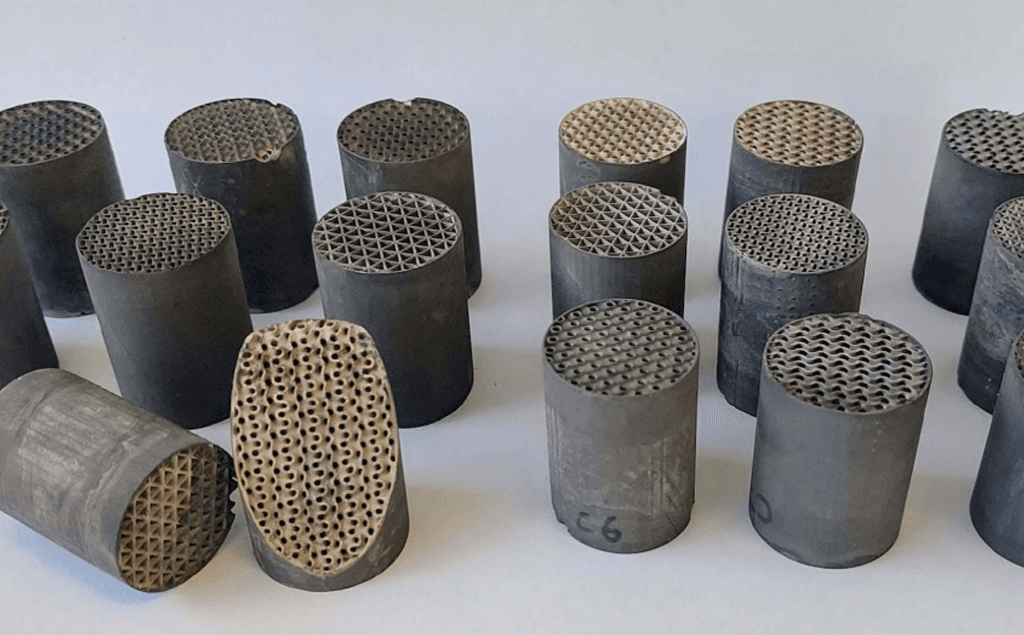
Inside the stainless steel shell sits a honeycomb substrate. Manufacturers coat this surface with a porous washcoat. This layer contains a precise “loading” of platinum, palladium, and rhodium. Platinum and palladium drive the oxidation of $CO$ and $HC$. Rhodium manages the reduction of $NO_x$. The device requires high temperatures to initiate these transformations. Most units reach their “light-off” temperature at roughly $600$ degrees Fahrenheit. A healthy 3원 촉매 변환기 eliminates over $95\%$ of tailpipe toxins.
Substrate Science: Ceramic vs. Metallic Cores
Engineers prioritize 기판 재료 based on flow dynamics and thermal shock resistance. The choice dictates how a 3원 촉매 변환기 behaves under load.
Cordierite Ceramic Honeycombs
Standard duty applications utilize cordierite ceramic. This material offers exceptional thermal stability. It survives temperatures exceeding $2,000$ degrees Fahrenheit. Most OEM and aftermarket restoration units use a $400$ CPSI (cells per square inch) density. This creates massive surface area for gas interaction. Ceramic remains the reliable choice for daily commuters seeking longevity.
Metallic Foil Substrates
Performance-oriented Aftermarket Catalytic Converter Solutions often feature metallic substrates. These use ultra-thin stainless steel foils. Because the walls are thinner than ceramic, they offer less flow restriction. This design reduces engine backpressure. It also allows the 3원 촉매 변환기 to heat up faster. For older, high-performance cars, metallic foils provide a noticeable improvement in throttle response.
Diagnostic Logic and the Stoichiometric Window
에이 3원 촉매 변환기 depends on precise engine calibration. The engine control unit (ECU) must maintain an air-fuel ratio of exactly $14.7:1$. This is the stoichiometric window.
If the mixture runs “rich” (excess fuel), the converter cannot oxidize $CO$ effectively. If it runs “lean” (excess air), the reduction of $NO_x$ fails. Upstream and downstream oxygen sensors monitor this efficiency constant. Low-quality aftermarket parts often trigger a $P0420$ fault code. This happens when the unit lacks sufficient Oxygen Storage Capacity (OSC). High-quality Aftermarket Catalytic Converter Solutions utilize ceria-zirconia in the washcoat to buffer these oxygen swings.
OEM vs. Aftermarket: Technical Matrix
OEM vs Aftermarket Three Way Catalytic Converter Comparison
| Engineering Factor | OEM Restoration Unit | Premium Aftermarket | Budget Aftermarket |
|---|---|---|---|
| PGM 로딩 | Maximum / Consistent | Optimized / High | Minimal / Low |
| OSC Components | Ceria-Zirconia High | Ceria-Zirconia Mid | Basic Washcoat |
| Shell Grade | 409 스테인리스 스틸 | 409 스테인리스 스틸 | Aluminized Steel |
| 서비스 수명 | $100,000+$ Miles | $50,000 – 80,000$ Miles | $<20,000$ Miles |
| Flow Dynamics | Factory Restricted | High Flow (200 CPSI) | 제한된 |
| 규정 준수 | 미국 환경보호청(EPA) / 캘리포니아 대기자원위원회(CARB) | EPA or CARB | EPA (Federal Only) |
The Economics of Precious Metal Loading
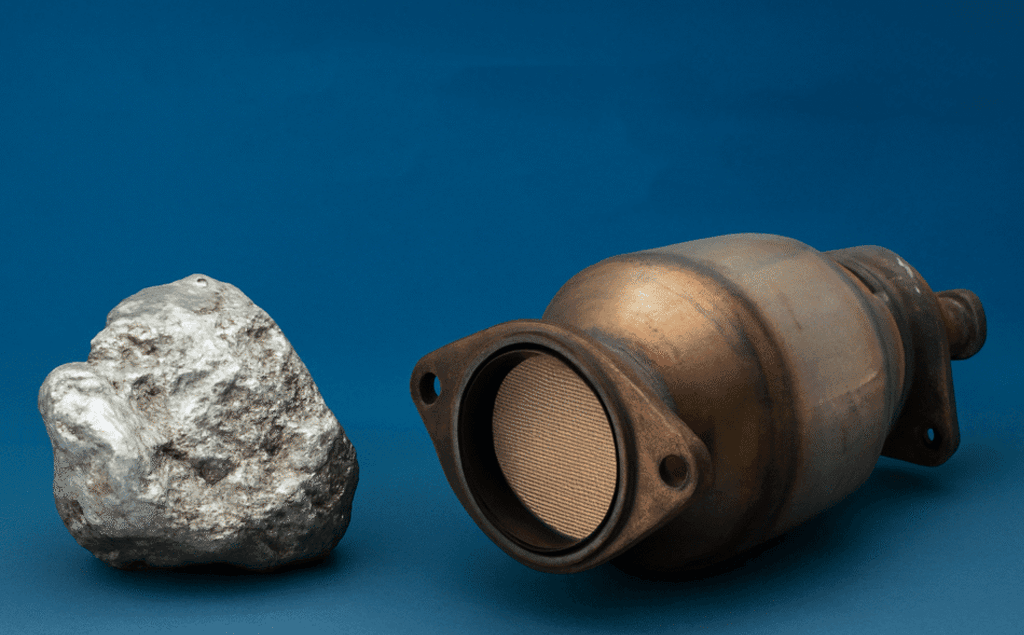
Precious metals drive the total cost of every 3원 촉매 변환기. Rhodium, palladium, and platinum remain among the rarest elements on earth.
OEM manufacturers use “heavy loading” to ensure the part survives $100,000$ miles under extreme conditions. Aftermarket companies often optimize these levels to reduce the retail price. However, “budget” units frequently skimp on these metals. A unit costing under $\$150$ likely contains insufficient rhodium. It will fail to reduce $NO_x$ effectively over time. Our Aftermarket Catalytic Converter Solution analysis suggests avoiding units that seem suspiciously cheap. They lack the chemical “reserve” to handle engine aging.
Legal Mandates: EPA and CARB Compliance
Lawmakers regulate the 3원 촉매 변환기 with different intensity levels. You must verify your local laws before selecting a unit.
- EPA Standards: Most states accept federal 환경보호청-compliant hardware. These units satisfy basic filtration levels and legal requirements in roughly $40$ states.
- CARB Standards: California, New York, and Colorado require 탄수화물-compliant units. These 3원 촉매 변환기 units carry an Executive Order ($EO$) number. They contain higher PGM loading and undergo more rigorous durability testing. Installing a non-CARB unit in a regulated state results in an automatic inspection failure.
Why Catalytic Converters Fail in Older Cars
Engineers classify the 3원 촉매 변환기 as a durable component. It usually fails due to upstream engine malfunctions.
- Fuel Poisoning: Antifreeze or excessive oil in the exhaust coats the washcoat. This blocks the chemical reactions.
- 열 용융: Misfiring spark plugs send raw fuel into the exhaust. This fuel ignites inside the 3원 촉매 변환기, melting the ceramic core.
- Carbon Fouling: A rich-running engine produces excessive soot. This soot clogs the pores of the honeycomb, increasing backpressure.
Any Aftermarket Catalytic Converter Solution must include a full engine tune-up. Replacing the hardware without fixing the misfire or oil leak ensures a second failure.
Countering the Crisis of Catalytic Converter Theft
Theft has reached epidemic levels across North America and Europe. Thieves target the 3원 촉매 변환기 for its scrap value. High-clearance SUVs and hybrid vehicles, like the Toyota Prius, are top targets.
Aftermarket units offer a unique security advantage. They typically contain less PGM loading than OEM units. Scrap yards pay less for them. Thieves prefer original factory units for their higher metal yield. Replacing a stolen unit with an aftermarket 3원 촉매 변환기 reduces the “bounty” on your vehicle. We also recommend installing a steel shield or security cage to provide physical protection.
Installation Engineering: Direct-Fit vs. Universal
Direct-Fit Replacements
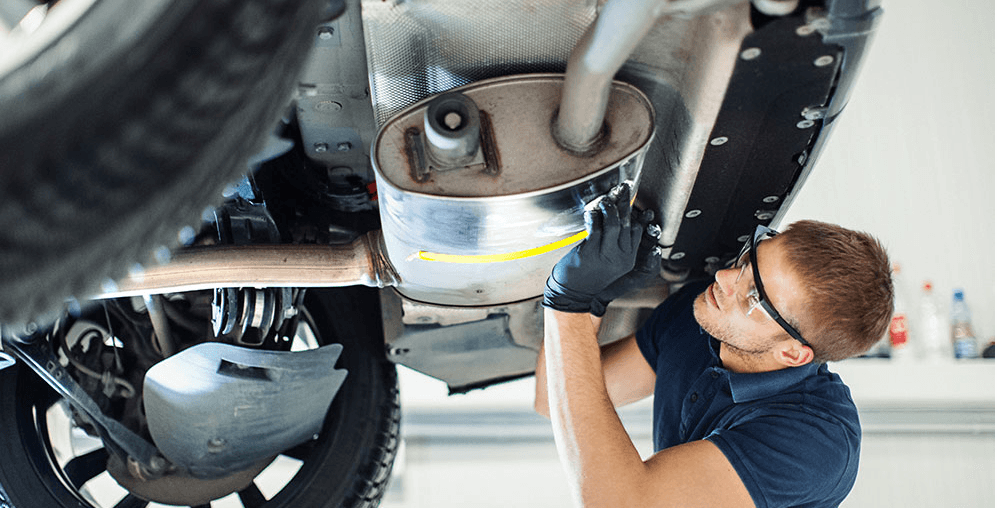
These units match the factory dimensions exactly. They include all hangers, flanges, and sensor bungs. You can install a direct-fit 3원 촉매 변환기 with standard hand tools. This ensures a 100% airtight seal and original exhaust geometry.
Universal Replacements
Universal units consist of the core canister only. They require professional cutting and welding. While the hardware costs less, the labor at a muffler shop increases the total price. Universal units provide an excellent solution for custom exhaust systems or vehicles with discontinued parts.
Manufacturing Precision and Washcoat Quality
High-quality Aftermarket Catalytic Converter Solutions depend on slurry precision. Manufacturers must ensure an even distribution of the washcoat across the honeycomb. Any “cold spots” in the coating will reduce the conversion efficiency.
Automated canning processes ensure the substrate remains secure. A loose substrate will rattle and eventually break apart. This leads to a blocked exhaust and engine power loss. When you shop for a 3원 촉매 변환기, look for brands with ISO-certified manufacturing facilities.
Troubleshooting P0420: The ECU Logic
The $P0420$ code (Catalyst System Efficiency Below Threshold) is the enemy of the car owner. The ECU triggers this code by comparing the signal from the front and rear oxygen sensors.
In a healthy system, the front sensor oscillates rapidly. The rear sensor should remain steady. If the rear sensor mirrors the front sensor, the 3원 촉매 변환기 has lost its oxygen storage capacity. Before replacing the unit, smart mechanics check for exhaust leaks. Even a pinhole leak near a flange introduces fresh oxygen, which ruins the sensor reading.
Environmental Strategy and Future Compliance
그만큼 3원 촉매 변환기 remains the most important environmental component of your car. As global standards move toward Euro 7, efficiency requirements will increase.
Choosing a premium Aftermarket Catalytic Converter Solution today prepares your older vehicle for stricter future inspections. High-loading units handle the degradation of older engines better than budget alternatives. Restoring your exhaust system protects air quality and ensures your vehicle remains road-legal for years to come.
결론
Restoring an older vehicle requires a balanced approach to the exhaust system. The 3원 촉매 변환기 serves as the heart of environmental compliance. While OEM units offer the highest precision, quality aftermarket options provide a vital value proposition for aging cars. By understanding PGM loading, substrate materials, and regional laws, you can make a strategic choice.
Always prioritize reputable brands that offer transparent technical data. Avoid the lowest-cost “no-name” converters, as they frequently lead to recurring $P0420$ errors. Use this Aftermarket Catalytic Converter Solution guide to ensure your vehicle remains clean, efficient, and legal for its remaining life cycle.