pengenalan
The penukar pemangkin tiga hala stands at the center of modern vehicle emission control. Engineers design it to reduce hydrocarbons (HC), carbon monoxide (CO), and nitrogen oxides (NOx) at the same time. However, the converter does not operate independently. The On-Board Diagnostics system (OBD-II) continuously evaluates its condition and efficiency.
OBD monitoring systems influence penukar pemangkin tiga hala performance by tracking oxygen storage capacity (OSC) through upstream and downstream oxygen sensors. The system does not directly measure tailpipe emissions. Instead, it interprets sensor signals and determines whether the converter performs within regulatory limits. When performance drops below a defined threshold, the system triggers diagnostic trouble codes such as P0420.
This article explains how OBD monitoring shapes penukar pemangkin tiga hala performance. It analyzes construction, operation, diagnostics, and regulatory integration. It also explores how monitoring strategies affect maintenance decisions and long-term durability.
Historical Development of the Three Way Catalytic Converter
In the mid-1970s, emission regulations transformed the automotive industry. The Clean Air Act forced manufacturers to reduce harmful exhaust pollutants. Early catalytic converters focused mainly on oxidation reactions to control HC and CO. Engineers later improved the design to address NOx emissions.
The penukar pemangkin tiga hala emerged as a solution capable of handling oxidation and reduction reactions simultaneously. This innovation required precise fuel control and the integration of oxygen sensor feedback systems. Since its introduction, the penukar pemangkin tiga hala has influenced engine calibration, exhaust architecture, and electronic control strategies.

Structure of the Three Way Catalytic Converter
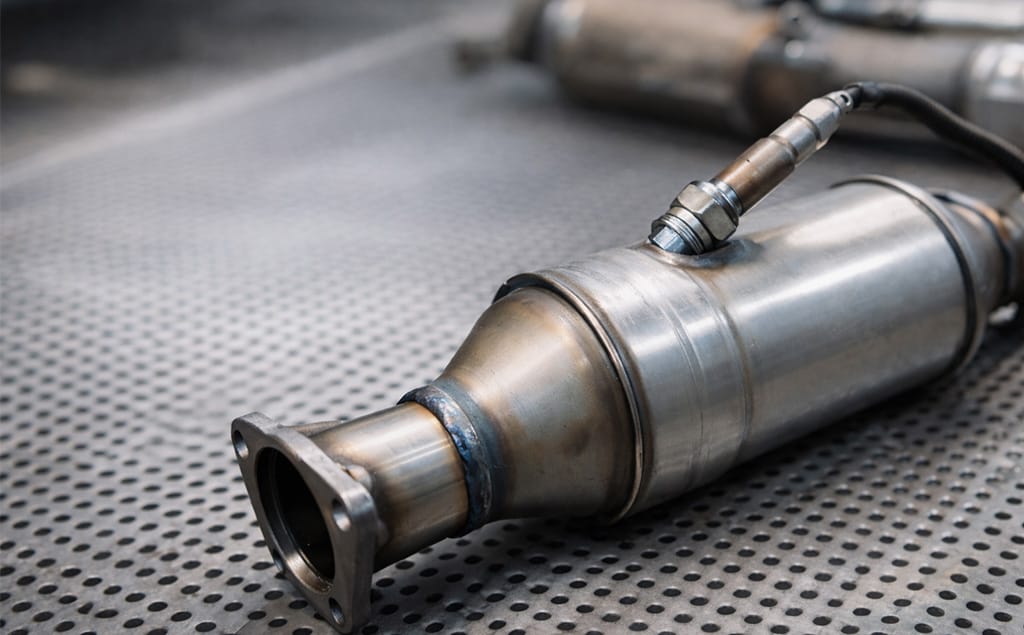
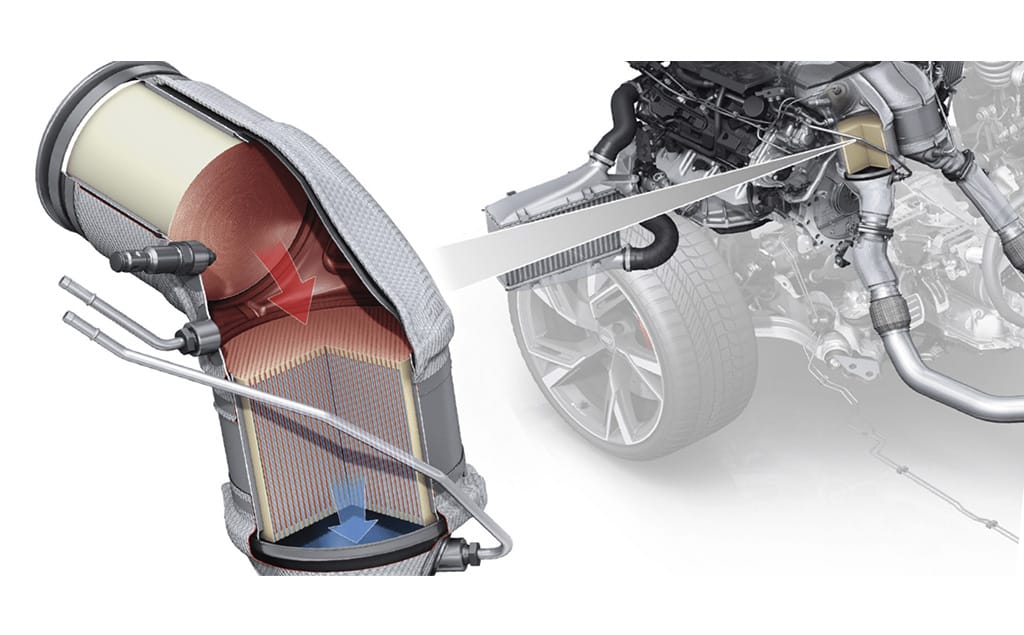
Engineers divide the penukar pemangkin tiga hala into four primary components:
- Housing
- Substrat
- Washcoat
- Catalyst (precious metals)
Housing
Manufacturers commonly use stainless steel or cast iron for the housing. The housing must tolerate high temperatures, rapid thermal cycling, and corrosive exhaust gases. Stainless steel expands significantly under heat. Engineers therefore install intumescent mats or wire mesh between the housing and the substrate. These materials absorb expansion stress and prevent cracking or separation.
Substrat
The substrate forms the internal framework. Early designs used pellet beds. Modern designs rely on ceramic or metallic honeycomb monoliths. Early honeycomb substrates contained 200 cells per square inch (cpsi). Modern units often contain 400 cpsi or higher.
Higher cell density increases surface area. Increased surface area improves reaction efficiency and enhances oxygen storage behavior. This improvement directly affects OBD monitoring sensitivity.
Washcoat
The washcoat covers the substrate and dramatically increases effective surface area. It contains aluminum oxide and oxygen storage materials such as cerium oxide. The washcoat allows precious metals to disperse evenly and remain chemically active.
Precious Metals
The penukar pemangkin tiga hala typically contains platinum, palladium, and rhodium. Each metal performs a distinct function.
| Logam Berharga | Fungsi Utama | Reaction Type |
|---|---|---|
| Platinum (Pt) | Oxidizes CO and HC | Pengoksidaan |
| Paladium (Pd) | Enhances HC oxidation | Pengoksidaan |
| Rhodium (Rh) | Reduces NOx | Pengurangan |
Rhodium remains the most expensive component. Manufacturers constantly adjust metal ratios to balance cost and emission performance.

Chemical Operation of the Three Way Catalytic Converter
A catalyst accelerates chemical reactions without being consumed. The penukar pemangkin tiga hala performs two essential reaction categories.
Oxidation Reactions
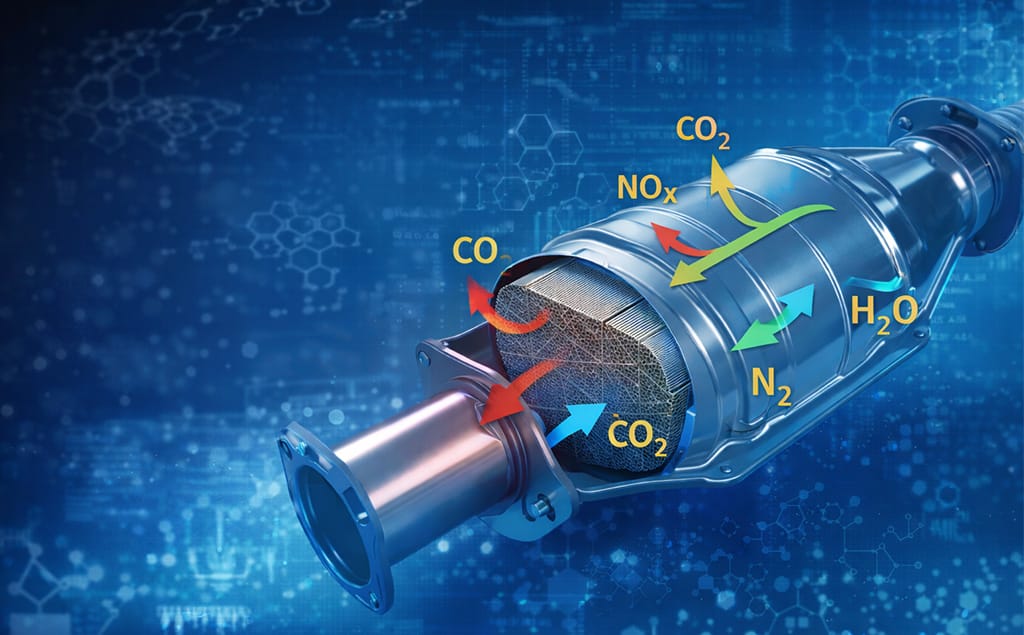
2CO + O2 → 2CO2 HC + O2 → CO2 + H2O
These reactions convert toxic gases into less harmful compounds.
Reduction Reactions
2CO + NOx → 2CO2 + N2 HC + NO → CO2 + H2O + N2
Reduction removes oxygen from nitrogen oxides and releases nitrogen gas. The converter operates most efficiently near the stoichiometric air-fuel ratio. The engine control module maintains this balance through oxygen sensor feedback.
Oxygen Sensors and Fuel Strategy
The three way catalytic converter depends on rapid air-fuel oscillation. Oxygen sensors generate voltage signals that reflect oxygen concentration in exhaust gas.
The upstream sensor controls fuel mixture. The downstream sensor evaluates catalyst efficiency. When the upstream sensor voltage rises, the mixture becomes rich. The converter promotes NOx reduction. When voltage drops, the mixture becomes lean. The converter oxidizes HC and CO.
Cerium within the washcoat temporarily stores oxygen. This oxygen storage capacity allows the converter to buffer fluctuations and stabilize downstream oxygen levels.
OBD-II Monitoring Strategy
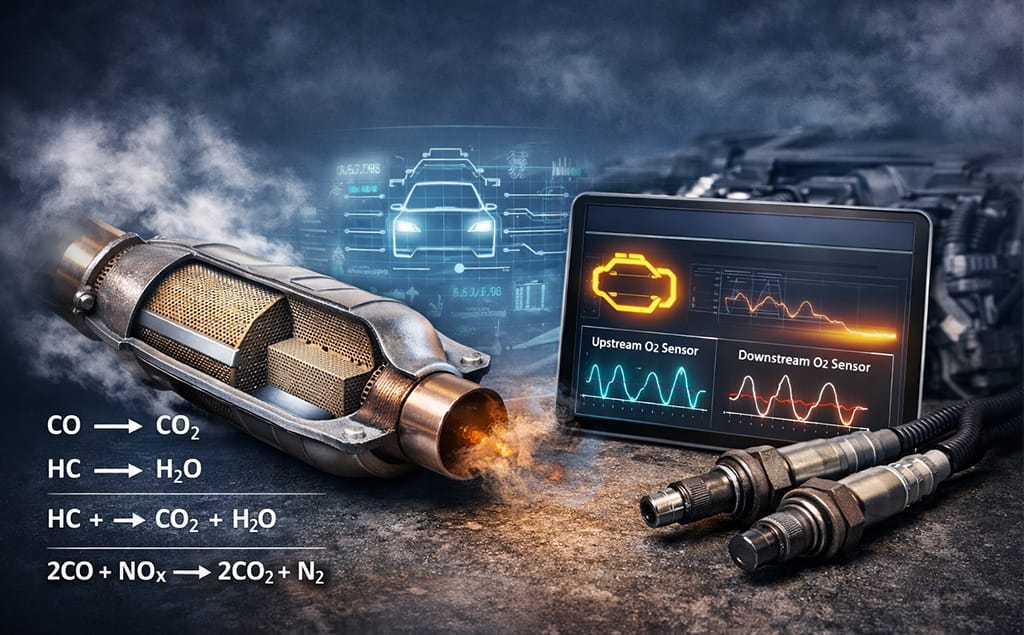
OBD-II regulations require continuous monitoring of catalyst efficiency. The system compares upstream and downstream oxygen sensor signals.
Sihat penukar pemangkin tiga hala smooths oxygen fluctuations. The downstream sensor shows stable and slower switching. A degraded converter fails to buffer oxygen effectively. The downstream signal begins to resemble the upstream signal in frequency and amplitude.
Engineers design algorithms that analyze signal frequency, amplitude, and switching ratio. When efficiency drops below regulatory limits, the system activates a malfunction indicator light and stores a diagnostic code.
Common Diagnostic Trouble Codes
The most common catalyst-related codes include:
| Code | Penerangan |
|---|---|
| P0420 | Catalyst System Efficiency Below Threshold (Bank 1) |
| P0430 | Catalyst System Efficiency Below Threshold (Bank 2) |
| P0421 | Warm-up Catalyst Efficiency Below Threshold |
| P0431 | Warm-up Catalyst Efficiency Below Threshold (Bank 2) |
P0420 appears most frequently. It indicates insufficient oxygen storage or reduced oxidation efficiency.
Catalyst Temperature Modeling
Temperature strongly influences penukar pemangkin tiga hala performance. The converter must reach light-off temperature before reactions occur efficiently.
Most systems do not install direct temperature sensors. Instead, the engine control module estimates temperature using airflow, engine load, coolant temperature, and vehicle speed. The system only runs catalyst monitoring when the estimated temperature exceeds a calibrated threshold. This strategy prevents false failure detection.
Exhaust Flow Influence
Exhaust flow affects oxygen adsorption and release rates. High flow increases oxygen switching frequency. The downstream sensor may show higher activity even if the converter remains functional.
Manufacturers therefore conduct monitoring under controlled conditions. Typical test conditions include steady cruise between 40 and 60 mph and stable engine load. The catalyst monitor usually runs after other system monitors complete.
Protective Functions of OBD Monitoring
OBD systems protect the penukar pemangkin tiga hala from thermal damage. The system detects misfires, excessive fuel trim deviations, and unburned fuel entering the exhaust stream.
Unburned fuel can overheat the catalyst and cause substrate melting. The engine control module responds by adjusting fuel injection or disabling specific cylinders in severe cases. This protective function extends catalyst lifespan and reduces costly failures.
Diagnostic Best Practices
Technicians should not immediately replace a penukar pemangkin tiga hala after a P0420 code appears. Other conditions may trigger false readings. Common causes include exhaust leaks, faulty oxygen sensors, fuel system imbalance, or outdated software calibration.
Technicians should compare upstream and downstream oxygen sensor waveforms under identical operating conditions. A switching ratio approaching 1:1 often indicates reduced oxygen storage capacity.
Manufacturers sometimes release technical service bulletins that require control module reprogramming rather than hardware replacement.
Advanced Monitoring and System Evolution
Modern vehicles may use dual-brick systems with a warm-up catalyst near the exhaust manifold and a main converter downstream. Each brick uses different substrate structures and metal compositions. Monitoring strategies adjust accordingly.
Advanced software models oxygen storage dynamics mathematically. Engineers apply frequency correlation analysis to improve detection accuracy. These strategies increase sensitivity while minimizing false positives.
Impact on Emission Compliance and Vehicle Lifecycle
OBD monitoring ensures that the penukar pemangkin tiga hala maintains compliance throughout the vehicle’s operational life. The system provides early detection of degradation. It prevents excessive pollutant release. It reduces long-term maintenance costs. It ensures conformity with emission regulations.
Without OBD oversight, converters could degrade unnoticed and release high levels of harmful gases. Continuous monitoring protects both environmental quality and engine reliability.
Kesimpulan
The penukar pemangkin tiga hala forms the core of modern emission control systems. It simultaneously oxidizes hydrocarbons and carbon monoxide while reducing nitrogen oxides. However, its effectiveness depends heavily on OBD monitoring systems.
OBD-II evaluates oxygen storage capacity by comparing upstream and downstream sensor behavior. The engine control module analyzes switching frequency, signal correlation, and estimated temperature. When performance declines below defined limits, the system triggers diagnostic trouble codes and alerts the driver.
Manufacturers integrate airflow modeling, temperature estimation, and calibrated testing conditions to prevent false failures. These strategies protect the catalyst from overheating, ensure emission compliance, and extend service life.
The penukar pemangkin tiga hala and OBD system operate as a unified network. Together, they reduce pollution, maintain regulatory standards, and safeguard long-term vehicle performance.