Konwertery katalityczne are essential components in modern vehicles, designed to reduce harmful emissions by converting toxic gases into less harmful substances. But how are these critical devices actually manufactured? The process involves several precise steps — from preparing the substrate to applying the washcoat, impregnating the catalyst metals, and finally canning the unit into its steel shell. Each stage is crucial for ensuring performance, durability, and compliance with global emission standards.
In this article, we’ll break down the manufacturing process step by step.
Step 1: Substrate Preparation
At the core of every katalizator is the substrate, usually made from ceramic (cordierite) or metallic (stainless steel foil) materials. The substrate is shaped like a honeycomb, with hundreds of tiny channels that maximize surface area while allowing exhaust gases to pass through with minimal restriction.
Key points:
- Ceramic substrates are lightweight, heat-resistant, and cost-effective.
- Metallic substrates offer higher strength, quicker light-off times, and can withstand thermal shock better.
- The honeycomb structure is carefully designed to balance strength, flow, and catalytic efficiency.
| Aspect | Bliższe dane |
| Tworzywo | Cordierite (ceramic), Fecralloy (metal) |
| Kształt | Honeycomb, cylindrical |
| Funkcjonować | Provides large surface area for catalytic coating and gas flow |
| Properties | High thermal stability, low pressure drop, lightweight |
Step 2: Washcoat Application
The raw substrate alone cannot effectively catalyze reactions. That’s where the washcoat comes in.
- The washcoat is typically made of alumina (Al₂O₃) mixed with other oxides like ceria (CeO₂) and zirconia (ZrO₂).
- Its function is to increase surface area dramatically — providing more space for catalytic reactions.
- The washcoat is applied as a slurry, then dried and calcined (heated at high temperatures) to form a porous, rough surface inside the honeycomb channels.
This stage is critical: a well-applied washcoat ensures better adhesion and higher catalyst loading.
| Step | Opis |
| Tworzywo | Aluminum oxide (Al₂O₃), titanium dioxide (TiO₂), silicon dioxide (SiO₂) |
| Aplikacja | Coating slurry is applied by dipping or spraying |
| Purpose | Increase surface area and provide adhesion for catalysts |
| Drying | Heated in an oven to remove moisture and solidify coatin |
Step 3: Impregnation with Precious Metals
Once the washcoat is applied, the substrate is impregnated with the active catalytic materials — typically platinum (Pt), palladium (Pd), and rhodium (Rh).
- Platinum (Pt): Efficient in oxidizing carbon monoxide (CO) and hydrocarbons (HC).
- Palladium (Pd): Primarily used for hydrocarbon and CO oxidation.
- Rhodium (Rh): Best for reducing nitrogen oxides (NOx).
The precious metals are dispersed in a liquid solution and applied to the washcoated substrate. After impregnation, the substrate undergoes high-temperature calcination again, which helps fix the metals securely in place.
This step is the most cost-intensive, as the metals are rare and expensive. Precise control ensures uniform distribution and maximized catalytic activity with minimal waste.
| Aspect | Bliższe dane |
| Metals Used | Platinum (Pt), Palladium (Pd), Rhodium (Rh) |
| Method | Soaking in metal solution, then drying |
| Purpose | Catalysts convert CO, HC, NOx into less harmful gases |
| Quality Control | Metal loading measured for uniformity |
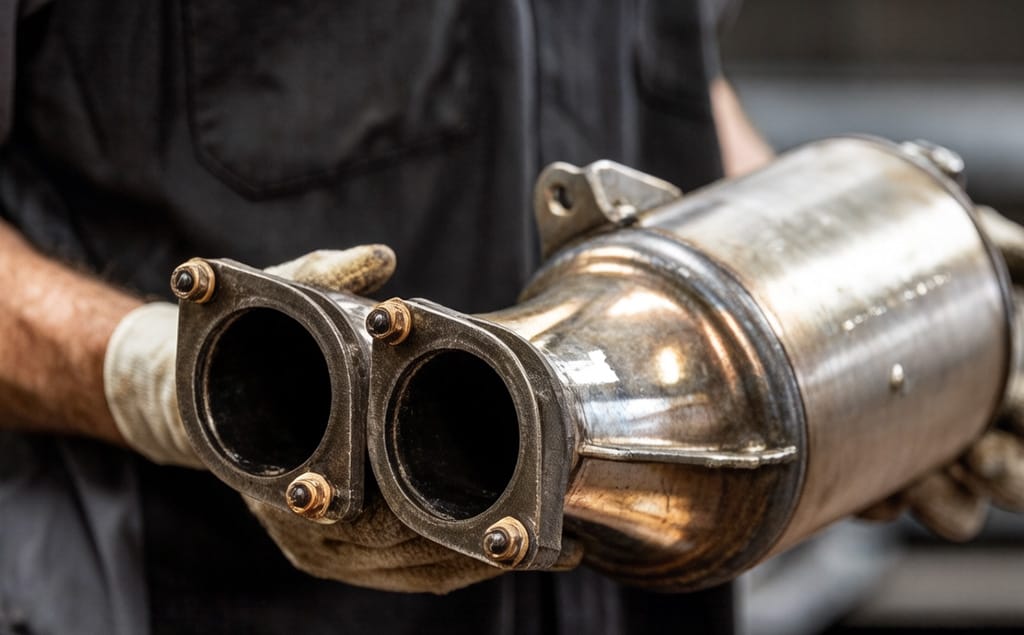
Step 4: Canning (Converter Assembly)
After the substrate is fully prepared with washcoat and catalyst, it needs to be housed inside a protective casing — a process called canning.
The canning involves placing the substrate inside a stainless steel shell.A mat or insulating layer (made from intumescent materials) is wrapped around the substrate to cushion it, absorb vibrations, and provide thermal insulation.The shell is then welded or mechanically locked to form a sealed unit.Inlet and outlet cones are added, allowing the converter to be connected to the vehicle’s exhaust system.
Canning ensures durability under extreme heat, vibration, and exhaust pressure conditions.
| Step | Opis |
| Shell Material | Stainless steel |
| Components | Outer shell, inner mat (for thermal and vibration protection) |
| Proces | Insert substrate into shell, seal edges, attach flanges |
| Purpose | Protect substrate and allow mounting in exhaust system |
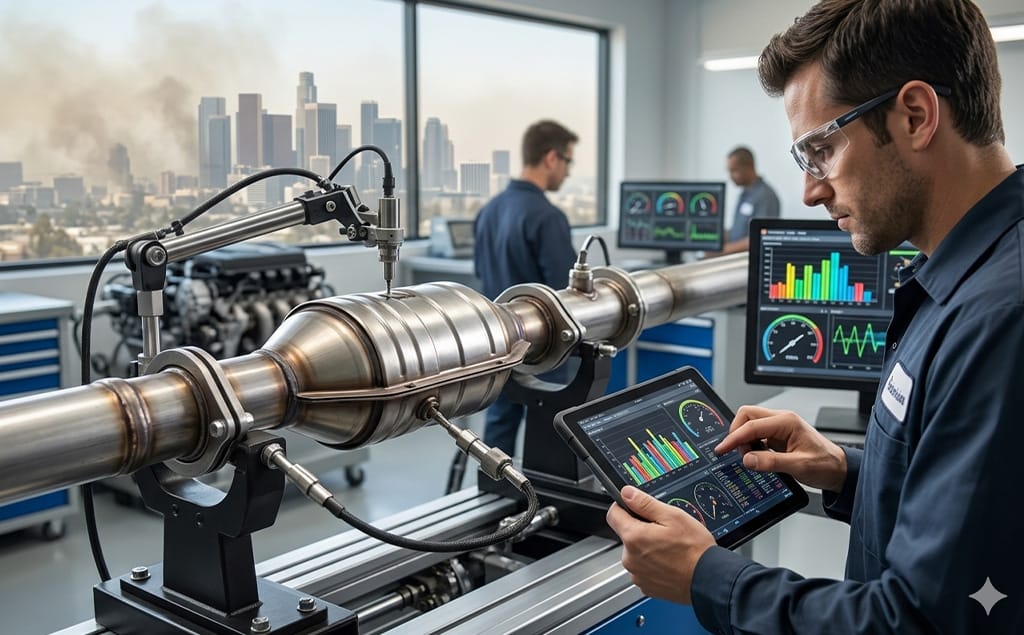
Quality Control and Testing
Before leaving the factory, catalytic converters undergo strict quality control:
- Flow tests to ensure exhaust gases pass smoothly.
- Thermal shock tests to check resistance to sudden temperature changes.
- Emission tests to verify catalytic efficiency.
Only converters meeting stringent standards are approved for use in vehicles.
Wniosek
The manufacturing of konwertery katalityczne is a highly precise process that combines advanced materials science with careful engineering. Starting with a ceramic or metallic substrate, manufacturers apply a washcoat to increase surface area, impregnate it with platinum, palladium, and rhodium for catalytic activity, and finally encase it in a durable stainless steel shell through canning.
Each step — substrate, washcoat, impregnation, and canning — is essential for ensuring that the katalizator performs reliably, reduces emissions effectively, and withstands the tough conditions inside a vehicle’s exhaust system.