Wstęp
Modern automotive engineering relies heavily on efficient emissions control. The katalizator trójdrożny stands as the most critical component in this effort. This device transforms toxic engine exhaust into harmless gases through complex chemical reactions. To function correctly, the catalyst requires a robust physical foundation known as a substrate. Engineers must select the right substrate material to ensure the katalizator trójdrożny meets strict environmental regulations and durability standards. This guide explores the materials, engineering criteria, and manufacturing processes that define high-performance catalyst supports. We focus on how these choices impact the efficiency of the katalizator trójdrożny in diverse operating environments.
The Fundamental Role of the Three Way Catalytic Converter
Ten katalizator trójdrożny manages three primary pollutants: carbon monoxide (CO), unburned hydrocarbons (HC), and nitrogen oxides (NOx). It performs oxidation and reduction reactions simultaneously. This dual functionality requires a precise balance of temperature, gas flow, and surface chemistry.
Platinum, palladium, and rhodium serve as the active noble metals in the katalizator trójdrożny. These metals facilitate the conversion of CO and HC into carbon dioxide and water. Simultaneously, they reduce NOx into nitrogen gas and oxygen. However, these expensive metals cannot float freely in the exhaust stream. They require a substrate with a massive surface area to maximize contact with exhaust gases. The substrate provides the structural integrity and surface geometry necessary for the katalizator trójdrożny to thrive under the vehicle’s hood.

Comprehensive Catalyst Substrate Material Overview
Material selection dictates the thermal, mechanical, and chemical performance of the system. Engineers primarily choose between ceramic and metallic options for the katalizator trójdrożny.
1. Ceramic (Synthetic Cordierite)
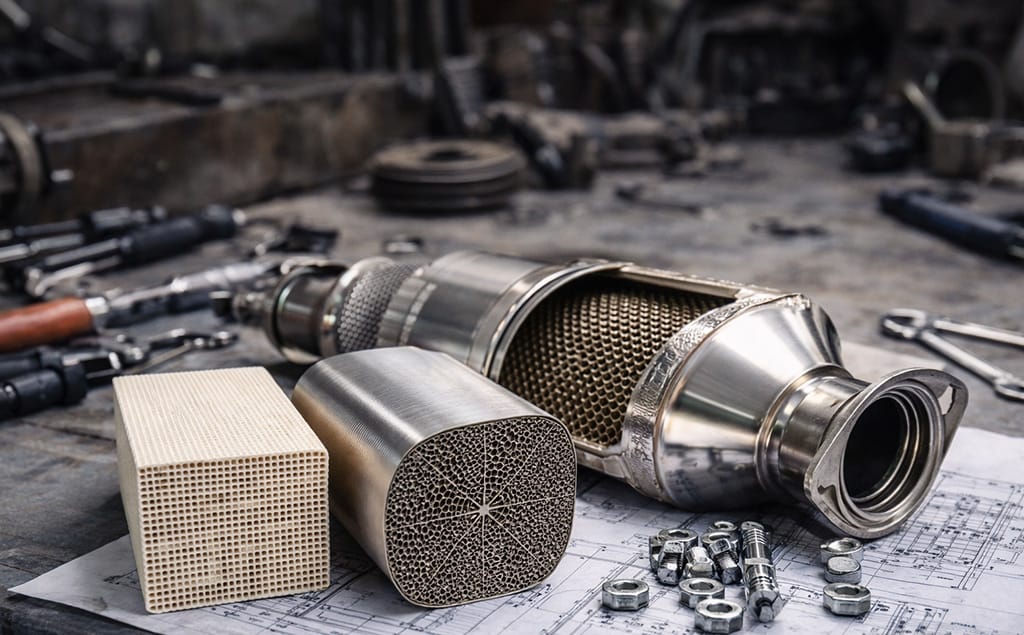
Cordierite remains the industry standard for the katalizator trójdrożny. It consists of magnesium oxide, alumina, and silica. This ceramic material offers a remarkably low thermal expansion coefficient. In the axial direction, this value stays below (1 \times 10^{-6}/^{\circ}C). This property grants the material superior thermal shock resistance. Cordierite substrates survive the rapid temperature swings common in daily driving. They are cost-effective and provide a stable surface for washcoat adhesion.
2. Metallic Foil Substrates
Metallic substrates usually utilize ferritic stainless steel, such as AISI 409 or 439. These substrates offer unique advantages for high-performance katalizator trójdrożny applications. Metal foils allow for thinner walls compared to ceramic structures. Thinner walls result in a larger open frontal area (OFA) and lower backpressure. Metal also conducts heat more quickly than ceramic. This characteristic allows the katalizator trójdrożny to reach “light-off” temperature faster, reducing cold-start emissions.
3. Silicon Carbide (SiC)
SiC enters the frame for demanding environments involving extreme vibration or ultra-high temperatures. It possesses higher mechanical strength and better thermal conductivity than cordierite. While more expensive, SiC substrates offer unmatched durability in heavy-duty katalizator trójdrożny systems.
4. Alumina ((Al{2}O{3}))
Industrial applications often use alumina-based supports. Alumina provides a high surface area and structural robustness. While less common in standard passenger car katalizatory trójdrożne, it remains vital for industrial emissions control and hydrogenation processes.

Critical Engineering Criteria for Substrate Selection
Choosing a material requires a deep understanding of the operating environment. Designers evaluate several key factors to ensure the katalizator trójdrożny functions for the life of the vehicle.
- Thermal Shock Resistance: Exhaust temperatures can jump from 20°C to 800°C in seconds. The material must expand and contract without cracking. Ceramics excel here due to their low expansion rates.
- Mechanical Durability: Ten katalizator trójdrożny sits in a high-vibration environment. Metallic substrates offer better resistance to physical impacts and road debris than brittle ceramic monoliths.
- Open Frontal Area (OFA): A high OFA reduces the restriction of gas flow. This improves engine power and fuel efficiency. Metal substrates typically achieve higher OFA than ceramic ones.
- Geometric Surface Area (GSA): A larger GSA allows more space for the catalyst washcoat. This maximizes the reaction sites available for the katalizator trójdrożny to process pollutants.
- Thermal Mass: Low thermal mass is ideal. It enables the katalizator trójdrożny to heat up rapidly using the energy from the exhaust gas.
Comparison of Substrate Technologies
The following table summarizes the performance metrics of the most common materials used in the katalizator trójdrożny industry.
| Funkcja | Cordierite (Ceramic) | Metallic Foil (Stainless) | Silicon Carbide (SiC) |
|---|---|---|---|
| Thermal Expansion | Ultra-Low | Wysoki | Umiarkowany |
| Max Operating Temp | ~1200°C+ | ~500°C – 1000°C | ~1400°C |
| Grubość ścianki | Standard (thick) | Very Thin | Umiarkowany |
| Przeciwciśnienie | Umiarkowany | Low | Umiarkowany |
| Manufacturing Cost | Low | Wysoki | Bardzo wysoki |
| Szok termiczny | Doskonały | Dobry | Umiarkowany |
| Vibration Resistance | Fair | Doskonały | Dobry |
The Intricate Manufacturing Process of Ceramic Substrates
Manufacturing a ceramic substrate for a katalizator trójdrożny involves high-precision extrusion. The process begins with raw materials: talc, alumina, silica, and kaolinite clay. Technicians grind these materials into a fine powder and mix them with a water-based paste.
During mixing, they add lubricants like ethylene glycol and bonding agents like methylcellulose. The mixture passes through a high-pressure extrusion die. This die creates the characteristic honeycomb structure of the katalizator trójdrożny substrate. After extrusion, the “green” parts undergo drying and cutting.
Finally, the parts enter a kiln for calcination. This process occurs at temperatures exceeding 1400°C. During calcination, the minerals fuse into synthetic cordierite. The material shrinks slightly during this stage. Manufacturers must calculate this shrinkage precisely to meet final dimensional specifications. For large-scale katalizator trójdrożny units, workers may machine the contours and apply an outer ceramic skin after the initial firing to ensure a perfect fit in the metal housing.
The Critical Synergy Between Washcoat and Substrate Architecture
The substrate provides the skeleton, but the washcoat provides the lungs of the katalizator trójdrożny. The washcoat is a porous layer applied to the substrate walls. It usually contains aluminum oxide, cerium oxide, and zirconium oxide. This layer creates a massive internal surface area for the noble metals.
A high-quality washcoat must bond perfectly with the substrate of the katalizator trójdrożny. If the washcoat peels off (delamination), the converter fails. Therefore, engineers match the chemical properties of the substrate to the washcoat formula. This synergy ensures the katalizator trójdrożny maintains high conversion efficiency over 150,000 miles or more.
The porous nature of the washcoat increases the effective surface area by a factor of 7,000 or more. This allows the katalizator trójdrożny to utilize minimal amounts of precious metals like Rhodium. Furthermore, the washcoat acts as a stabilizer. It prevents the active metal particles from moving and clumping together at high temperatures. This design philosophy ensures that the katalizator trójdrożny remains effective even as the vehicle ages.
Understanding Oxygen Storage Capacity (OSC)
Wysoka wydajność katalizator trójdrożny requires Ceria ((CeO_{2})) in the washcoat. Ceria acts as an oxygen reservoir. When the engine runs “rich” (too much fuel), the ceria releases oxygen to oxidize CO and HC. When the engine runs “lean” (too much air), the ceria absorbs excess oxygen to help reduce NOx. This storage capacity allows the katalizator trójdrożny to function even when the air-fuel ratio fluctuates.
Strategic Management of Thermal Transients in Cold-Start Scenarios
Modern hybrid vehicles present new challenges for the katalizator trójdrożny. In a hybrid system, the internal combustion engine turns off frequently. This causes the catalyst temperature to drop below its active range. When the engine restarts, it emits a burst of pollutants.
Engineers now favor metallic substrates or ultra-thin-wall ceramic substrates for these applications. These materials possess lower thermal mass. They regain their operating temperature much faster than traditional heavy substrates. By selecting a substrate with rapid thermal response, manufacturers ensure the katalizator trójdrożny stays active during the stop-start cycles of a hybrid vehicle. This strategic selection directly impacts the vehicle’s ability to pass strict “SULEV” (Super Ultra Low Emission Vehicle) standards.
Moreover, the positioning of the katalizator trójdrożny matters. “Close-coupled” converters sit right next to the engine manifold. This proximity allows the device to capture maximum heat immediately. However, this position also exposes the katalizator trójdrożny na ekstremalne naprężenia termiczne. Tylko materiały o wysokiej stabilności termicznej mogą przetrwać w tym miejscu bez degradacji.
Navigating Catalyst Poisoning and Thermal Degradation
NIE katalizator trójdrożny Trwa wiecznie. Dwa główne zagrożenia dla jego żywotności stanowią: zatrucie i spiekanie. Zatrucie występuje, gdy substancje chemiczne, takie jak siarka, fosfor lub ołów, pokrywają aktywne miejsca. Zanieczyszczenia te blokują dopływ spalin do metali szlachetnych.
Degradacja termiczna, czyli spiekanie, zachodzi podczas ekstremalnych temperatur. Wysokie temperatury powodują zlepianie się mikroskopijnych cząstek metali szlachetnych. Zmniejsza to dostępną powierzchnię. Powoduje to również zapadanie się porów warstwy pośredniej. Inżynierowie radzą sobie z tym problemem, stosując stabilizowany tlenek glinu i zaawansowane konstrukcje podłoży, które równomierniej rozprowadzają ciepło. Dobrze zaprojektowany katalizator trójdrożny Podłoże zapobiega powstawaniu lokalnych „gorących punktów”, wydłużając w ten sposób chemiczną żywotność urządzenia.
Industrial Applications Beyond the Automobile
Podczas gdy samochody wykorzystują większość katalizator trójdrożny Z technologii korzystają również inne sektory. Duże zakłady przemysłowe wykorzystują podobne substraty o strukturze plastra miodu do oczyszczania emisji z silników stacjonarnych i turbin. W takich przypadkach średnica substratu może sięgać kilku stóp.
Procesy uwodornienia w przemyśle chemicznym również wykorzystują katalizatory na nośniku z tlenku glinu. Technologia ogniw paliwowych stanowi kolejny krok naprzód. Ogniwa paliwowe wymagają metali na nośniku węglowym, aby kontrolować przewodnictwo elektryczne. Każde z tych zastosowań wymaga określonego materiału podłoża, w zależności od środowiska chemicznego i wymaganej żywotności systemu. Nawet w zastosowaniach niezwiązanych z motoryzacją, zasady katalizator trójdrożny pomagać inżynierom w wyborze czystszych rozwiązań energetycznych.
Optimization of Fluid Dynamics in Converter Design
Geometria katalizator trójdrożny Podłoże wpływa na przepływ spalin. Przepływ laminarny jest zazwyczaj preferowany wewnątrz kanałów. Jednak przejście z rury wydechowej do dużej powierzchni podłoża często powoduje turbulencje.
Inżynierowie wykorzystują obliczeniową mechanikę płynów (CFD) do modelowania tego przepływu. Projektują stożki wlotowe katalizator trójdrożny Aby gaz równomiernie rozprowadził się po całej powierzchni podłoża. Jeśli gaz przepływa tylko przez środek, zewnętrzne krawędzie katalizatora pozostają niewykorzystane. Powoduje to marnotrawstwo drogich metali szlachetnych i zmniejsza ogólną wydajność. katalizator trójdrożny. Równomierne rozprowadzenie gwarantuje, że każdy milimetr kwadratowy podłoża jest zaangażowany w proces czyszczenia.
The Economic Impact of Substrate Choice
Ten katalizator trójdrożny Platyna i pallad to jeden z najdroższych elementów układu wydechowego pojazdu. Ceny metali szlachetnych podlegają dużym wahaniom. Platyna i pallad często kosztują więcej niż złoto. Dlatego wydajność podłoża jest koniecznością finansową.
Podłoże o większej powierzchni pozwala producentowi na użycie mniejszej ilości metalu szlachetnego. Optymalizując geometrię podłoża, inżynierowie mogą osiągnąć te same wyniki emisji przy mniejszym „obciążeniu” platyną lub palladem. To zmniejszenie zużycia metalu szlachetnego obniża całkowity koszt. katalizator trójdrożny bez poświęcania efektywności środowiskowej.
Future Trends in Three Way Catalytic Converter Technology
Wraz ze zbliżaniem się norm emisji spalin, takich jak Euro 7 i China 6b, branża nieustannie wprowadza innowacje. Obserwujemy wzrost popularności „elektrycznie podgrzewanych katalizatorów” (EHC). Systemy te wykorzystują niewielki metalowy substrat podłączony do instalacji elektrycznej pojazdu. Podgrzewa on wstępnie katalizator trójdrożny jeszcze przed uruchomieniem silnika.
Ponadto naukowcy badają katalizatory nanostrukturalne i materiały na bazie zeolitu. Te zaawansowane materiały mają na celu zwiększenie szybkości reakcji i zapewnienie lepszej odporności na zatrucie siarką. katalizator trójdrożny pozostanie kluczową technologią nawet w miarę przechodzenia na elektryfikację. W pojazdach hybrydowych znaczenie wysokowydajnego katalizatora będzie rosło.
How to Choose the Right Catalyst: A Step-by-Step Guide
Wybór katalizatora do konkretnego zastosowania nie musi być trudny. Postępuj zgodnie z tym ustrukturyzowanym podejściem, aby zapewnić sobie najlepsze rezultaty. katalizator trójdrożny system.
- Zdefiniuj reakcję: Czy przeprowadzasz utlenianie, redukcję, czy oba procesy? katalizator trójdrożny jest niezbędny do jednoczesnego wykonywania zadań.
- Analiza warunków operacyjnych: Określ maksymalną temperaturę i ciśnienie. Scenariusze o wysokiej temperaturze wymagają kordierytu lub SiC.
- Sprawdź, czy nie ma zanieczyszczeń: Czy Twoje paliwo zawiera siarkę lub fosfor? Jeśli tak, wybierz powłokę odporną na działanie trucizn.
- Oceń ograniczenia przestrzenne: Jeśli masz ograniczoną przestrzeń, wybierz podłoże metalowe. Jego cienkie ścianki pozwalają na zmniejszenie rozmiaru konwertera.
- Ocena kosztów w stosunku do wydajności: W przypadku samochodów osobowych produkowanych masowo kordieryt oferuje najlepszą równowagę. Do wyścigów lub intensywnego użytkowania warto zainwestować w podłoża metalowe lub z węglika krzemu (SiC).
- Częstotliwość rotacji przeglądów (TOF): Poszukaj danych dotyczących liczby reakcji zachodzących na miejscu w ciągu sekundy. Wyższy TOF wskazuje na większą wydajność. katalizator trójdrożny.
Wniosek
Ten katalizator trójdrożny pozostaje kamieniem węgielnym ochrony środowiska w sektorze transportu. Materiał podłoża stanowi kluczowy fundament tej technologii. Niezależnie od tego, czy wybierzesz stabilność termiczną kordierytu, wysoką płynność metalu, czy ekstremalną trwałość węglika krzemu, Twój wybór decyduje o sukcesie systemu.
Inżynierowie muszą znaleźć równowagę między kosztami, trwałością i wydajnością. Rozumiejąc wymagania mechaniczne i chemiczne katalizator trójdrożnyProducenci mogą produkować czystsze pojazdy i procesy przemysłowe. W miarę jak dążymy do zrównoważonej przyszłości, ewolucja podłoży katalizatorów będzie nadal napędzać poprawę jakości powietrza i wydajności silników.