Введение
Modern internal combustion engines produce toxic exhaust gases during fuel combustion. Every street-legal gasoline vehicle relies on a трехкомпонентный каталитический нейтрализатор to neutralize these harmful emissions before they exit the tailpipe. However, replacing a failed converter presents a major engineering challenge for mechanics and vehicle owners. Exhaust systems vary drastically across engine families, model years, and regional emissions laws.
Installing an incompatible unit triggers dashboard warning lights, restricts exhaust flow, and ruins fuel economy. Worse yet, an improper match causes the vehicle to fail mandatory emissions inspections. You cannot simply pick a universal exhaust canister based on pipe diameter alone. Engineers design each трехкомпонентный каталитический нейтрализатор to operate within strict thermal, chemical, and volumetric boundaries. This technical guide explains the core chemistry behind exhaust catalysis, examines the internal architecture of modern converters, and establishes a clear three-step protocol to match a replacement unit to your specific engine.
How a Three Way Catalytic Converter Works
А трехкомпонентный каталитический нейтрализатор performs three simultaneous chemical reactions inside a single stainless-steel housing. Engineers call it “three-way” because it targets three primary pollutants produced by gasoline combustion: nitrogen oxides ($\text{NO}_x$), carbon monoxide ($\text{CO}$), and unburned hydrocarbons ($\text{HC}$).
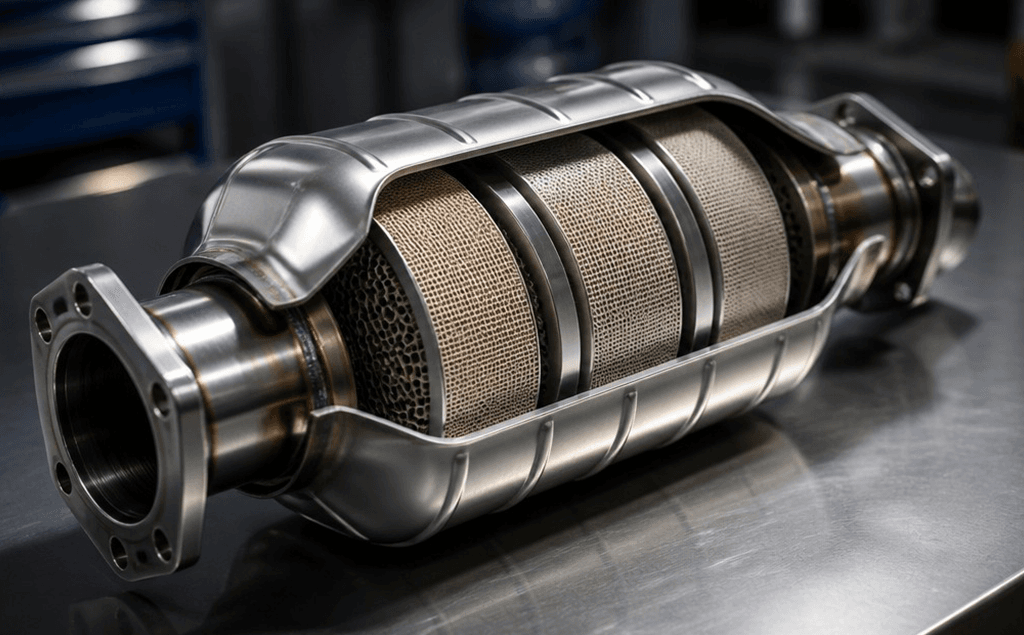
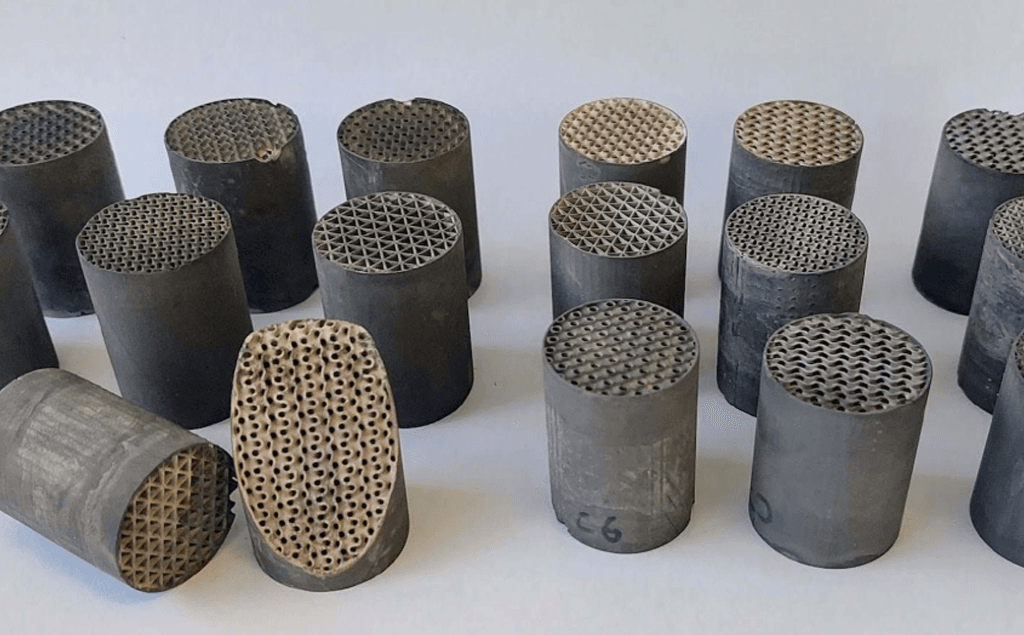
Inside the converter shell sits a dense ceramic or metallic honeycomb structure known as the substrate. Manufacturers coat this substrate with a porous “washcoat” containing microscopic particles of precious metals—specifically platinum, palladium, and rhodium. These metals act as catalysts. They accelerate chemical reactions without being consumed in the process.
As hot exhaust gases rush through thousands of tiny substrate channels, two distinct chemical phases occur:
- Reduction Phase: Rhodium and platinum strip oxygen atoms away from nitrogen oxide molecules ($\text{NO}_x$). This reaction breaks harmful smog-forming gases down into harmless elemental nitrogen ($\text{N}_2$) and oxygen ($\text{O}_2$).
- Oxidation Phase: Platinum and palladium burn off remaining carbon monoxide ($\text{CO}$) and unburned hydrocarbons ($\text{HC}$) by combining them with excess oxygen. This oxidation step converts toxic gases into carbon dioxide ($\text{CO}_2$) and water vapor ($\text{H}_2\text{O}$).
For these reactions to achieve peak efficiency, the converter must reach its “light-off” temperature—typically between 400°F and 600°F (204°C to 315°C). Cold exhaust gases pass through the honeycomb untreated until engine heat brings the precious metal washcoat up to operating temperature.
The Vital Role of Air-Fuel Ratio and Oxygen Sensors
А трехкомпонентный каталитический нейтрализатор cannot clean exhaust gases effectively unless the engine maintains a precise air-fuel mixture. Modern Engine Control Units (ECUs) constantly adjust fuel injector pulse widths to hold the air-fuel ratio right around the stoichiometric point of 14.7 parts air to 1 part fuel.
Two heated oxygen ($\text{O}_2$) sensors monitor this chemical balance in real time:
- Upstream Oxygen Sensor (Sensor 1): Positioned ahead of the converter, this sensor measures raw oxygen levels exiting the exhaust manifold. It sends rapid voltage fluctuations to the ECU, instructing the computer to add or subtract fuel.
- Downstream Oxygen Sensor (Sensor 2): Mounted behind the converter, this sensor verifies catalytic efficiency. A healthy трехкомпонентный каталитический нейтрализатор consumes oxygen during the oxidation phase, so the downstream sensor outputs a steady, flat voltage signal.
If you install an undersized or low-grade converter with insufficient precious metal loading, oxygen passes straight through the substrate unconsumed. The downstream sensor then mimics the upstream sensor’s rapid switching pattern. The ECU immediately detects this failure and illuminates the Check Engine Light with a P0420 или P0430 catalyst efficiency trouble code.
Core Components of an Exhaust Converter Assembly
Understanding physical fitment requires inspecting how manufacturers construct a complete трехкомпонентный каталитический нейтрализатор assembly. Four primary elements dictate both durability and mechanical compatibility.
1. The Outer Stainless-Steel Shell
Manufacturers stamp the outer body from corrosion-resistant 409 or 304 stainless steel. This shell shields the fragile internal core from road debris, thermal shock, and moisture. Exhaust engineers shape the inlet and outlet cones carefully to distribute exhaust gas evenly across the entire face of the honeycomb core. Poor cone geometry funnels gas solely into the center of the substrate, causing localized overheating and premature core meltdown.
2. The Monolith Substrate
The substrate provides the surface area necessary for chemical catalysis. Most passenger vehicles use a cordierite ceramic monolith extruded with 400 to 600 cells per square inch (CPSI). High-performance and heavy-duty applications often use a brazed metallic foil substrate. Metallic cores feature thinner walls, resist vibration damage better, and flow more exhaust gas with lower backpressure.
3. The Intumescent Mounting Mat
Ceramic substrates expand at a much slower rate than the surrounding steel shell when heated to 1,200°F. To prevent the ceramic brick from rattling loose and shattering, manufacturers wrap the monolith in a specialized intumescent vermiculite mat. As exhaust heat rises, this mat expands outward, locking the fragile ceramic core tightly inside the steel housing while insulating the outer shell.
4. Precious Metal Washcoat (PGMs)
The washcoat applies a rough, microscopic texture to the smooth substrate walls, expanding the total reactive surface area to the size of several football fields. Manufacturers impregnate this washcoat with Platinum Group Metals (PGMs). Higher PGM loading increases oxygen storage capacity, speeds up light-off times, and prevents the ECU from triggering efficiency fault codes.
Comparing Converter Specifications: OEM vs. Aftermarket
Not all replacement converters deliver identical chemical performance. Choosing between Original Equipment Manufacturer (OEM), Агентство по охране окружающей среды-compliant aftermarket, and УГЛЕВОД-compliant units involves major trade-offs in precious metal density and longevity.
| Specification Metric | OEM-заменитель преобразователя | CARB-Compliant Aftermarket | Federal EPA Aftermarket |
|---|---|---|---|
| Загрузка драгоценных металлов | Maximum factory specification | High (matches OEM thresholds) | Minimum legal baseline |
| Substrate Cell Density | 400–600 CPSI (application specific) | 400–600 CPSI | Typically 300–400 CPSI |
| Емкость хранилища кислорода | Engineered for strict ECU tolerances | High capacity; prevents P0420 codes | Moderate; may trigger sensitive ECUs |
| Emissions Certification | 50-State Legal | Legal in CA, NY, CO, and CARB states | Legal in 49/46 non-CARB states only |
| Expected Service Life | 100,000+ miles (with healthy engine) | 80,000–100,000 miles | 30,000–50,000 miles |
As the comparison shows, modern vehicles equipped with tight-tolerance OBD-II diagnostics often reject low-cost Federal aftermarket units. Matching the converter’s oxygen storage capacity to your ECU’s programming prevents repeat repair costs.
3 Steps to Ensure Your Replacement Converter Matches Your Engine
Solving the fitment puzzle requires systematic verification before you order parts or weld pipes. Follow these three engineering steps to guarantee seamless physical and chemical compatibility.
Step 1: Match Engine Displacement, Weight Class, and Emissions Tier
Каждый трехкомпонентный каталитический нейтрализатор carries an official certification rating tied to specific engine parameters. Check the Vehicle Emission Control Information (VECI) label under your hood before shopping.
- Verify Engine Family and Liter Size: A converter rated for a 2.0-liter four-cylinder engine lacks the thermal mass and catalyst surface area to clean exhaust from a 5.3-liter V8. Overloading an undersized core creates excessive exhaust backpressure, drops horsepower, and melts the substrate.
- Confirm Gross Vehicle Weight Rating (GVWR): Trucks and SUVs haul heavier loads and sustain higher exhaust gas temperatures than passenger sedans. Always select a converter certified for your vehicle’s exact weight class.
- Check Regional Compliance Laws: Determine whether your vehicle requires Federal EPA certification or strict California Air Resources Board (CARB) Executive Order (EO) approval. Installing an EPA-only converter on a CARB-certified vehicle violates federal emissions law and fails smog inspection immediately.
Step 2: Verify Physical Geometry, Flange Angles, and Sensor Bungs
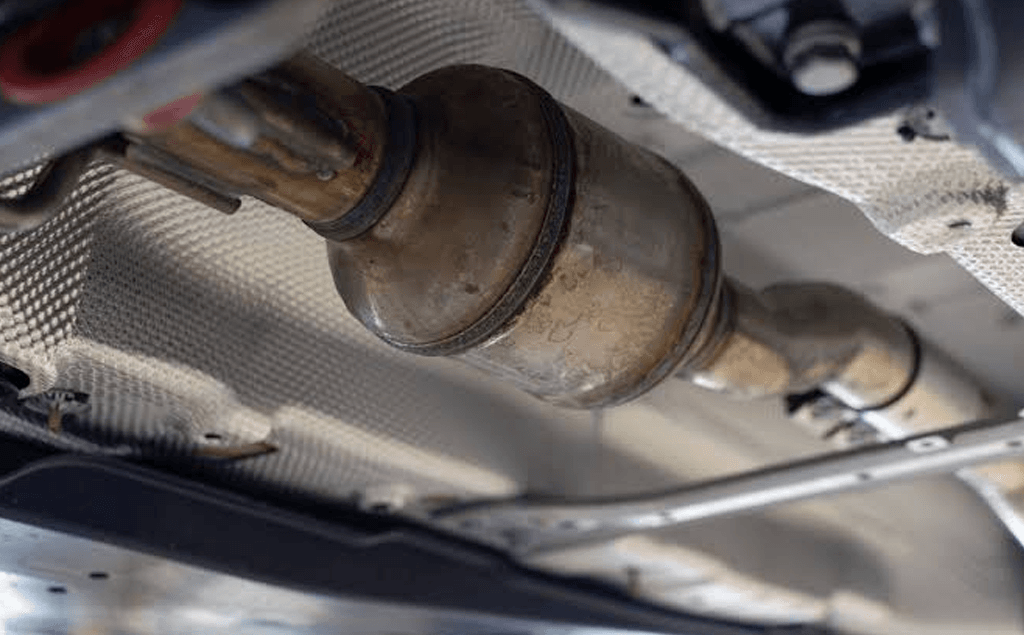
Direct-fit converters bolt directly into factory exhaust hangers without cutting or welding, whereas universal converters require custom fabrication. Measure every mechanical interface carefully:
- Pipe Diameter and Flange Orientation: Confirm outer and inner pipe diameters (common sizes include 2.0, 2.25, 2.5, and 3.0 inches). Check bolt-hole spacing and flange angles on manifold-mounted converters (“mani-cats”) to ensure stress-free alignment against cylinder head studs.
- Oxygen Sensor Bung Placement: Verify that upstream and downstream $\text{O}_2$ sensor bungs sit at the exact factory distance and clock angle. Moving a sensor bung even two inches alters exhaust gas velocity and temperature at the sensor tip, skewing fuel trim calculations.
- Heat Shield and Chassis Clearance: Ensure the replacement housing includes integrated heat shields if the factory unit sits near floor pans, fuel lines, or rubber transmission mounts.
Step 3: Diagnose Root Engine Faults Before Installation
А трехкомпонентный каталитический нейтрализатор rarely fails from old age alone; upstream engine problems almost always destroy it. Installing a brand-new converter onto a poorly running engine will ruin the replacement unit within weeks. Resolve these underlying issues first:
- Пропуски зажигания в двигателе: Unburned fuel from a dead ignition coil or fouled spark plug dumps straight into the hot exhaust manifold. That raw fuel ignites inside the converter core, spiking internal temperatures past 2,000°F and melting the ceramic honeycomb into a solid block.
- Oil or Coolant Consumption: Worn piston rings, leaking valve seals, or a blown head gasket introduce phosphorus, zinc, and silicates into the exhaust stream. These chemical contaminants coat the precious metal washcoat, permanently “poisoning” the catalyst and halting chemical conversion.
- Rich Fuel Trims: Leaking fuel injectors, a stuck-open purge valve, or a skewed Mass Airflow (MAF) sensor flood the catalyst with excess carbon monoxide, overheating the substrate during oxidation.
Direct-Fit vs. Universal Converters: Which Should You Choose?
Mechanics frequently weigh cost against installation speed when selecting a replacement unit. The table below outlines the practical differences between direct-fit assemblies and universal weld-in canisters.
| Особенность | Direct-Fit Catalytic Converter | Универсальный каталитический нейтрализатор |
|---|---|---|
| Installation Method | Bolt-on using factory flanges and hangers | Requires cutting, pipe sizing, and welding |
| Sensor Bung Integration | Pre-welded in exact OEM locations | May lack bungs; requires bung welding |
| Точность подгонки | Engineered to match chassis clearances | Requires careful technician alignment |
| Labor Time | 1 to 2 hours | 2 to 4+ hours |
| Best Use Case | Modern OBD-II cars and manifold-integrated units | Older vehicles or custom exhaust systems |
Заключение
Matching a replacement трехкомпонентный каталитический нейтрализатор to your engine requires far more than matching exhaust pipe diameters. You must align the unit’s precious metal loading, substrate capacity, and emissions certification with your engine’s displacement and ECU programming. By verifying your under-hood emissions tier, confirming exact flange and oxygen sensor geometry, and eliminating upstream engine misfires or fluid leaks before installation, you protect your investment. Following these three steps restores clean tailpipe emissions, maintains factory engine power, and keeps your dashboard free of trouble codes for years to come.