Введение
When a Peugeot 307 triggers an “anti-pollution fault,” it often signals a failure or inefficiency in the трехкомпонентный каталитический нейтрализатор system. This fault can degrade engine performance, increase emissions, and lead to costly repairs or fines in regions with strict emission testing. In this article, we explore how to diagnose and fix the anti-pollution fault in a Peugeot 307—focusing especially on the role of the three-way catalytic converter. We examine component function, inspection steps, replacement options, cost considerations, and best practices. This rewrite emphasizes clarity, accuracy, short sentences, and active voice to deliver a technical but accessible guide for mechanics, hobbyists, and car owners.
Understanding the Three Way Catalytic Converter in a Peugeot 307
What Is a Three Way Catalytic Converter?
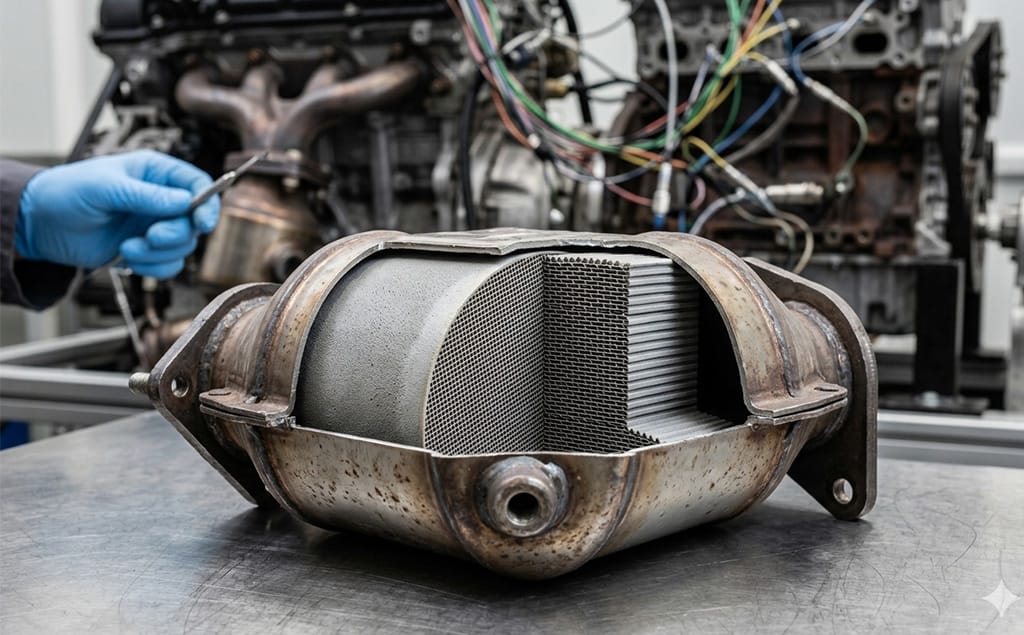
A three way catalytic converter (TWCC) performs three chemical reactions simultaneously. It converts:
- Carbon monoxide (CO) → carbon dioxide (CO₂)
- Hydrocarbons (HC) → water (H₂O) + CO₂
- Nitrogen oxides (NOₓ) → nitrogen (N₂) + oxygen (O₂)
Hence the term “three way.” In petrol (gasoline) engines, this converter acts on all three pollutants in one unit.
In the Peugeot 307, a direct-fit three way catalytic converter attaches to the exhaust system without modifications. It preserves the original routing, mounting points, and sensors. It integrates with oxygen (O₂) sensors upstream and downstream to monitor catalytic efficiency and emissions.
Why the Peugeot 307 Needs It
- Emission laws in many countries require vehicles to maintain low NOₓ, CO, and HC emissions.
- The 307’s engine control unit (ECU) monitors O₂ sensor readings and detects deviations in converter efficiency. If efficiency falls below thresholds, the ECU logs an “anti-pollution fault.”
- A faulty converter can cause poor fuel economy, rough idle, stalling, and engine limp mode.
- Many regions require that the converter pass emissions inspection; failing that test may prevent vehicle registration.

Causes of an Anti-Pollution Fault in the Peugeot 307
Here are common reasons why the fault may occur:
- Aging or wear: Over time, the catalyst substrate degrades, reducing conversion efficiency.
- Thermal damage: Overheating (e.g. from misfire or clogged converter) can melt the internal substrate or washcoat.
- Физический ущерб: Impacts, corrosion, or broken internal structures can impair function.
- Загрязнение: Oil, coolant, or fuel additives that poison the catalyst reduce its performance.
- Sensor fault or wiring issue: Upstream or downstream O₂ sensors may fail or have wiring shorts/opens, leading to incorrect reading.
- Exhaust leaks: Leaks upstream of the converter can allow fresh air into the exhaust, disrupting sensor readings.
- Engine faults: Misfires, rich or lean running, or excessive hydrocarbon loads can overload the converter.
Because many of these issues are secondary to other problems, you should check other systems before replacing the converter.
Step-by-Step Diagnosis to Pinpoint the Fault
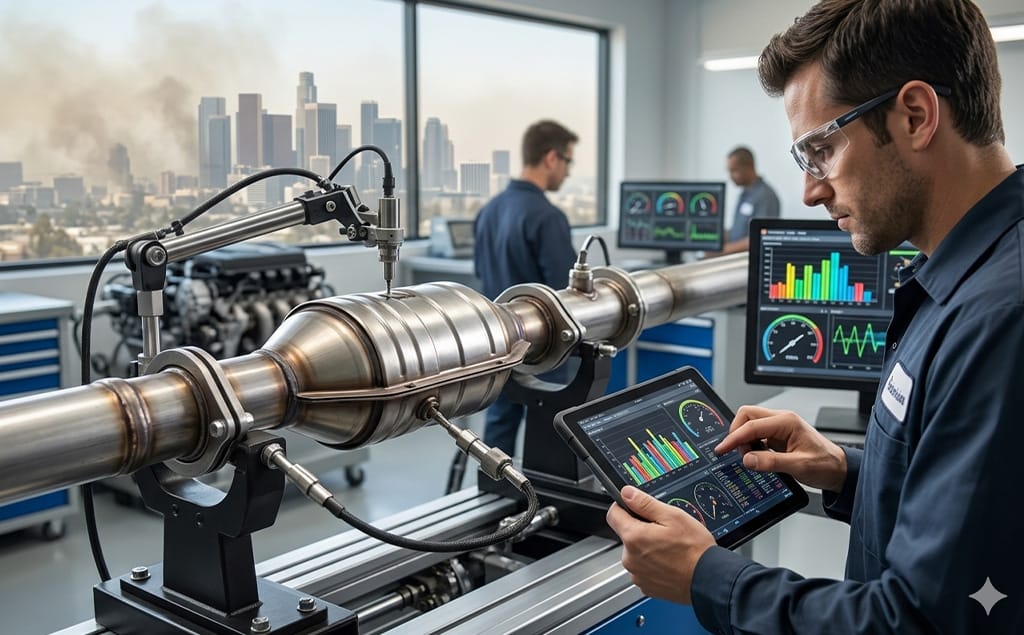
Below is a recommended diagnostic sequence:
| Шаг | Действие | What You Look For / Expected Outcome |
|---|---|---|
| 1 | Read fault codes via OBD scanner | The anti-pollution fault often appears as a P0420 / P0430 (catalyst efficiency low) or manufacturer-specific code |
| 2 | Inspect O₂ sensors and wiring | Check connectors, wiring integrity, sensor voltages |
| 3 | Perform backpressure / exhaust restriction test | High backpressure suggests clogging inside converter |
| 4 | Check for exhaust leaks | Leaks can introduce unmetered air and upset readings |
| 5 | Monitor live O₂ sensor data | The downstream sensor should show lower variability if the converter works; flat line or identical to upstream suggests failure |
| 6 | Inspect for physical damage | Look under car for dents, local overheating, signs of melted internals |
| 7 | Check engine condition | Confirm no misfires, correct fuel trim, no oil or coolant leaks into the combustion chamber |
| 8 | Decide whether to repair or replace | If internal damage or inefficiency exists, replacement is usually the only fix |
Extra paragraph (subtitle: The importance of O₂ sensor behavior): When diagnosing, pay attention to the behavior of both oxygen sensors. The upstream (pre-converter) sensor should fluctuate rapidly as the ECU adjusts the air/fuel ratio. The downstream (post-converter) sensor should have a more steady, smoother response if the converter works well. If the downstream sensor mirrors upstream responses too closely, the converter isn’t altering the gas composition as expected. This gives a clear sign that catalyst performance has degraded.
Replacement: Selecting the Right Three Way Catalytic Converter
When you confirm that the converter fails, you must choose a replacement. Here’s what to consider.
Direct-Fit vs Universal Converters
- Прямая посадка units bolt into the original exhaust layout. You avoid cutting, welding, or pipe modification. They incorporate the correct sensor bungs and mounting.
- Универсальный converters use straight pipe segments. You cut and weld to fit. Universal often cost less but require fabrication work.
For the Peugeot 307, direct-fit gives simplicity and preserves compliance.
OEM vs Aftermarket
- OEM (производитель оригинального оборудования) offers a factory equivalent quality, often required to maintain compliance under warranty or emissions regulations.
- Вторичный рынок can offer cost savings or slightly higher flow designs. But quality varies.
If the car still falls under emissions warranty or you live in a strict regulatory region, choose OEM or “emissions-legal” aftermarket brands. Otherwise, reputable aftermarket brands like BM Catalysts, FA1, or Walker offer viable alternatives.
Emission Compliance: CARB / EPA / Euro Standards
Where you live matters. You must confirm:
- Whether your state or country mandates a CARB-compliant part (for instance, California in the US).
- Whether EPA-compliant or Euro emissions standards apply.
- That the converter has certification or label marking meeting the standards.
If you install a noncompliant converter, you may fail inspection or violate laws.
Material and Construction
Typically, converters use:
- Stainless steel housing to resist corrosion
- A ceramic or metallic substrate coated with precious catalysts (platinum, palladium, rhodium)
- Proper heat shielding and preheating design
In high-performance variants, manufacturers sometimes use higher flow cores or thinner substrates (but these may reduce longevity or compliance).
Installation Guide and Cost Considerations
Labor and Time
A trained mechanic typically replaces the converter in 1 to 2 hours. Complexity can rise if rust, broken bolts, or structural damage exists.
Labor rates vary by region and shop, typically $70 to $130 per hour in many regions.
Part Costs
Part cost depends on brand, material, compliance certification, and quality:
- Basic aftermarket direct-fit: ~$300–$800
- OEM equivalent: ~$700–$1,500
- High end or performance converters: up to $2,500
Combined with labor, the total job cost often lands between $400 and $2,800, depending on your location and converter choice.
Installation Steps (Active Voice)
- Disconnect the battery to avoid electrical hazards.
- Raise and support the vehicle safely.
- Remove heat shields, if present, to expose the converter.
- Unbolt the upstream and downstream flanges or clamps.
- Remove the old converter. If bolts are seized, apply penetrating oil or heat.
- Inspect mating surfaces and clean flange faces.
- Position the new converter. Ensure the flanges and sensor ports align.
- Tighten bolts or clamps to factory torque specs.
- Reinstall heat shields.
- Reconnect the battery.
- Clear fault codes from the ECU and perform a test drive.
- Monitor O₂ sensor readings to confirm conversion behavior.
During installation, always use new gaskets and hardware when recommended.
Extra Section: Common Mistakes and Preventive Measures
Mistakes to Avoid
- Installing noncompliant converters (illegal or fails inspection)
- Reusing damaged gaskets or hardware
- Ignoring O₂ sensor condition and wiring issues
- Driving with a known misfire or fuel system fault and then replacing the converter (you’ll damage the new converter too)
- Failing to adapt ECU or reset codes properly after installation
Preventive Measures to Extend Converter Life
- Use high-quality fuel and avoid fuel contamination
- Maintain the ignition system (spark plugs, coils) to prevent misfires
- Keep oil and coolant systems healthy (no leaks into combustion chamber)
- Avoid aftermarket tuning that leans mixture aggressively
- Inspect the exhaust system and sensors periodically
Comparison Table of Converter Options for Peugeot 307
| Option Type | Pros | Cons | Best Use Case |
|---|---|---|---|
| OEM direct-fit three way converter | Guaranteed fit, emissions legal, high reliability | Highest cost | Vehicles under warranty or regulated inspection zones |
| Aftermarket direct-fit certified (CARB/EPA) | Good balance of cost and quality | Slight variation in quality | Most common replacement scenario |
| Performance / high-flow converter | Potential power gains, better flow | May shorten lifespan or reduce compliance | Racing or modified engines (if legal) |
| Universal converter + fabrication | Lowest part cost | Requires cutting / welding, custom work | Budget builds or nonstandard exhaust layouts |
Detailed Example: Peugeot 307 1.6L Application
For the Peugeot 307 1.6L gasoline engine, the factory converter integrates seamlessly with the original exhaust geometry. It handles both harmful gases and some particulate matter, functioning as the central pollution control device. When the ECU detects poor catalytic behavior (by comparing upstream and downstream O₂ sensor signals), it triggers the anti-pollution fault.
The replacement can be either OEM or aftermarket, but you must ensure compatibility with the sensor locations, flange angles, and emissions certification. Using a direct-fit three way catalytic converter ensures you do not alter the geometry or sensor positioning.
Real-World Scenario: Diagnosing a Fault in Practice
Suppose a driver gets “anti-pollution fault” and a rough idle. Using an OBD scanner, you find a P0420 code (catalyst efficiency low bank 1). You monitor O₂ sensors and see:
- Upstream sensor (pre-converter) oscillates between 0.1V and 0.9V — normal.
- Downstream sensor lags too much or duplicates upstream fluctuations.
That indicates the converter fails to smooth composition. You perform backpressure test and detect high resistance. You inspect for leaks—none exist. You check the engine: no misfires or fuel trim anomalies.
You decide to replace. You select a direct-fit aftermarket converter with EPA certification. You install it with new gaskets, torque the bolts correctly, reset ECU codes, and test drive. After installation, O₂ sensor readings show appropriate lag, and the code does not return. Emissions test passes.
Заключение
Repairing an anti-pollution fault in a Peugeot 307 demands a clear understanding of how the трехкомпонентный каталитический нейтрализатор works, how the ECU monitors it, and how to diagnose failures. By following a systematic process—scanning codes, checking sensors, testing exhaust flow, and assessing engine health—you can distinguish whether the converter truly fails or other systems cause the fault. When replacement becomes necessary, choosing a quality direct-fit, emissions-compliant three way catalytic converter ensures proper performance, legal compliance, and longevity. Install with care, reset fault codes, and test. With proper diagnosis and components, you restore reliable emissions control and avoid repeated faults.