การแนะนำ
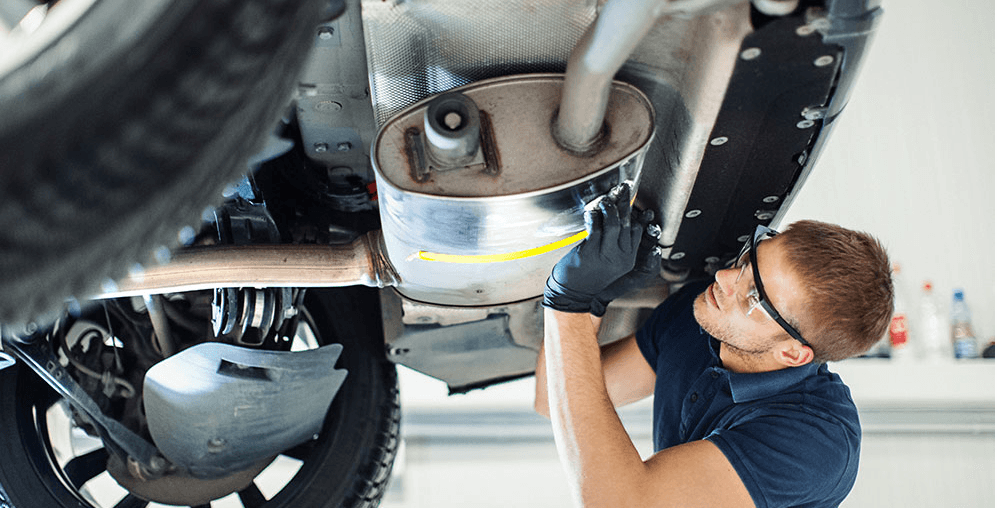
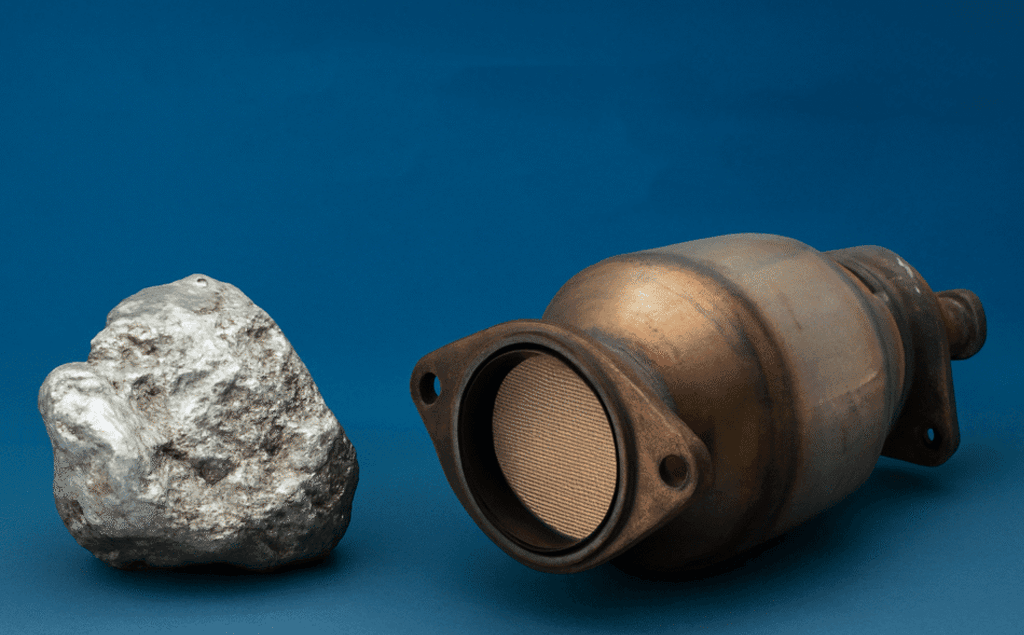
Most drivers never think about what happens inside a ตัวเร่งปฏิกิริยาสามทาง. Mounted on the car’s underbelly, it goes about its business quietly while the engine runs. But inside that small metal housing lies a highly capital-intensive chemical process.
Rhodium belongs to the โลหะกลุ่มแพลทินัม, yet even among its elite peers, it stands out as an exceptional anomaly.Not platinum. Not palladium. Rhodium.
Without it, modern emission standards would be extremely difficult to meet. That alone already explains part of its value. But there is another side—supply. Rhodium is extremely rare, and the market has no easy way to increase production.
These two things together—function and scarcity—are what drive its price and make catalytic converters valuable in recycling.especially when evaluating catalytic converter scrap value.
Rhodium is not a common industrial metal
Rhodium belongs to the platinum group metals, but even inside that group it stands out.
It is not mined directly in any meaningful amount. Miners usually recover it as a secondary material when they process platinum or nickel ores. That already limits supply. You cannot simply “turn up production” when demand rises.
Another point people often miss: rhodium survives inside extremely harsh conditions. Exhaust gas inside a ตัวเร่งปฏิกิริยาสามทาง can easily reach temperatures where most metals would deform or lose activity. Rhodium stays stable.
So in practice, it becomes a long-life reaction surface rather than a consumed material.
What actually happens inside a three way catalytic converter
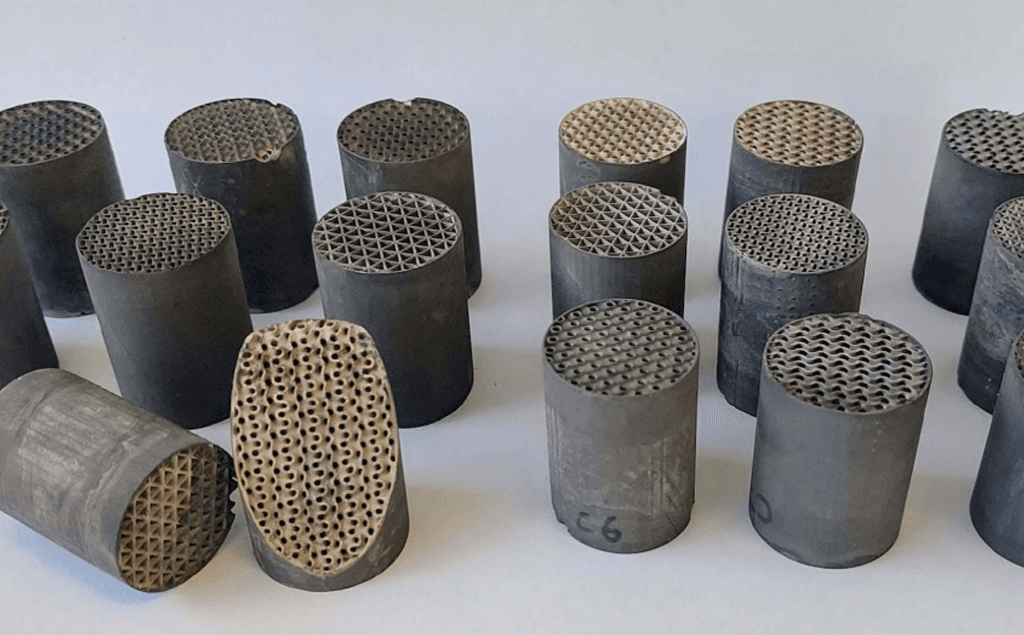
เอ ตัวเร่งปฏิกิริยาสามทาง is doing three reactions at the same time:
- Carbon monoxide gets converted into CO₂
- Hydrocarbons get converted into CO₂ and water
- Nitrogen oxides (NOx) get broken down into nitrogen and oxygen
The first two are relatively straightforward. Platinum and palladium handle those pretty well.
The third one is where things get complicated.
NOx is stable. It does not break apart easily under normal exhaust conditions. That is where rhodium becomes necessary.
Inside the converter, rhodium interacts with NOx molecules and helps split them into nitrogen and oxygen. That is the part of the system that no other commonly used metal can fully replace at scale.
Why the system depends on a combination of metals
เอ ตัวเร่งปฏิกิริยาสามทาง is not built around a single metal. It is a combination system.
Each metal has a job:
- Platinum handles CO oxidation
- Palladium handles hydrocarbon oxidation
- Rhodium handles NOx reduction
If you remove one of them, the system still works—but not fully. If you remove rhodium, the converter may still oxidize gases, but NOx emissions rise quickly.
That is why manufacturers cannot easily eliminate rhodium even when prices spike.
Table: How the metals behave differently
| โลหะ | Main Role | Strength in real use | Weak point |
|---|---|---|---|
| แพลตตินัม | CO oxidation | Stable and durable | Weak NOx control |
| แพลเลเดียม | การออกซิเดชันของไฮโดรคาร์บอน | Cost efficient | Limited reduction ability |
| โรเดียม | การลด NOx | Very strong catalytic power | Extremely rare |
Rhodium is the smallest portion by weight, but often the most critical part of emissions compliance.This is explained in more detail in the platinum palladium rhodium comparison.
Why rhodium supply is so limited
There is no large rhodium mine. That is the first problem.
Most of it comes from a few mining regions, mainly as a byproduct. So production depends on other metals being mined first. That creates a natural bottleneck.
Even if demand doubles, supply cannot respond quickly. It is not like manufacturing a chemical in a factory. It depends on geology, mining output, and refining capacity.
This is also why catalytic converter recycling became such an important secondary source of rhodium.especially through the catalytic converter recycling process.
Why rhodium is expensive in real markets
The price is not stable, and it rarely behaves like a normal commodity.
A few real drivers matter:
- Tight emission regulations increase usage per vehicle
- Mining output stays relatively fixed
- Recycling supply changes slowly
- Automotive industry consumes most of it
When regulations tighten, automakers often increase rhodium loading in a ตัวเร่งปฏิกิริยาสามทาง. That immediately pushes demand higher.
But supply cannot adjust quickly. That gap creates price spikes.
How much rhodium is actually inside a converter
The amount is very small. In most cases, it is measured in fractions of a gram.
But this is where scale matters.
One converter is nothing. Millions of vehicles become a large global pool of rhodium.
That is why recyclers pay attention even to tiny differences in metal content. A slight change in loading can significantly affect scrap value.
How rhodium affects scrap catalytic converter value
When recyclers evaluate a catalytic converter, they do not look at size or shape. They look at metal content.which directly impacts catalytic converter scrap value.
Rhodium is one of the main value drivers, along with platinum and palladium.
Common evaluation methods include:
- XRF scanning (quick surface estimation)
- Database lookup based on OEM codes
- Lab sampling for confirmation
- Smelting and refining tests for final accuracy
Even small errors in estimation can change profitability, so recyclers usually combine multiple methods.
Recycling is not just cost-driven anymore
There is also a supply reason behind recycling.
Mining rhodium requires processing massive amounts of ore for very small yield. Recycling skips that step.
A used ตัวเร่งปฏิกิริยาสามทาง already contains concentrated PGMs. That makes it a much more efficient input material compared to raw ore.
So recycling is not just cheaper—it is structurally more efficient.
Why rhodium cannot be easily replaced
There have been attempts to reduce rhodium usage, especially when prices spike. But in real driving conditions, NOx reduction performance drops without it.
Engine conditions are not stable. Temperature changes. Oxygen levels fluctuate. Acceleration and cold starts create irregular exhaust patterns.
Rhodium performs consistently across those variations. That is the key reason it stays in the system.
At the moment, no alternative material fully matches that behavior at scale.
Future demand is still tied to combustion engines
Even with EV growth, ตัวเร่งปฏิกิริยาสามทาง are not disappearing quickly.
Hybrid vehicles still use them. Many global markets still rely heavily on gasoline engines.
Emission standards are also getting stricter, not looser.
So even if total vehicle mix changes, demand for rhodium inside catalytic converters will remain structurally important.especially under tightening emissions standards เช่น สำนักงานปกป้องสิ่งแวดล้อมแห่งสหรัฐอเมริกา and Euro 7 regulations.
บทสรุป
Rhodium is not valuable just because it is rare. It is valuable because it solves a problem that is still difficult to replace—NOx reduction inside a ตัวเร่งปฏิกิริยาสามทาง under real engine conditions.
At the same time, supply is naturally limited, and recycling has become an important part of keeping the system running.
That combination—technical necessity plus supply constraint—is what keeps rhodium at the center of catalytic converter value.