giriiş
Modern automotive engineering relies heavily on efficient emissions control. The üç yollu katalitik konvertör stands as the most critical component in this effort. This device transforms toxic engine exhaust into harmless gases through complex chemical reactions. To function correctly, the catalyst requires a robust physical foundation known as a substrate. Engineers must select the right substrate material to ensure the üç yollu katalitik konvertör meets strict environmental regulations and durability standards. This guide explores the materials, engineering criteria, and manufacturing processes that define high-performance catalyst supports. We focus on how these choices impact the efficiency of the üç yollu katalitik konvertör in diverse operating environments.
The Fundamental Role of the Three Way Catalytic Converter
The üç yollu katalitik konvertör manages three primary pollutants: carbon monoxide (CO), unburned hydrocarbons (HC), and nitrogen oxides (NOx). It performs oxidation and reduction reactions simultaneously. This dual functionality requires a precise balance of temperature, gas flow, and surface chemistry.
Platinum, palladium, and rhodium serve as the active noble metals in the üç yollu katalitik konvertör. These metals facilitate the conversion of CO and HC into carbon dioxide and water. Simultaneously, they reduce NOx into nitrogen gas and oxygen. However, these expensive metals cannot float freely in the exhaust stream. They require a substrate with a massive surface area to maximize contact with exhaust gases. The substrate provides the structural integrity and surface geometry necessary for the üç yollu katalitik konvertör to thrive under the vehicle’s hood.

Comprehensive Catalyst Substrate Material Overview
Material selection dictates the thermal, mechanical, and chemical performance of the system. Engineers primarily choose between ceramic and metallic options for the üç yollu katalitik konvertör.
1. Ceramic (Synthetic Cordierite)
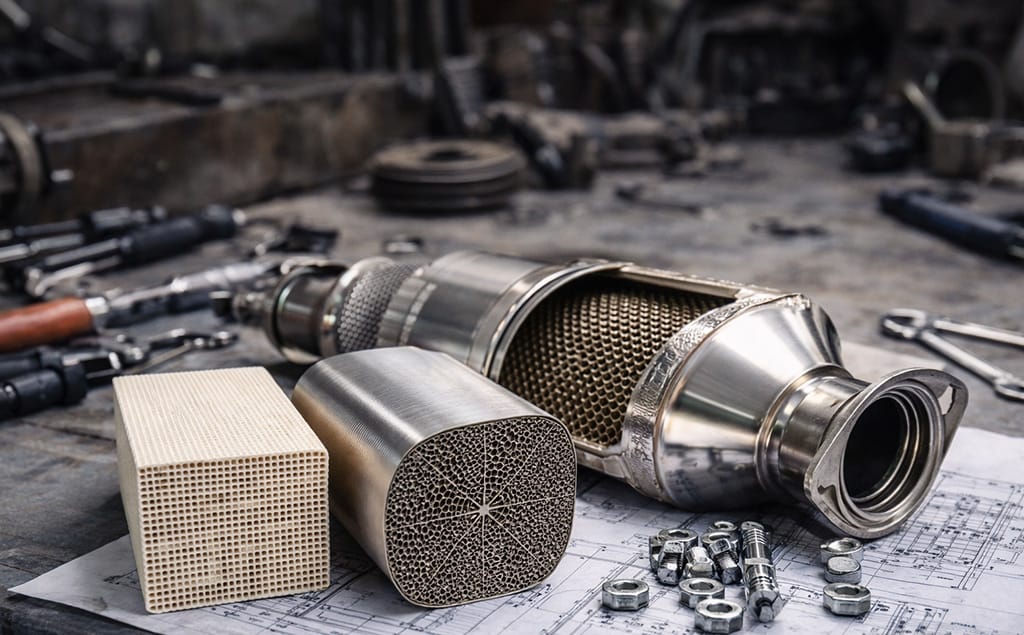
Cordierite remains the industry standard for the üç yollu katalitik konvertör. It consists of magnesium oxide, alumina, and silica. This ceramic material offers a remarkably low thermal expansion coefficient. In the axial direction, this value stays below (1 \times 10^{-6}/^{\circ}C). This property grants the material superior thermal shock resistance. Cordierite substrates survive the rapid temperature swings common in daily driving. They are cost-effective and provide a stable surface for washcoat adhesion.
2. Metallic Foil Substrates
Metallic substrates usually utilize ferritic stainless steel, such as AISI 409 or 439. These substrates offer unique advantages for high-performance üç yollu katalitik konvertör applications. Metal foils allow for thinner walls compared to ceramic structures. Thinner walls result in a larger open frontal area (OFA) and lower backpressure. Metal also conducts heat more quickly than ceramic. This characteristic allows the üç yollu katalitik konvertör to reach “light-off” temperature faster, reducing cold-start emissions.
3. Silicon Carbide (SiC)
SiC enters the frame for demanding environments involving extreme vibration or ultra-high temperatures. It possesses higher mechanical strength and better thermal conductivity than cordierite. While more expensive, SiC substrates offer unmatched durability in heavy-duty üç yollu katalitik konvertör systems.
4. Alumina ((Al{2}O{3}))
Industrial applications often use alumina-based supports. Alumina provides a high surface area and structural robustness. While less common in standard passenger car üç yollu katalitik konvertörler, it remains vital for industrial emissions control and hydrogenation processes.

Critical Engineering Criteria for Substrate Selection
Choosing a material requires a deep understanding of the operating environment. Designers evaluate several key factors to ensure the üç yollu katalitik konvertör functions for the life of the vehicle.
- Thermal Shock Resistance: Exhaust temperatures can jump from 20°C to 800°C in seconds. The material must expand and contract without cracking. Ceramics excel here due to their low expansion rates.
- Mechanical Durability: The üç yollu katalitik konvertör sits in a high-vibration environment. Metallic substrates offer better resistance to physical impacts and road debris than brittle ceramic monoliths.
- Open Frontal Area (OFA): A high OFA reduces the restriction of gas flow. This improves engine power and fuel efficiency. Metal substrates typically achieve higher OFA than ceramic ones.
- Geometric Surface Area (GSA): A larger GSA allows more space for the catalyst washcoat. This maximizes the reaction sites available for the üç yollu katalitik konvertör to process pollutants.
- Thermal Mass: Low thermal mass is ideal. It enables the üç yollu katalitik konvertör to heat up rapidly using the energy from the exhaust gas.
Comparison of Substrate Technologies
The following table summarizes the performance metrics of the most common materials used in the üç yollu katalitik konvertör industry.
| Özellik | Cordierite (Ceramic) | Metallic Foil (Stainless) | Silicon Carbide (SiC) |
|---|---|---|---|
| Thermal Expansion | Ultra-Low | Yüksek | Ilıman |
| Max Operating Temp | ~1200°C+ | ~500°C – 1000°C | ~1400°C |
| Duvar Kalınlığı | Standard (thick) | Very Thin | Ilıman |
| Geri basınç | Ilıman | Düşük | Ilıman |
| Manufacturing Cost | Düşük | Yüksek | Çok Yüksek |
| Termal Şok | Harika | İyi | Ilıman |
| Vibration Resistance | Fair | Harika | İyi |
The Intricate Manufacturing Process of Ceramic Substrates
Manufacturing a ceramic substrate for a üç yollu katalitik konvertör involves high-precision extrusion. The process begins with raw materials: talc, alumina, silica, and kaolinite clay. Technicians grind these materials into a fine powder and mix them with a water-based paste.
During mixing, they add lubricants like ethylene glycol and bonding agents like methylcellulose. The mixture passes through a high-pressure extrusion die. This die creates the characteristic honeycomb structure of the üç yollu katalitik konvertör substrate. After extrusion, the “green” parts undergo drying and cutting.
Finally, the parts enter a kiln for calcination. This process occurs at temperatures exceeding 1400°C. During calcination, the minerals fuse into synthetic cordierite. The material shrinks slightly during this stage. Manufacturers must calculate this shrinkage precisely to meet final dimensional specifications. For large-scale üç yollu katalitik konvertör units, workers may machine the contours and apply an outer ceramic skin after the initial firing to ensure a perfect fit in the metal housing.
The Critical Synergy Between Washcoat and Substrate Architecture
The substrate provides the skeleton, but the washcoat provides the lungs of the üç yollu katalitik konvertör. The washcoat is a porous layer applied to the substrate walls. It usually contains aluminum oxide, cerium oxide, and zirconium oxide. This layer creates a massive internal surface area for the noble metals.
A high-quality washcoat must bond perfectly with the substrate of the üç yollu katalitik konvertör. If the washcoat peels off (delamination), the converter fails. Therefore, engineers match the chemical properties of the substrate to the washcoat formula. This synergy ensures the üç yollu katalitik konvertör maintains high conversion efficiency over 150,000 miles or more.
The porous nature of the washcoat increases the effective surface area by a factor of 7,000 or more. This allows the üç yollu katalitik konvertör to utilize minimal amounts of precious metals like Rhodium. Furthermore, the washcoat acts as a stabilizer. It prevents the active metal particles from moving and clumping together at high temperatures. This design philosophy ensures that the üç yollu katalitik konvertör remains effective even as the vehicle ages.
Understanding Oxygen Storage Capacity (OSC)
Yüksek performanslı üç yollu katalitik konvertör requires Ceria ((CeO_{2})) in the washcoat. Ceria acts as an oxygen reservoir. When the engine runs “rich” (too much fuel), the ceria releases oxygen to oxidize CO and HC. When the engine runs “lean” (too much air), the ceria absorbs excess oxygen to help reduce NOx. This storage capacity allows the üç yollu katalitik konvertör to function even when the air-fuel ratio fluctuates.
Strategic Management of Thermal Transients in Cold-Start Scenarios
Modern hybrid vehicles present new challenges for the üç yollu katalitik konvertör. In a hybrid system, the internal combustion engine turns off frequently. This causes the catalyst temperature to drop below its active range. When the engine restarts, it emits a burst of pollutants.
Engineers now favor metallic substrates or ultra-thin-wall ceramic substrates for these applications. These materials possess lower thermal mass. They regain their operating temperature much faster than traditional heavy substrates. By selecting a substrate with rapid thermal response, manufacturers ensure the üç yollu katalitik konvertör stays active during the stop-start cycles of a hybrid vehicle. This strategic selection directly impacts the vehicle’s ability to pass strict “SULEV” (Super Ultra Low Emission Vehicle) standards.
Moreover, the positioning of the üç yollu katalitik konvertör matters. “Close-coupled” converters sit right next to the engine manifold. This proximity allows the device to capture maximum heat immediately. However, this position also exposes the üç yollu katalitik konvertör to extreme thermal stress. Only materials with high thermal stability can survive in this location without degrading.
Navigating Catalyst Poisoning and Thermal Degradation
HAYIR üç yollu katalitik konvertör lasts forever. Two primary enemies threaten its lifespan: poisoning and sintering. Poisoning occurs when chemicals like sulfur, phosphorus, or lead coat the active sites. These contaminants block the exhaust gases from reaching the noble metals.
Thermal degradation, or sintering, happens during extreme heat events. High temperatures cause the microscopic noble metal particles to clump together. This reduces the available surface area. It also causes the washcoat pores to collapse. Engineers combat this by using stabilized alumina and advanced substrate designs that distribute heat more evenly. A well-designed üç yollu katalitik konvertör substrate prevents local “hot spots,” thereby extending the chemical life of the device.
Industrial Applications Beyond the Automobile
While cars use the majority of üç yollu katalitik konvertör technology, other sectors benefit as well. Large-scale industrial plants use similar honeycomb substrates to treat emissions from stationary engines and turbines. In these cases, the size of the substrate can reach several feet in diameter.
Hydrogenation processes in the chemical industry also utilize alumina-supported catalysts. Fuel cell technology represents another frontier. Fuel cells require carbon-supported metals to manage electrical conductivity. Each of these applications demands a specific substrate material based on the chemical environment and the required lifespan of the system. Even in these non-automotive roles, the principles of the üç yollu katalitik konvertör guide engineers toward cleaner energy solutions.
Optimization of Fluid Dynamics in Converter Design
The geometry of the üç yollu katalitik konvertör substrate affects the flow of exhaust gases. Laminar flow is generally preferred inside the channels. However, the transition from the exhaust pipe to the large face of the substrate often creates turbulence.
Engineers use Computational Fluid Dynamics (CFD) to model this flow. They design the inlet cones of the üç yollu katalitik konvertör to distribute the gas evenly across the entire substrate face. If the gas only flows through the center, the outer edges of the catalyst remain unused. This wastes expensive noble metals and reduces the overall efficiency of the üç yollu katalitik konvertör. Even distribution ensures that every square millimeter of the substrate contributes to the cleaning process.
The Economic Impact of Substrate Choice
The üç yollu katalitik konvertör is one of the most expensive parts of a vehicle’s exhaust system. Noble metal prices fluctuate wildly. Platinum and palladium often cost more than gold. Therefore, substrate efficiency is a financial necessity.
A substrate that offers a higher surface area allows the manufacturer to use less noble metal. By optimizing the substrate geometry, engineers can achieve the same emission results with a lower “loading” of platinum or palladium. This reduction in precious metal usage lowers the total cost of the üç yollu katalitik konvertör without sacrificing environmental performance.
Future Trends in Three Way Catalytic Converter Technology
As emission standards like Euro 7 and China 6b approach, the industry continues to innovate. We are seeing the rise of “electrically heated catalysts” (EHC). These systems use a small metallic substrate connected to the vehicle’s electrical system. It pre-heats the üç yollu katalitik konvertör before the engine even starts.
Furthermore, scientists are investigating nano-structured catalysts and zeolite-based materials. These advanced materials aim to boost reaction rates and provide better resistance to sulfur poisoning. The üç yollu katalitik konvertör Elektrikli araçlara geçiş sürecinde bile, yüksek performanslı katalizör alt tabakası hayati bir teknoloji olarak kalmaya devam edecektir. Hibrit araçlarda ise yüksek performanslı katalizör alt tabakasının önemi giderek artacaktır.
How to Choose the Right Catalyst: A Step-by-Step Guide
Belirli bir uygulama için katalizör seçmek zorlu bir süreç olmak zorunda değil. En iyi sonuçları elde etmek için bu yapılandırılmış yaklaşımı izleyin. üç yollu katalitik konvertör sistem.
- Tepkimeyi tanımlayın: Oksidasyon mu, indirgeme mi yoksa her ikisini birden mi gerçekleştiriyorsunuz? A üç yollu katalitik konvertör Eş zamanlı görevler için gereklidir.
- Çalışma Koşullarını Analiz Edin: Maksimum sıcaklık ve basıncı belirleyin. Yüksek ısı gerektiren senaryolarda kordiyerit veya SiC kullanılmalıdır.
- Kirleticileri kontrol edin: Yakıtınız kükürt veya fosfor içeriyor mu? İçeriyorsa, zehirlenmeye dayanıklı bir yıkama kaplaması seçin.
- Mekansal Kısıtlamaları Değerlendirin: Alanınız sınırlıysa, metalik bir altlık seçin. İnce duvarları, genel dönüştürücü boyutunun daha küçük olmasını sağlar.
- Maliyet ve Performansı Değerlendirin: Seri üretim binek otomobiller için kordiyerit en iyi dengeyi sunar. Üst düzey yarış veya ağır hizmet kullanımı için metalik veya SiC alt tabakalara yatırım yapın.
- İnceleme Devir Sıklığı (TOF): Saniyede her bir bölgede kaç reaksiyon gerçekleştiğine dair verilere bakın. Daha yüksek TOF değeri, daha verimli bir süreci gösterir. üç yollu katalitik konvertör.
Çözüm
The üç yollu katalitik konvertör Ulaşım sektöründe çevre korumasının temel taşı olmaya devam etmektedir. Alt tabaka malzemesi, bu teknoloji için kritik bir temel oluşturmaktadır. Kordiyeritin termal kararlılığını, metalin yüksek akış özelliklerini veya silisyum karbürün aşırı dayanıklılığını seçmeniz, sistemin başarısını belirler.
Mühendisler maliyet, dayanıklılık ve verimlilik arasında denge kurmalıdır. Mekanik ve kimyasal gereksinimleri anlayarak bu dengeyi sağlayabilirler. üç yollu katalitik konvertörÜreticiler daha temiz araçlar ve endüstriyel süreçler üretebilirler. Sürdürülebilir bir geleceğe doğru ilerlerken, katalizör alt tabakalarının evrimi, hava kalitesinde ve motor performansında iyileştirmeleri yönlendirmeye devam edecektir.