مقدمة
Modern automotive engineering relies heavily on complex emission control systems. The heart of this system is the المحول الحفاز ثلاثي الاتجاهات (TWC). When the Powertrain Control Module (PCM) detects an inefficiency in this component, it triggers Diagnostic Trouble Code (DTC) P0420: “Catalyst System Efficiency Below Threshold (Bank 1).” This code indicates that the Exhaust Catalytic Converter is no longer managing oxygen storage and chemical reduction effectively.
However, a P0420 code does not always signify a failed converter. It often serves as a symptom of upstream engine issues. Technicians must differentiate between a degraded المحول الحفاز OEM and system faults that mimic converter failure. Replacing a catalytic converter without diagnosing the root cause leads to repeat failures. This article provides a scientific, step-by-step analysis of the P0420 code, utilizing waveform analysis and data interpretation to validate the health of the المحول الحفاز ثلاثي الاتجاهات.
The Science of the Three-Way Catalytic Converter
To diagnose the system, one must understand the chemistry. The المحول الحفاز ثلاثي الاتجاهات performs three simultaneous processes to reduce toxic emissions. It reduces nitrogen oxides (NOx) into nitrogen and oxygen. It oxidizes carbon monoxide (CO) into carbon dioxide. Finally, it oxidizes unburnt hydrocarbons (HC) into carbon dioxide and water.
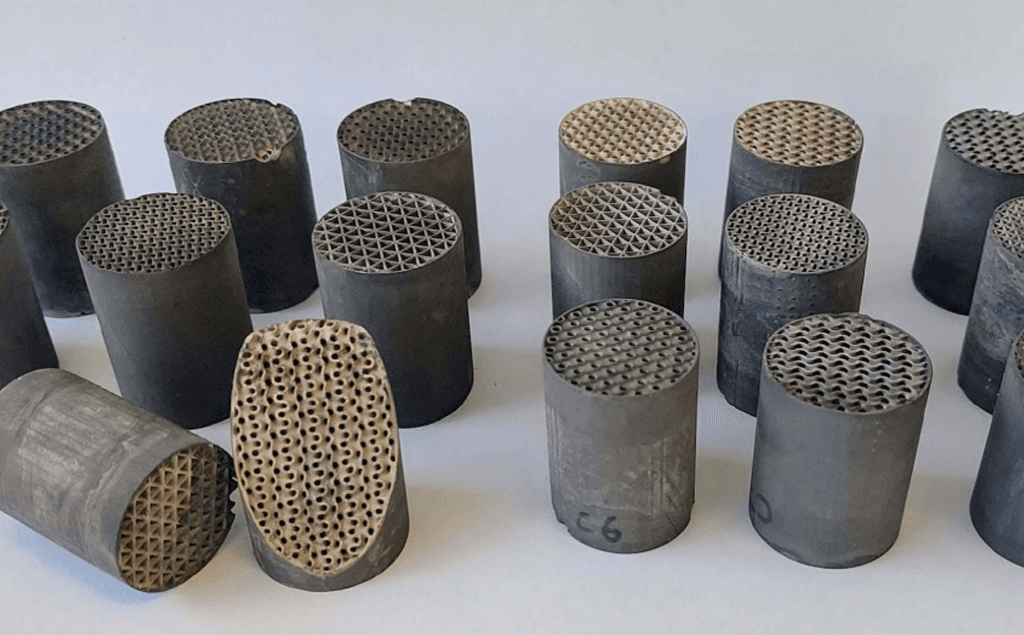
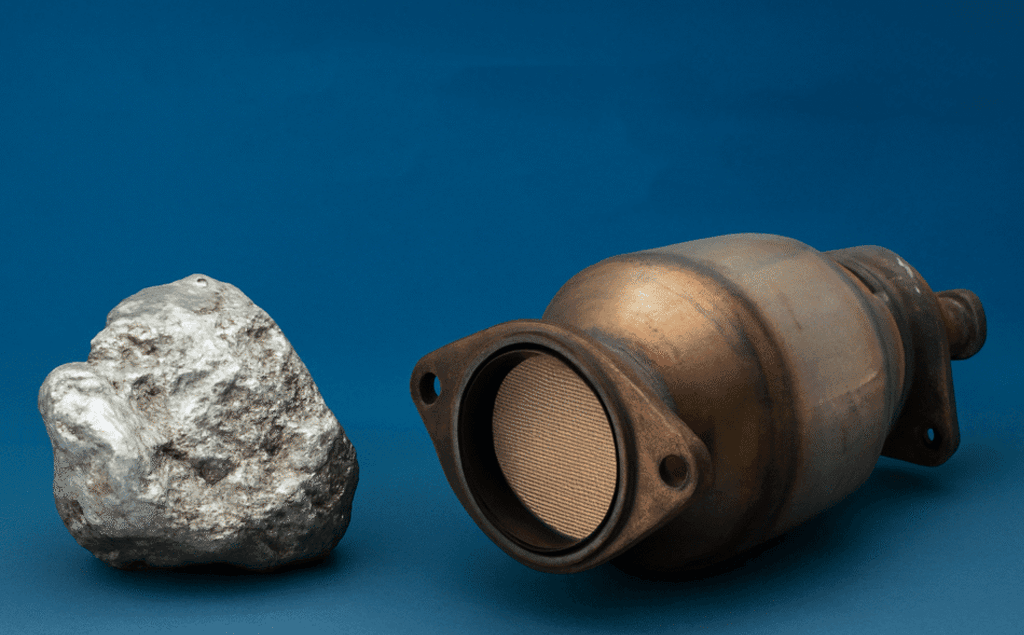
The converter utilizes a ceramic honeycomb structure coated with precious metals. Platinum and palladium facilitate oxidation. Rhodium handles the reduction of NOx. A crucial element in this process is Cerium. Cerium acts as an oxygen sponge. It stores excess oxygen when the fuel mixture is lean. It releases oxygen when the mixture is rich. This Oxygen Storage Capacity (OSC) allows the converter to oxidize pollutants even during momentary rich conditions.
The PCM monitors this OSC to determine efficiency. It compares the switching rate of the upstream oxygen sensor against the downstream oxygen sensor. A healthy المحول الحفاز ثلاثي الاتجاهات dampens the fluctuations. If the downstream sensor mimics the upstream sensor, the OSC is depleted. The PCM then flags the P0420 code.

Initial Diagnostics: Excluding External Variables
Before condemning the Exhaust Catalytic Converter, technicians must rule out external variables. The monitor relies on accurate data inputs. Corrupted inputs trigger false positives.
1. Verification of Other DTCs
The PCM often prioritizes P0420, but other codes reveal the true culprit. Misfire codes (P0300-P0308) dump raw fuel into the exhaust. This fuel overheats the substrate. Fuel trim codes (P0171/P0174 or P0172/P0175) indicate air/fuel mixture imbalances. Camshaft timing codes indicate valve overlap issues. Address these codes first. They directly affect exhaust composition.
2. Exhaust Leak Inspection
This is the most common cause of false P0420 codes. Leaks upstream of the converter introduce unmetered oxygen. Leaks near the downstream sensor create a “Venturi effect.” This effect pulls outside air into the exhaust stream. The sensor detects this excess oxygen and reports a lean condition. The PCM commands more fuel. The resulting rich mixture overheats the converter.
- فعل: Inspect the exhaust manifold and flex pipes. Look for black soot markings. Smoke test the exhaust system if visual inspection yields no results.
3. Thermal Verification
A functional converter generates heat via exothermic chemical reactions. The outlet temperature should exceed the inlet temperature.
- Method: Use an infrared thermometer. Measure the weld ring at the inlet. Measure the weld ring at the outlet.
- Standard: The outlet should read at least 20°C to 50°C hotter than the inlet. If the outlet is cooler, the chemical reaction has ceased.
TWC Analysis: Waveform Interpretation
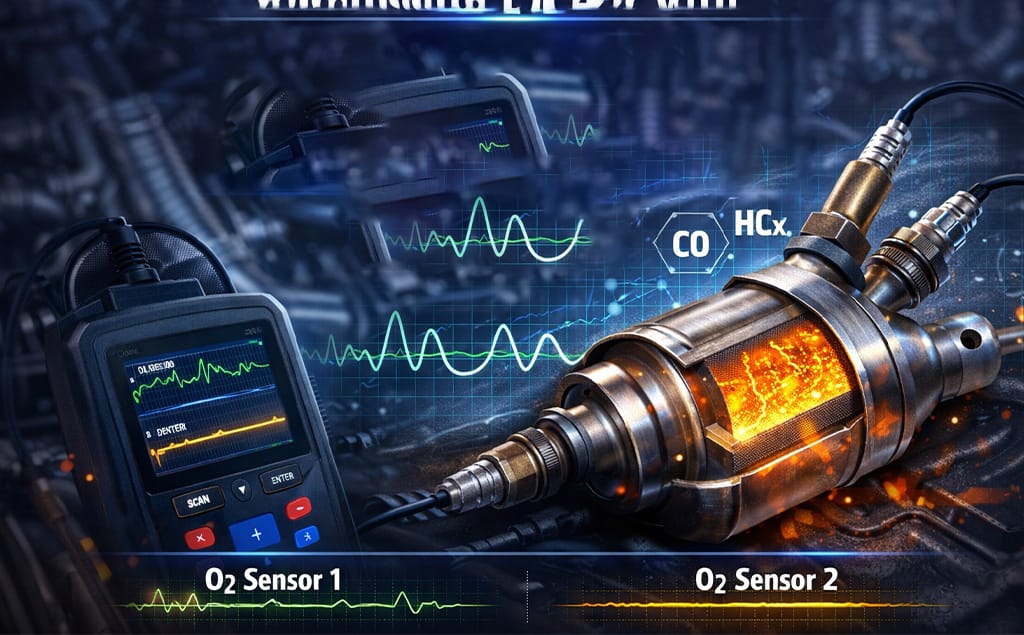
The most definitive method for diagnosing a المحول الحفاز ثلاثي الاتجاهات is waveform analysis. This requires a graphing scan tool or an oscilloscope. You must observe the voltage relationship between Bank 1 Sensor 1 (upstream) and Bank 1 Sensor 2 (downstream).
The Healthy Waveform
Operate the engine at 2500 RPM. Ensure the system is in Closed Loop. The upstream sensor should oscillate rapidly between 0.1V (lean) and 0.9V (rich). This indicates the PCM is actively managing the air/fuel ratio. The downstream sensor should display a steady voltage, typically around 0.45V to 0.6V. This steady line proves the المحول الحفاز ثلاثي الاتجاهات is absorbing the oxygen pulses. The chemical reduction is active.
The Failing Waveform (Loss of OSC)
In a failing unit, the Cerium washcoat no longer stores oxygen. The downstream sensor loses its ability to buffer the signal. The downstream waveform begins to mirror the upstream waveform. It switches rapidly from low to high voltage. When the switch ratio between the front and rear sensors approaches 1:1, the PCM sets the P0420 code.
Comparison of Sensor Data Patterns
| Data Point | Healthy المحول الحفاز ثلاثي الاتجاهات | Failed/Degraded Converter |
| Upstream O2 Sensor | Rapid switching (0.1V – 0.9V) | Rapid switching (0.1V – 0.9V) |
| Downstream O2 Sensor | Steady voltage (approx. 0.5V – 0.7V) | Rapid switching (Mirrors Upstream) |
| Cross Counts | High count (Upstream) / Low count (Downstream) | High count on both sensors |
| Outlet Temp | Higher than inlet (+50°F / +28°C) | Equal to or lower than inlet |
| Fuel Trim (LTFT) | Near 0% (+/- 5%) | May be normal, or elevated if leak exists |
Mode $06 Data: The Advanced Diagnostic Layer
Most technicians stop at the live data graph. However, Mode $06 offers deeper insight. This mode displays the raw test results for non-continuous monitors. The PCM runs specific tests on the catalyst monitor to verify OSC.
Access Mode $06 on your scan tool. Locate the TID (Test ID) and CID (Component ID) for the Catalyst Monitor Bank 1. The data will show a “Test Value,” a “Min Limit,” and a “Max Limit.” Even if the Check Engine Light is off, Mode $06 reveals if the converter is marginally passing. A Test Value perilously close to the failure threshold indicates the المحول الحفاز OEM is degrading. This confirms that a P0420 code is imminent. This step validates the repair before you order expensive parts.
Causes of Converter Degradation
أ المحول الحفاز ثلاثي الاتجاهات contains no moving parts. It rarely fails on its own. External factors usually destroy it.
1. Thermal Shock and Melting
Raw fuel entering the exhaust ignites inside the converter. This causes temperatures to exceed 2000°F (1100°C). The ceramic substrate melts. This creates a restriction. Backpressure increases. Engine power plummets. Misfires and leaking injectors are the primary causes.
2. Chemical Poisoning
Certain contaminants coat the precious metals. This renders the washcoat inert.
- Silicone: Enters via leaking coolant (head gasket failure) or non-sensor-safe sealants. It coats the sensor and catalyst glass-like.
- Phosphorus: Enters via excessive oil consumption. Worn piston rings or valve guides allow oil into the combustion chamber.
- الزنك: Found in certain oil additives. It accumulates on the catalyst surface.
3. Mechanical Damage
Impacts from road debris fracture the ceramic honeycomb. The pieces rattle inside the shell. They block the gas flow. A “rattle test” using a rubber mallet confirms this structural failure.
High-Flow vs. OEM: Understanding Replacement Options
When replacement becomes necessary, the choice between an المحول الحفاز OEM و أ High-Flow Catalytic Converter impacts the repair success.
أن المحول الحفاز OEM contains a high density of cells (typically 400 to 600 Cells Per Square Inch – CPSI). It also contains a high loading of precious metals. The PCM calibration expects this specific efficiency.
أ High-Flow Catalytic Converter typically features a lower cell count (200 CPSI). This reduces backpressure and increases horsepower. However, the lower surface area reduces Oxygen Storage Capacity. On a standard street vehicle, a High-Flow Catalytic Converter often triggers a P0420 code because it cannot store enough oxygen to satisfy the strict factory monitor. You should only use high-flow units on vehicles with modified ECU software (tuning) that accounts for the different efficiency curve. For standard repairs, an OEM or a high-quality “OEM-grade” aftermarket unit is mandatory to keep the light off.
Manufacturer-Specific Diagnostic Nuances
Different manufacturers utilize distinct strategies to monitor the Exhaust Catalytic Converter.
Honda / Acura
Honda PCMs are extremely sensitive. They often flag P0420 before the converter is completely dead. Software updates are a critical first step. Check for TSBs regarding PCM reflashing. Additionally, Honda V6 engines with Variable Cylinder Management (VCM) often consume oil. This oil fouls the converter. You must address the VCM issue to prevent the new converter from failing.
Toyota / Lexus
Toyota utilizes Air/Fuel (A/F) ratio sensors upstream rather than standard Zirconia sensors. A/F sensors operate at a specific current rather than voltage. The diagnosis requires viewing the equivalence ratio (Lambda). Toyota downstream sensors are lazy by design. A slight increase in downstream activity triggers the code quickly. Verify the A/F sensor response time before condemning the cat.
Ford
Ford EcoBoost engines impose high thermal stress on the المحول الحفاز ثلاثي الاتجاهات. Turbos cool the exhaust at idle but heat it significantly under load. Check for “soot loading” from direct injection. Often, a ” Italian Tune-up” (driving at sustained high RPM) clears the soot and restores efficiency temporarily. Ford also monitors the downstream sensor for “deceleration fuel cutoff” response.
نيسان
Nissan integrates the catalytic converter into the exhaust manifold on many models. These manifolds crack easily. The crack introduces air. This triggers P0420. Furthermore, when these converters disintegrate, the engine vacuum can suck ceramic dust back into the combustion chamber. This destroys cylinder walls. Early diagnosis on Nissan models is vital to save the engine.
Step-by-Step Diagnostic Protocol
Follow this scientific method to ensure accuracy.
Step 1: Code Analysis and Freeze Frame
Connect the scan tool. Record the freeze frame data. Note the RPM, Load, and Coolant Temperature at the time of failure. If the code set during cold start, suspect the heater circuit. If it set at cruise, suspect the catalyst efficiency.
Step 2: Fundamental System Health Check
Verify the engine mechanical condition. Check the oil level and condition. Check the coolant level. Listen for exhaust leaks. Perform a visual inspection of the O2 sensor wiring.
Step 3: Induce Rich/Lean Conditions
Verify sensor authority.
- Propane Enrichment: Add propane to the intake. The upstream sensor must go high (Rich). The downstream sensor should rise slowly.
- Vacuum Leak: Create a vacuum leak. The upstream sensor must go low (Lean).
- If the sensors do not respond, the sensors are the fault, not the converter.
Step 4: The Drive Cycle Test
Warm the engine to operating temperature (above 190°F). Drive at a steady cruise (55 MPH). Observe the downstream O2 sensor data stream.
- Result A: The line is flat. The converter is good. The code may be intermittent or caused by a leak.
- Result B: The line oscillates in sync with the upstream sensor. The المحول الحفاز ثلاثي الاتجاهات has failed chemically.
Step 5: Backpressure Testing
Remove the upstream oxygen sensor. Install a pressure gauge. Rev the engine to 2500 RPM.
- Limit: Backpressure should not exceed 1.5 PSI.
- Analysis: High pressure indicates a melted or clogged Exhaust Catalytic Converter.
Repair and Validation
If the diagnostics confirm a failed المحول الحفاز ثلاثي الاتجاهات, replacement is the only option. Cleaning additives rarely fix a chemically depleted washcoat.
Select the correct part. An المحول الحفاز OEM ensures the highest probability of success. If choosing aftermarket, verify it is “EPA Certified” or “CARB Compliant” depending on your region. Avoid “Universal” converters on modern Low-Emission Vehicles (LEV); they lack the necessary precious metal loading.
After installation, reset the Keep Alive Memory (KAM) in the PCM. This clears the learned fuel trims and aging factors. The PCM must relearn the new converter’s characteristics. Perform the manufacturer-specific drive cycle to set the “Catalyst Monitor” to “Ready.”
خاتمة
The P0420 code is a reliable indicator of المحول الحفاز ثلاثي الاتجاهات inefficiency, but it is the end result of a diagnostic path, not the beginning. A scientific approach differentiates between a symptom and a root cause. Technicians must analyze waveforms, verify fuel control, and inspect for physical leaks.
Whether dealing with a standard المحول الحفاز OEM or a performance High-Flow Catalytic Converter, the principles remain the same. The converter requires a balanced chemical environment to function. Ignoring the root cause—be it oil consumption, misfires, or exhaust leaks—guarantees the destruction of the replacement part. Accurate diagnosis saves time, money, and ensures the vehicle meets environmental standards.