مقدمة
Modern automotive engineering relies heavily on efficient emissions control. The محول حفاز ثلاثي الاتجاهات stands as the most critical component in this effort. This device transforms toxic engine exhaust into harmless gases through complex chemical reactions. To function correctly, the catalyst requires a robust physical foundation known as a substrate. Engineers must select the right substrate material to ensure the محول حفاز ثلاثي الاتجاهات meets strict environmental regulations and durability standards. This guide explores the materials, engineering criteria, and manufacturing processes that define high-performance catalyst supports. We focus on how these choices impact the efficiency of the محول حفاز ثلاثي الاتجاهات in diverse operating environments.
The Fundamental Role of the Three Way Catalytic Converter
ال محول حفاز ثلاثي الاتجاهات manages three primary pollutants: carbon monoxide (CO), unburned hydrocarbons (HC), and nitrogen oxides (NOx). It performs oxidation and reduction reactions simultaneously. This dual functionality requires a precise balance of temperature, gas flow, and surface chemistry.
Platinum, palladium, and rhodium serve as the active noble metals in the محول حفاز ثلاثي الاتجاهات. These metals facilitate the conversion of CO and HC into carbon dioxide and water. Simultaneously, they reduce NOx into nitrogen gas and oxygen. However, these expensive metals cannot float freely in the exhaust stream. They require a substrate with a massive surface area to maximize contact with exhaust gases. The substrate provides the structural integrity and surface geometry necessary for the محول حفاز ثلاثي الاتجاهات to thrive under the vehicle’s hood.

Comprehensive Catalyst Substrate Material Overview
Material selection dictates the thermal, mechanical, and chemical performance of the system. Engineers primarily choose between ceramic and metallic options for the محول حفاز ثلاثي الاتجاهات.
1. Ceramic (Synthetic Cordierite)
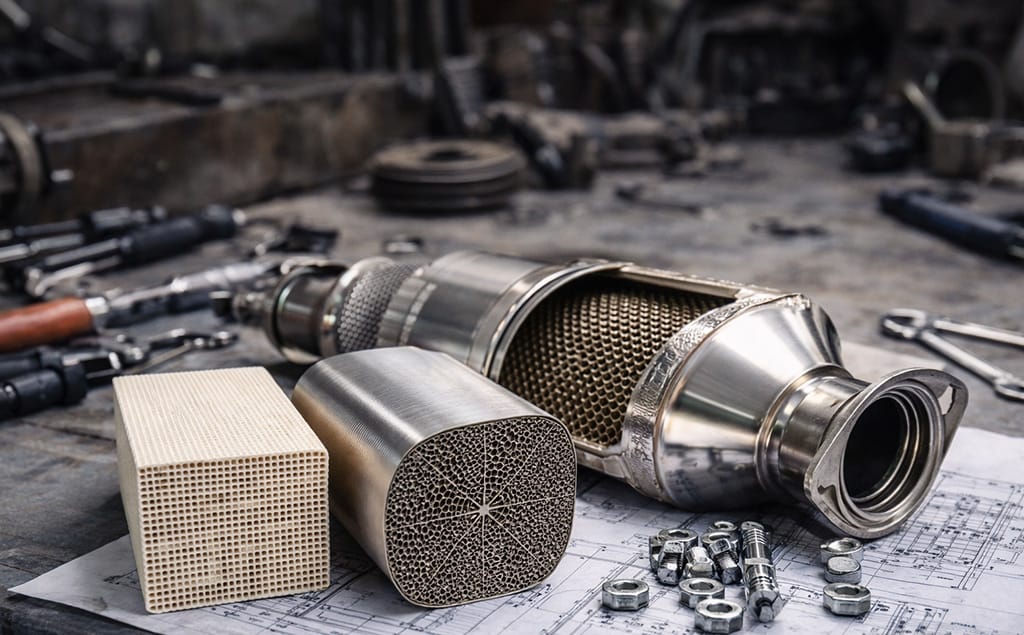
Cordierite remains the industry standard for the محول حفاز ثلاثي الاتجاهات. It consists of magnesium oxide, alumina, and silica. This ceramic material offers a remarkably low thermal expansion coefficient. In the axial direction, this value stays below (1 \times 10^{-6}/^{\circ}C). This property grants the material superior thermal shock resistance. Cordierite substrates survive the rapid temperature swings common in daily driving. They are cost-effective and provide a stable surface for washcoat adhesion.
2. Metallic Foil Substrates
Metallic substrates usually utilize ferritic stainless steel, such as AISI 409 or 439. These substrates offer unique advantages for high-performance محول حفاز ثلاثي الاتجاهات applications. Metal foils allow for thinner walls compared to ceramic structures. Thinner walls result in a larger open frontal area (OFA) and lower backpressure. Metal also conducts heat more quickly than ceramic. This characteristic allows the محول حفاز ثلاثي الاتجاهات to reach “light-off” temperature faster, reducing cold-start emissions.
3. Silicon Carbide (SiC)
SiC enters the frame for demanding environments involving extreme vibration or ultra-high temperatures. It possesses higher mechanical strength and better thermal conductivity than cordierite. While more expensive, SiC substrates offer unmatched durability in heavy-duty محول حفاز ثلاثي الاتجاهات systems.
4. Alumina ((Al{2}O{3}))
Industrial applications often use alumina-based supports. Alumina provides a high surface area and structural robustness. While less common in standard passenger car three way catalytic converters, it remains vital for industrial emissions control and hydrogenation processes.

Critical Engineering Criteria for Substrate Selection
Choosing a material requires a deep understanding of the operating environment. Designers evaluate several key factors to ensure the محول حفاز ثلاثي الاتجاهات functions for the life of the vehicle.
- Thermal Shock Resistance: Exhaust temperatures can jump from 20°C to 800°C in seconds. The material must expand and contract without cracking. Ceramics excel here due to their low expansion rates.
- Mechanical Durability: ال محول حفاز ثلاثي الاتجاهات sits in a high-vibration environment. Metallic substrates offer better resistance to physical impacts and road debris than brittle ceramic monoliths.
- Open Frontal Area (OFA): A high OFA reduces the restriction of gas flow. This improves engine power and fuel efficiency. Metal substrates typically achieve higher OFA than ceramic ones.
- Geometric Surface Area (GSA): A larger GSA allows more space for the catalyst washcoat. This maximizes the reaction sites available for the محول حفاز ثلاثي الاتجاهات to process pollutants.
- Thermal Mass: Low thermal mass is ideal. It enables the محول حفاز ثلاثي الاتجاهات to heat up rapidly using the energy from the exhaust gas.
Comparison of Substrate Technologies
The following table summarizes the performance metrics of the most common materials used in the محول حفاز ثلاثي الاتجاهات industry.
| ميزة | Cordierite (Ceramic) | Metallic Foil (Stainless) | Silicon Carbide (SiC) |
|---|---|---|---|
| Thermal Expansion | Ultra-Low | عالي | Moderate |
| Max Operating Temp | ~1200°C+ | ~500°C – 1000°C | ~1400°C |
| سمك الجدار | Standard (thick) | Very Thin | Moderate |
| الضغط العكسي | Moderate | قليل | Moderate |
| Manufacturing Cost | قليل | عالي | مرتفع جداً |
| Thermal Shock | ممتاز | جيد | Moderate |
| Vibration Resistance | Fair | ممتاز | جيد |
The Intricate Manufacturing Process of Ceramic Substrates
Manufacturing a ceramic substrate for a محول حفاز ثلاثي الاتجاهات involves high-precision extrusion. The process begins with raw materials: talc, alumina, silica, and kaolinite clay. Technicians grind these materials into a fine powder and mix them with a water-based paste.
During mixing, they add lubricants like ethylene glycol and bonding agents like methylcellulose. The mixture passes through a high-pressure extrusion die. This die creates the characteristic honeycomb structure of the محول حفاز ثلاثي الاتجاهات substrate. After extrusion, the “green” parts undergo drying and cutting.
Finally, the parts enter a kiln for calcination. This process occurs at temperatures exceeding 1400°C. During calcination, the minerals fuse into synthetic cordierite. The material shrinks slightly during this stage. Manufacturers must calculate this shrinkage precisely to meet final dimensional specifications. For large-scale محول حفاز ثلاثي الاتجاهات units, workers may machine the contours and apply an outer ceramic skin after the initial firing to ensure a perfect fit in the metal housing.
The Critical Synergy Between Washcoat and Substrate Architecture
The substrate provides the skeleton, but the washcoat provides the lungs of the محول حفاز ثلاثي الاتجاهات. The washcoat is a porous layer applied to the substrate walls. It usually contains aluminum oxide, cerium oxide, and zirconium oxide. This layer creates a massive internal surface area for the noble metals.
A high-quality washcoat must bond perfectly with the substrate of the محول حفاز ثلاثي الاتجاهات. If the washcoat peels off (delamination), the converter fails. Therefore, engineers match the chemical properties of the substrate to the washcoat formula. This synergy ensures the محول حفاز ثلاثي الاتجاهات maintains high conversion efficiency over 150,000 miles or more.
The porous nature of the washcoat increases the effective surface area by a factor of 7,000 or more. This allows the محول حفاز ثلاثي الاتجاهات to utilize minimal amounts of precious metals like Rhodium. Furthermore, the washcoat acts as a stabilizer. It prevents the active metal particles from moving and clumping together at high temperatures. This design philosophy ensures that the محول حفاز ثلاثي الاتجاهات remains effective even as the vehicle ages.
Understanding Oxygen Storage Capacity (OSC)
أداء عالي محول حفاز ثلاثي الاتجاهات requires Ceria ((CeO_{2})) in the washcoat. Ceria acts as an oxygen reservoir. When the engine runs “rich” (too much fuel), the ceria releases oxygen to oxidize CO and HC. When the engine runs “lean” (too much air), the ceria absorbs excess oxygen to help reduce NOx. This storage capacity allows the محول حفاز ثلاثي الاتجاهات to function even when the air-fuel ratio fluctuates.
Strategic Management of Thermal Transients in Cold-Start Scenarios
Modern hybrid vehicles present new challenges for the محول حفاز ثلاثي الاتجاهات. In a hybrid system, the internal combustion engine turns off frequently. This causes the catalyst temperature to drop below its active range. When the engine restarts, it emits a burst of pollutants.
Engineers now favor metallic substrates or ultra-thin-wall ceramic substrates for these applications. These materials possess lower thermal mass. They regain their operating temperature much faster than traditional heavy substrates. By selecting a substrate with rapid thermal response, manufacturers ensure the محول حفاز ثلاثي الاتجاهات stays active during the stop-start cycles of a hybrid vehicle. This strategic selection directly impacts the vehicle’s ability to pass strict “SULEV” (Super Ultra Low Emission Vehicle) standards.
Moreover, the positioning of the محول حفاز ثلاثي الاتجاهات matters. “Close-coupled” converters sit right next to the engine manifold. This proximity allows the device to capture maximum heat immediately. However, this position also exposes the محول حفاز ثلاثي الاتجاهات للتعرض لإجهاد حراري شديد. فقط المواد ذات الثبات الحراري العالي يمكنها البقاء في هذا الموقع دون أن تتدهور.
Navigating Catalyst Poisoning and Thermal Degradation
لا محول حفاز ثلاثي الاتجاهات يدوم إلى الأبد. هناك عدوان رئيسيان يهددان عمره: التسمم والتلبيد. يحدث التسمم عندما تغطي مواد كيميائية مثل الكبريت أو الفوسفور أو الرصاص المواقع النشطة. تمنع هذه الملوثات غازات العادم من الوصول إلى المعادن النبيلة.
يحدث التحلل الحراري، أو التلبيد، أثناء موجات الحر الشديدة. تتسبب درجات الحرارة المرتفعة في تكتل جزيئات المعدن النبيل المجهرية، مما يقلل من مساحة السطح المتاحة، ويؤدي أيضًا إلى انهيار مسام طبقة الطلاء. يتغلب المهندسون على هذه المشكلة باستخدام الألومينا المستقرة وتصاميم الركائز المتقدمة التي توزع الحرارة بشكل أكثر تجانسًا. محول حفاز ثلاثي الاتجاهات تمنع الركيزة "البقع الساخنة" الموضعية، مما يؤدي إلى إطالة العمر الكيميائي للجهاز.
Industrial Applications Beyond the Automobile
بينما تستخدم السيارات غالبية محول حفاز ثلاثي الاتجاهات بفضل التكنولوجيا، تستفيد قطاعات أخرى أيضاً. تستخدم المصانع الصناعية الكبيرة ركائز مماثلة على شكل قرص العسل لمعالجة الانبعاثات من المحركات والتوربينات الثابتة. في هذه الحالات، قد يصل قطر الركيزة إلى عدة أقدام.
تستخدم عمليات الهدرجة في الصناعة الكيميائية أيضًا محفزات مدعومة بالألومينا. وتمثل تقنية خلايا الوقود مجالًا جديدًا واعدًا. تتطلب خلايا الوقود معادن مدعومة بالكربون للتحكم في التوصيل الكهربائي. يتطلب كل تطبيق من هذه التطبيقات مادة ركيزة محددة بناءً على البيئة الكيميائية والعمر الافتراضي المطلوب للنظام. حتى في هذه التطبيقات غير المتعلقة بالسيارات، تظل مبادئ... محول حفاز ثلاثي الاتجاهات توجيه المهندسين نحو حلول طاقة أنظف.
Optimization of Fluid Dynamics in Converter Design
هندسة محول حفاز ثلاثي الاتجاهات يؤثر سطح الركيزة على تدفق غازات العادم. يُفضل عمومًا التدفق الصفائحي داخل القنوات. ومع ذلك، غالبًا ما يُسبب الانتقال من أنبوب العادم إلى السطح الكبير للركيزة اضطرابًا.
يستخدم المهندسون ديناميكيات الموائع الحسابية (CFD) لنمذجة هذا التدفق. ويقومون بتصميم مخاريط المدخل لـ محول حفاز ثلاثي الاتجاهات لتوزيع الغاز بالتساوي على كامل سطح الركيزة. إذا تدفق الغاز عبر المركز فقط، فإن الحواف الخارجية للمحفز تبقى غير مستخدمة. هذا يهدر المعادن النفيسة باهظة الثمن ويقلل من الكفاءة الإجمالية. محول حفاز ثلاثي الاتجاهات. يضمن التوزيع المتساوي أن يساهم كل مليمتر مربع من الركيزة في عملية التنظيف.
The Economic Impact of Substrate Choice
ال محول حفاز ثلاثي الاتجاهات يُعدّ أحد أغلى أجزاء نظام عادم السيارة. وتتذبذب أسعار المعادن النفيسة بشكل كبير، وغالبًا ما يكون سعر البلاتين والبلاديوم أعلى من سعر الذهب. لذا، تُعتبر كفاءة المادة الأساسية ضرورة مالية.
تتيح الركيزة ذات المساحة السطحية الأكبر للمصنّع استخدام كميات أقل من المعادن النفيسة. ومن خلال تحسين هندسة الركيزة، يستطيع المهندسون تحقيق نفس نتائج الانبعاثات باستخدام كمية أقل من البلاتين أو البلاديوم. ويؤدي هذا التخفيض في استخدام المعادن النفيسة إلى خفض التكلفة الإجمالية. محول حفاز ثلاثي الاتجاهات دون التضحية بالأداء البيئي.
Future Trends in Three Way Catalytic Converter Technology
مع اقتراب معايير الانبعاثات مثل يورو 7 والصين 6ب، يواصل قطاع صناعة السيارات الابتكار. نشهد حاليًا ظهور "المحفزات المسخنة كهربائيًا" (EHC). تستخدم هذه الأنظمة ركيزة معدنية صغيرة متصلة بالنظام الكهربائي للمركبة، حيث تقوم بتسخينها مسبقًا. محول حفاز ثلاثي الاتجاهات حتى قبل أن يبدأ تشغيل المحرك.
علاوة على ذلك، يُجري العلماء أبحاثاً على المحفزات النانوية والمواد القائمة على الزيوليت. تهدف هذه المواد المتقدمة إلى تعزيز معدلات التفاعل وتوفير مقاومة أفضل للتسمم بالكبريت. محول حفاز ثلاثي الاتجاهات ستظل هذه التقنية حيوية حتى مع انتقالنا نحو السيارات الكهربائية. وفي السيارات الهجينة، ستزداد أهمية ركيزة المحفز عالية الأداء.
How to Choose the Right Catalyst: A Step-by-Step Guide
لا يجب أن يكون اختيار المحفز المناسب لتطبيق معين أمرًا معقدًا. اتبع هذا النهج المنظم لضمان أفضل النتائج. محول حفاز ثلاثي الاتجاهات نظام.
- حدد رد الفعل: هل تقوم بعملية الأكسدة، أم الاختزال، أم كليهما؟ محول حفاز ثلاثي الاتجاهات ضروري للمهام المتزامنة.
- تحليل ظروف التشغيل: حدد أقصى درجة حرارة وضغط لديك. تتطلب حالات الحرارة العالية استخدام الكوردييريت أو كربيد السيليكون.
- التحقق من وجود الملوثات: هل يحتوي وقودك على الكبريت أو الفوسفور؟ اختر معطفًا مقاومًا للسموم إذا كان الأمر كذلك.
- تقييم قيود المساحة: إذا كانت المساحة لديك محدودة، فاختر ركيزة معدنية. تسمح جدرانها الرقيقة بحجم محول أصغر بشكل عام.
- تقييم التكلفة مقابل الأداء: بالنسبة لسيارات الركاب المنتجة بكميات كبيرة، يوفر الكوردييريت أفضل توازن. أما بالنسبة لسباقات السيارات عالية الأداء أو الاستخدامات الشاقة، فاستثمر في ركائز معدنية أو ركائز من كربيد السيليكون.
- معدل دوران الموظفين (TOF): ابحث عن بيانات حول عدد التفاعلات التي تحدث لكل موقع في الثانية. يشير معدل دوران التفاعل الأعلى إلى كفاءة أكبر. محول حفاز ثلاثي الاتجاهات.
خاتمة
ال محول حفاز ثلاثي الاتجاهات لا تزال هذه التقنية حجر الزاوية في حماية البيئة في قطاع النقل. وتُشكّل مادة الركيزة الأساس الحاسم لهذه التقنية. وسواء اخترتَ الثبات الحراري للكوردييريت، أو خصائص التدفق العالي للمعادن، أو المتانة الفائقة لكربيد السيليكون، فإن اختيارك يُحدّد نجاح النظام.
يجب على المهندسين تحقيق التوازن بين التكلفة والمتانة والكفاءة. وذلك من خلال فهم المتطلبات الميكانيكية والكيميائية لـ محول حفاز ثلاثي الاتجاهاتبفضل هذه التقنيات، يستطيع المصنّعون إنتاج مركبات وعمليات صناعية أنظف. ومع سعينا نحو مستقبل مستدام، سيستمر تطور ركائز المحفزات في دفع عجلة تحسين جودة الهواء وأداء المحركات.