Zavedení
Automotive engineering stands at a crossroads. The transition to strict emissions standards demands a total rethink of hardware. This shift focuses entirely on three way catalytic converter Euro 7 compliance. For decades, the třícestný katalyzátor served as a basic filter. Today, it must act as a precision chemical reactor.
OEMs and Tier 1 suppliers must overhaul their exhaust architectures to survive. This guide analyzes the engineering shifts required for 2027 and beyond. We cover substrate density, washcoat kinetics, and thermal shielding. If you seek three way catalytic converter Euro 7 compliance, you must master these micro-details. There is no margin for error in the modern regulatory climate.
The Regulatory Landscape: Euro 7 vs. Global Standards
Regulators in Brussels and Washington have issued a clear mandate. Emissions must remain ultra-low in every driving condition. They do not care if it is a cold-start at $-10^\circ C$ or a heavy climb. The three way catalytic converter Euro 7 compliance framework covers all boundary conditions.
Real Driving Emissions (RDE) Challenges
Euro 7 eliminates the gap between lab tests and road reality. Engineers now focus on the “worst-case” scenario. Under Euro 6, we optimized for specific cycles. Euro 7 destroys that strategy. Now, three way catalytic converter Euro 7 compliance requires performance during short city trips and high-speed towing alike.
Durability is the primary legal bottleneck. The law mandates 200,000 kilometers of guaranteed performance. This is a massive 25% increase. If a catalyst fails at 180,000 km, the OEM faces global recalls. We must design for the end-of-life state. For more on the legal framework, consult the European Commission Euro 7 Proposal.
Washcoat Stabilization: The Chemical Foundation
Extra Technical Insight: Achieving three way catalytic converter Euro 7 compliance starts at the molecular level.
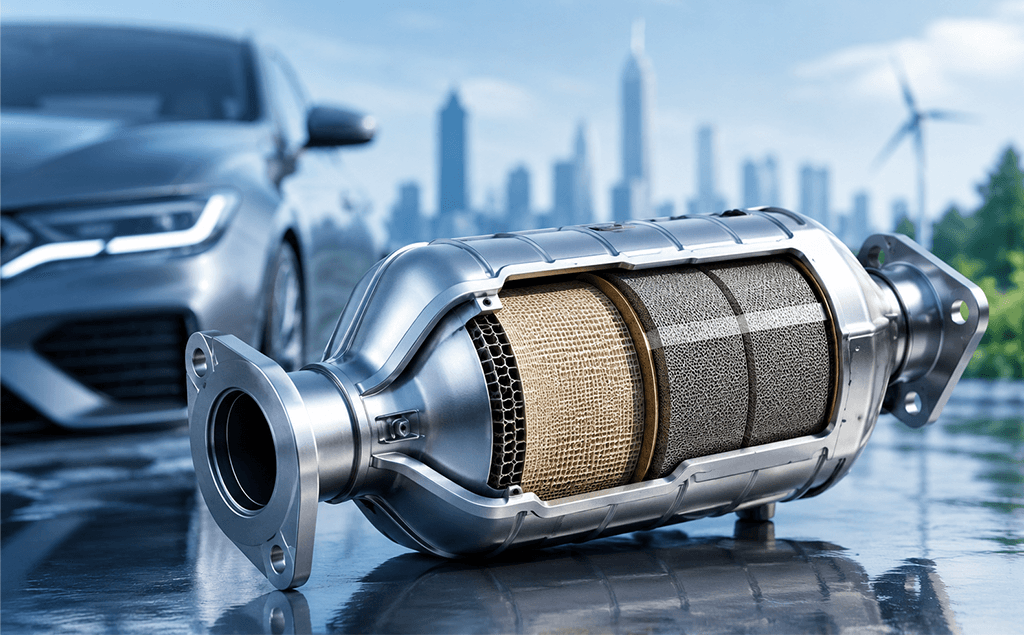
The washcoat is more than a carrier; it is a dynamic thermal stabilizer. We use gamma-alumina as the base. However, extreme heat causes alumina to collapse. To prevent this, we dope the structure with Lanthanum. This creates a heat-resistant “skeleton.”
Furthermore, we must manage “precious metal dispersion.” Rhodium atoms tend to clump together under heat—a process called sintering. To stop this, we use “anchor sites” made of Zirconia. These sites lock Rhodium in place. A stabilized washcoat maintains its active surface area for the full vehicle life. Without this chemistry, three way catalytic converter Euro 7 compliance is impossible to maintain.
Substrate Architecture for Three Way Catalytic Converter Euro 7 Compliance
The substrate provides the reaction stage. Euro 7 demands more surface area with less backpressure.
High-Density Cell Structures
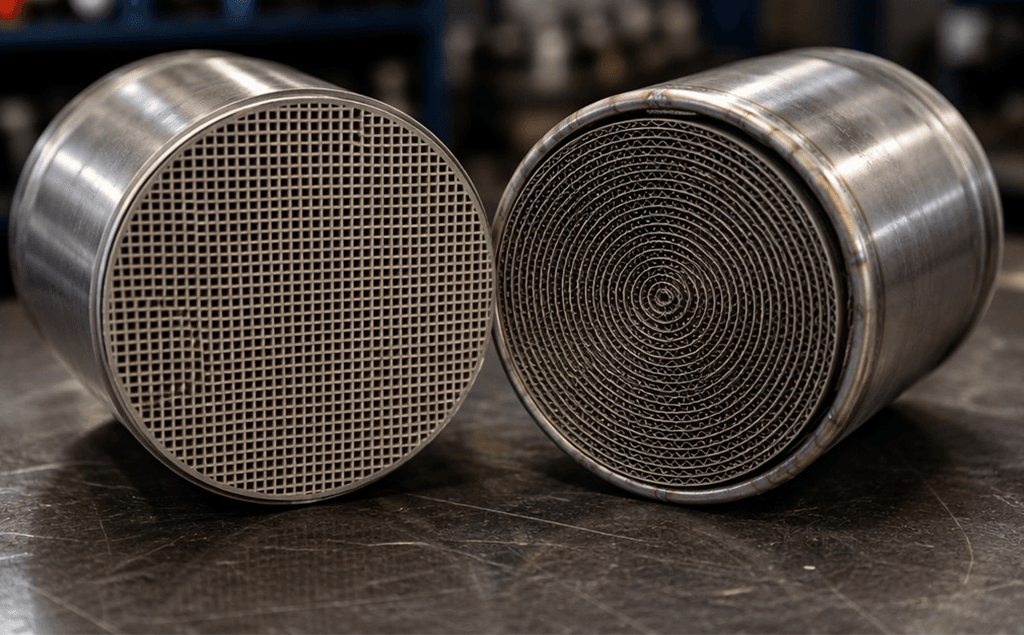
We now use 600 cps or 900 cpsi ceramic bricks. However, higher density increases air resistance. Engineers utilize “Thin Wall” technology to compensate. We reduce wall thickness to 2.5 mils. This opens the flow channels and reduces “light-off” time. A lighter brick heats up faster. Faster heating is the secret to three way catalytic converter Euro 7 compliance during cold starts.
Oxygen Storage Capacity (OSC)
The washcoat includes Ceria-Zirconia mixed oxides. These act as “oxygen sponges.” When the engine runs rich, the OSC releases oxygen to oxidize $CO$. When it runs lean, it stores oxygen. Three way catalytic converter Euro 7 compliance depends on OSC stability. If the Ceria layer collapses, the converter fails during transient driving. You can find detailed research on OSC at the Association for Emissions Control by Catalyst (AECC).
Data: Engineering Targets for Three Way Catalytic Converter Euro 7 Compliance
| Metric | Euro 6 Requirement | Euro 7 Compliance Requirement | Impact on TWCC |
|---|---|---|---|
| NOx Limit | 60 mg/km | 60 mg/km (Tight RDE) | Increased Rhodium Loading |
| Životnost | 160,000 km | 200,000 km | Lanthanum Stabilization |
| Particle Size | PN23 | PN10 (Finer particles) | Integrated GPF-TWCC |
| Light-Off Speed | ~300 Seconds | <60 Seconds | Electric Heating (EHC) |
| Monitoring | OBD | OBM (Real-time) | Dual Oxygen Sensors |
Thermal Management: The 60-Second Light-Off War
The first minute of operation determines your status. A cold catalyst is useless.
Electric Heated Catalysts (EHC)
We now see 48V EHC units in modern designs. These heaters sit upstream of the main brick. They consume 3kW to 5kW to heat the gas stream before the engine fires. This allows the three way catalytic converter Euro 7 compliance strategy to work from the first second. This is critical for heavy SUVs and trucks.
Close-Coupled Architectures
Engineers move the catalyst closer to the cylinder head. This “Close-Coupled TWCC” captures maximum engine heat. But it creates a thermal aging problem. The manifold reaches $1050^\circ C$. We use high-temperature Zirconia to protect the noble metals. For technical standards on exhaust heat, refer to SAE International.
Sealing and Integrity: The Zero-Leakage Mandate
A leak is a death sentence for three way catalytic converter Euro 7 compliance. If untreated gas escapes, the vehicle fails the RDE test instantly.
MLS Gaskets and Support Mats
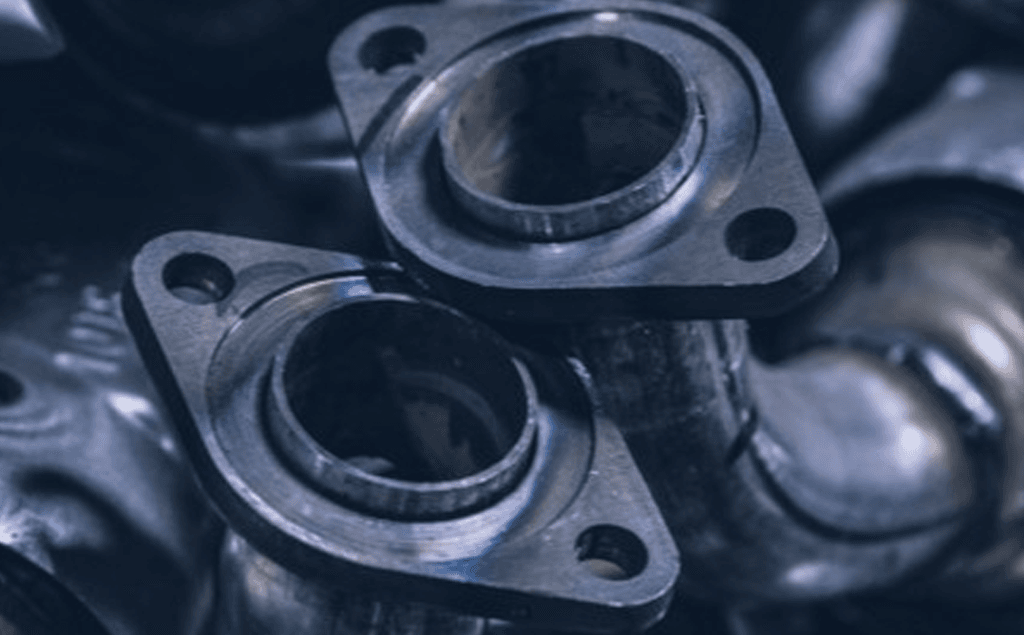
We use Multi-Layer Steel (MLS) gaskets with specialized coatings. These seals handle the “micro-warping” of exhaust flanges. The support mat holds the ceramic brick inside the steel can. It must exert constant pressure for ten years. We use “Vermiculite-free” mats to ensure stable expansion forces. This ensures the three way catalytic converter Euro 7 compliance remains intact throughout the vehicle’s life.
Manufacturing Precision: The Final Barrier
Consistency defines your success. In the Euro 7 era, “average” is not a business strategy. Every unit must be a clone of the master.
- Laser Dosing: We measure exact washcoat depth via lasers.
- Automated Canning: Robots monitor insertion forces in real-time.
- Chemical Fingerprinting: We track the Rhodium batch for every unit.
- Helium Testing: Every assembly undergoes a high-pressure leak test.
At ACS Industries, we embrace this precision. We know that three way catalytic converter Euro 7 compliance depends on the smallest manufacturing details. We deliver that certainty to our global OEM partners.
Závěr
The Euro 7 era is a trial by fire. It forces the industry to innovate. The třícestný katalyzátor remains our best defense against tailpipe pollution. However, the Euro 7 version is far more complex than its predecessors. It requires advanced washcoat chemistry, electric heating, and zero-leakage sealing.
Achieving three way catalytic converter Euro 7 compliance is not a simple task. It requires a deep partnership between engineers and component suppliers. We must prioritize durability and thermal management. If we master these areas, the internal combustion engine has a clean, sustainable future.