1. Einführung in 3-Wege-Katalysatoren in Benzinfahrzeugen
The automotive industry’s relentless pursuit of reduced environmental impact has positioned the 3-way catalytic converter (TWC) as a cornerstone technology for controlling harmful emissions from gasoline internal combustion engines. This report delves into the intricate material science and engineering behind these critical components, focusing specifically on their application in gasoline vehicles. The TWC is a sophisticated chemical reactor designed to simultaneously mitigate three primary pollutants found in engine exhaust: carbon monoxide (CO), unburnt hydrocarbons (HC), and nitrogen oxides (NOx) [1][5].
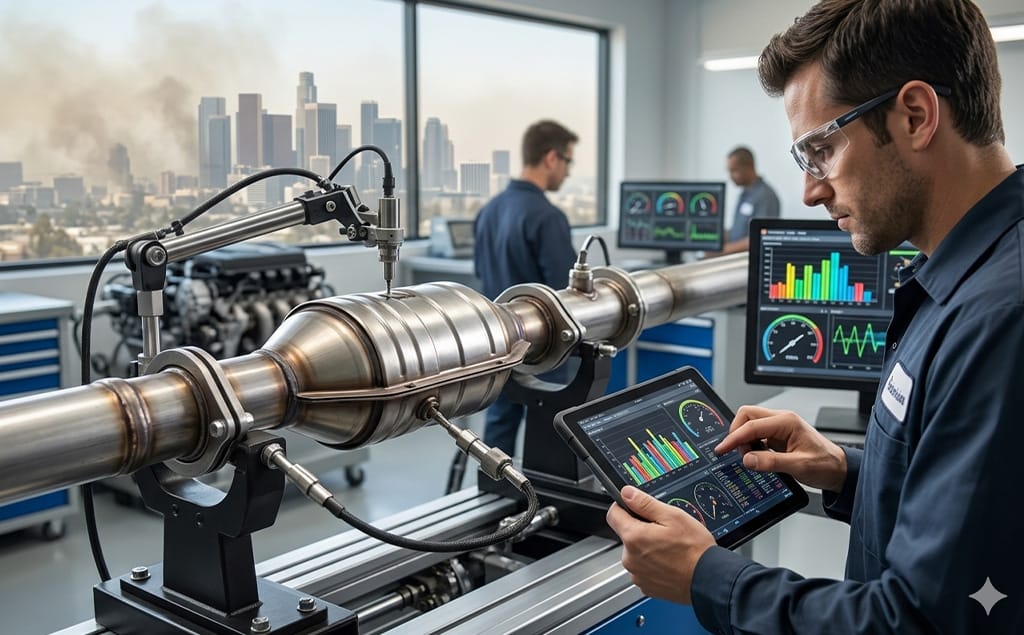
Operating within a tightly controlled environment, the TWC functions optimally when the engine’s air-fuel ratio is maintained near the stoichiometric point, precisely regulated by a lambda sensor in a closed-loop feedback system [5]. This precise control is crucial because the catalyst must facilitate both oxidation (for CO and HC) and reduction (for NOx) reactions concurrently. The evolution of TWCs has progressed from simpler oxidation catalysts to dual-bed systems, culminating in the highly efficient single-bed TWCs prevalent today, which are designed for thermal stability and rapid activation, often mounted close to the exhaust manifold [1][3]. The continuous tightening of global emission standards for CO, HC, NOx, and particulate matter is a primary driver for ongoing advancements in catalyst design and material innovation [1][6].
2. Katalytische Substratmaterialien und Eigenschaften
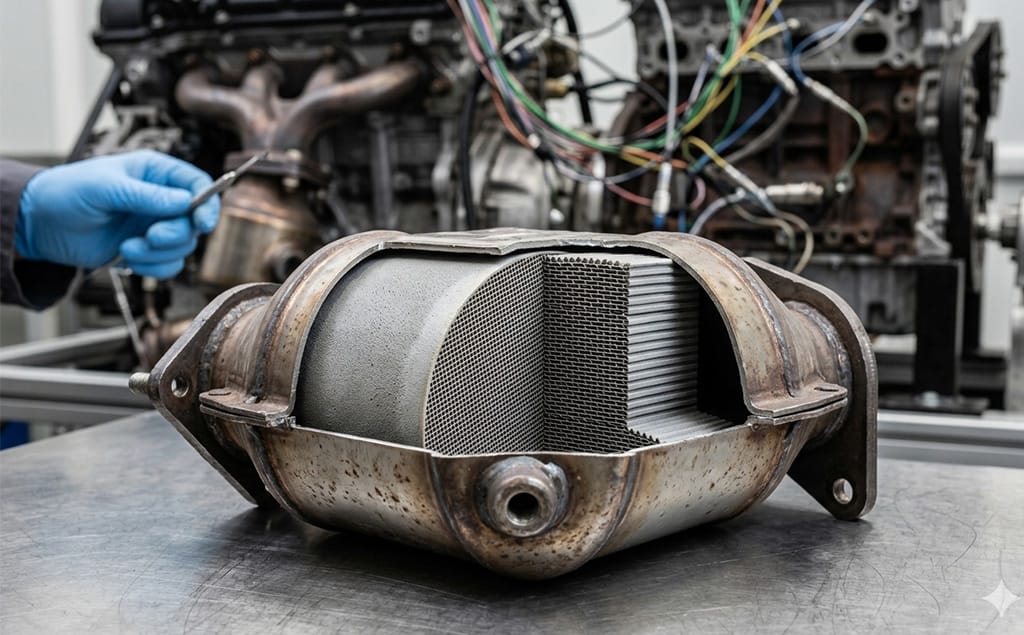
The foundation of a 3-way catalytic converter is its monolithic substrate, which provides the structural support for the catalytically active materials. While metallic substrates are also used, ceramic honeycomb structures, primarily made from cordierite, are the most common choice due to their advantageous properties [6]. Cordierite is a magnesium iron aluminum cyclosilicate mineral with the chemical formula (Mg,Fe)₂Al₄Si₅O₁₈.
Seine einzigartige Kristallstruktur ermöglicht die Bildung einer hochporösen, wabenartigen Matrix mit Tausenden parallelen Kanälen. Die physikalische Struktur des Cordieritsubstrats ist entscheidend für seine Funktion. Es weist typischerweise eine hohe Zelldichte (Zellen pro Quadratzoll, cpsi) auf, was eine große geometrische Oberfläche innerhalb eines kompakten Volumens bedeutet. Dies maximiert den Kontakt zwischen den Abgasen und dem katalytischen Washcoat.
Zu den wichtigsten Eigenschaften, die Cordierit zu einem idealen Substratmaterial machen, gehören:
- Thermische Stabilität: Hervorragende Temperaturwechselbeständigkeit, widersteht schnellen Temperaturschwankungen von Raumtemperatur auf über 1000 °C.
- Geringe Wärmeausdehnung: Verhindert Spannungen und Risse durch Temperaturgradienten.
- Mechanische Festigkeit: Ausreichend robust, um Vibrationen und Stößen standzuhalten.
- Große Oberfläche: Unterstützt die effektive Anwendung von Washcoat.
- Geringer Druckabfall: Gerade Kanäle erhalten die Motorleistung, indem sie den Abgasströmungswiderstand minimieren.
Design parameters like length and cell density are often optimized using simulation software such as Solidworks [7].
3. Washcoat-Formulierungen und funktionelle Rollen
Der Washcoat ist eine poröse Oxidschicht, die auf das Substrat aufgetragen wird und eine hohe Dispersion und Stabilität der Edelmetalle ermöglicht.
- Gamma-Aluminiumoxid (γ-Al2O3): Große Oberfläche (100–200 m²/g), unterstützt die Dispersion von Edelmetallen.
- Ceroxid-Zirkonoxid (CeO₂-ZrO₂):Ceria (CeO₂) is indispensable for its remarkable oxygen storage capacity (OSC)[1][2]. It undergoes reversible redox reactions:2CeO₂ ⇌ Ce₂O₃ + ½O₂The addition of zirconia (ZrO₂) forms a solid solution, CeO₂-ZrO₂, enhancing thermal stability and oxygen mobility. Ceria-zirconia-yttria mixed oxides (CZY) are considered the industry standard .
- Andere Stabilisatoren: Lanthanoxid (La₂O₃), Bariumoxid (BaO) und Neodymoxid (Nd₂O₃) verbessern die Oberflächenstabilität und Giftresistenz.
The washcoat is applied as a slurry and then calcined, forming a highly porous, rough surface that maximizes the contact area for the exhaust gases and provides a stable platform for the precious metals. Some advanced TWC designs utilize double-layer washcoats, where different precious metals (e.g., Pd/Pt in one layer and Rh in another) are supported on specific ceria- or zirconia-based oxides to prevent sintering and optimize their individual catalytic functions [1][3]. The development of mesoporous oxide supports with optimal pore geometries is an ongoing area of research, aiming to reduce catalyst size and weight while significantly decreasing the required precious metal loadings [7].
4. Edelmetallkatalysatoren: Zusammensetzung und Mechanismen
Das katalytische Herzstück eines TWC basiert auf Platingruppenmetallen (PGMs):
- Platin (Pt): Katalysiert die Oxidation:
- CO + ½O₂ → CO₂
- CₓHᵧ + (x + y/4)O₂ → xCO₂ + y/2 H₂O
- Palladium (Pd): Katalysiert sowohl die Oxidation als auch die moderate NOx-Reduktion. Funktioniert gut bei niedrigeren Temperaturen und verfügt über eine Sauerstoffspeicherkapazität.
- Rhodium (Rh): Entscheidend für die NOx-Reduktion:
- 2NO + 2CO → N₂ + 2CO₂
- 2NO₂ + 4CO₂ → N₂ + 4CO₂
- 2NOₓ → N₂ + xO₂
The typical ratios of these PGMs vary depending on the specific application, engine type, and emission targets, but a common formulation might involve a higher proportion of palladium, followed by platinum, and a smaller but critical amount of rhodium. For instance, the platinum-based segment alone held over 40% of the market share in 2024 [6]. The chemical forms of these metals on the washcoat are typically highly dispersed nanoparticles, which maximize the active surface area for reactions. Modified impregnation procedures, such as using toluene, can produce well-dispersed Pt nanoparticles on various hydrophobic materials, showing good activity for CO and propane oxidation [1][2].
The reliance on PGMs presents significant cost and supply chain challenges due to their scarcity and price volatility [1][6]. This has driven extensive research into reducing PGM content or developing entirely PGM-free alternatives. While iridium, ruthenium, and osmium are also PGMs, they are generally not suitable for TWC conditions due to the volatility or toxicity of their oxide forms under exhaust conditions, effectively limiting the choice to Pt, Pd, and Rh [1].
5. Gehäuse- und Verpackungsmaterialien
Neben dem Katalysatorkern werden die strukturelle Integrität und das Wärmemanagement des 3-Wege-Katalysators durch Gehäuse und Verpackungsmaterialien gewährleistet. Diese Komponenten schützen das empfindliche Keramiksubstrat, isolieren vor extremen Temperaturen und bieten eine sichere Befestigung im Abgassystem des Fahrzeugs.
- Externes Gehäuse (Shell): Das Außengehäuse besteht typischerweise aus Edelstahl, often featuring a double-layered design with an integrated heat shield [9]. Stainless steel is chosen for its excellent corrosion resistance, particularly against the corrosive exhaust gases and external environmental factors, and its ability to withstand high temperatures. The double-layered shell serves multiple functions:
- Strukturelle Integrität: Es bietet einen robusten mechanischen Schutz für den internen Katalysatorblock und schützt ihn vor Straßenschmutz, Stößen und Vibrationen.
- Wärmedämmung: Der Luftspalt zwischen den Doppelschichten oder das Vorhandensein eines Hitzeschildes trägt dazu bei, die Wärmeabstrahlung des heißen Katalysators zu verringern, umliegende Fahrzeugkomponenten zu schützen und das Risiko von Verbrennungen zu verringern.
- Vorbeugung von Oxidhaut: It prevents the formation of an oxide skin on the catalyst surface, which could otherwise block the catalytic sites and reduce efficiency [9].
- Montage: Es bietet die notwendigen Flansche und Anschlüsse zur Integration in die Abgasanlage.
- Interne aufschäumende Matten: Zwischen dem Keramiksubstrat und dem Edelstahlgehäuse befindet sich ein aufschäumende Matten Material wird gepackt. Diese Matte besteht typischerweise aus Keramikfasern (z. B. Aluminiumoxid-Siliziumdioxid-Fasern), die sich bei Erwärmung stark ausdehnen. Ihre Funktionen sind entscheidend für die Haltbarkeit und Leistung des Konverters:
- Mechanischer Schutz und Dämpfung: Es wirkt als Stoßdämpfer und dämpft die Vibrationen und mechanischen Belastungen des spröden Keramiksubstrats durch Fahrzeugbewegungen und Abgaspulsationen. Dadurch wird verhindert, dass das Substrat reißt oder bricht.
- Wärmedämmung: Die Matte sorgt für eine zusätzliche Wärmeisolierung, verringert den Wärmeverlust des Katalysators und trägt dazu bei, dass dieser schneller seine Betriebstemperatur (Light-Off-Temperatur) erreicht.
- Sichere Montage: Durch die Ausdehnung bei Erwärmung übt die intumeszierende Matte eine Druckkraft auf den Keramikstein aus, hält ihn sicher an seinem Platz im Stahlgehäuse und verhindert Bewegungen oder Klappern.
- Versiegelung: It also provides a seal, preventing exhaust gases from bypassing the catalyst brick and ensuring that all gases flow through the active catalytic channels. Other vibration damping layers, such as metal mesh pads or ceramic gaskets, may also be used [9].
Die sorgfältige Auswahl und Integration dieser Gehäuse- und Verpackungsmaterialien sind für die langfristige Zuverlässigkeit und Leistung des 3-Wege-Katalysators von entscheidender Bedeutung und stellen sicher, dass er der rauen Betriebsumgebung eines Autoabgassystems standhält.
6. Integrierte Betrachtung von Materialleistung, Haltbarkeit und Kosten
Die Wirksamkeit eines 3-Wege-Katalysators ist eine direkte Folge des synergistischen Zusammenspiels aller seiner Komponenten: Trägermaterial, Washcoat, Edelmetalle und Gehäuse. Ihre gemeinsame Leistung bestimmt die katalytische Gesamtaktivität, die thermische Beständigkeit, die mechanische Robustheit und letztlich die Wirtschaftlichkeit des Gesamtsystems.
Katalytische Aktivität und Effizienz: The primary goal is to achieve high conversion efficiency for CO, HC, and NOx across a wide range of operating conditions. This is largely driven by the precious metals (Pt, Pd, Rh) and their dispersion on the high-surface-area washcoat [1]. The washcoat’s oxygen storage capacity, provided by ceria-zirconia, is crucial for maintaining high efficiency under fluctuating air-fuel ratios, acting as an oxygen buffer [1][2]. Computer models are extensively used to optimize catalyst loadings and layouts, enabling high performance even with reduced PGM content [1][3].
Thermische Haltbarkeit: Die Abgastemperaturen von Kraftfahrzeugen können über 1.000 °C erreichen, weshalb die thermische Beständigkeit eine entscheidende Rolle spielt.
- Untergrund: Cordierite’s low thermal expansion and high thermal shock resistance prevent cracking and structural degradation [6].
- Waschlack: The incorporation of zirconia into ceria (CeO₂-ZrO₂) significantly enhances the thermal stability of the oxygen storage component, preventing sintering and loss of surface area [7]. Advanced washcoat designs, such as double layers, can also help prevent sintering of PGMs at high temperatures [1][3].
- Edelmetalle: PGM sintering (agglomeration of nanoparticles into larger, less active particles) is a major cause of catalyst deactivation at high temperatures. The washcoat’s ability to disperse and stabilize PGMs is critical. Novel perovskite-based catalysts, for example, have shown superior thermal stability and resistance to activity loss even after hydrothermal aging at 1273K(1000°C), compared to standard dispersed metal catalysts [3][8]. This enhanced stability is often attributed to the substitution of palladium into the perovskite structure, which makes it less prone to sintering [8].
Mechanische Robustheit: Der Konverter muss erheblichen mechanischen Belastungen standhalten, darunter Vibrationen durch Motor und Straße sowie physische Stöße.
- Gehäuse: The stainless steel shell provides the primary structural integrity and protection [9].
- Aufschäumende Matten: This material is vital for cushioning the brittle ceramic substrate, absorbing vibrations, and securely holding the catalyst brick in place, preventing mechanical damage [9].
Kosteneffizienz: Die Kosten sind ein wesentlicher Faktor im Automobilbau. Der wichtigste Kostenfaktor in einem TWC ist die Edelmetallgehalt [6]. The market for automotive three-way catalytic converters was valued at USD 11.2 billion in 2024, with the platinum-based segment alone projected to exceed USD 7 billion by 2034 [6].
- PGM-Preisvolatilität: The fluctuating prices and secure supply of platinum, palladium, and rhodium directly impact manufacturing costs [6].
- Technologische Innovation: Manufacturers are continuously innovating to enhance fuel economy and reduce PGM loadings while maintaining or improving conversion efficiency and durability [6]. Projects like PROMETHEUS aim to reduce PGM content, potentially cutting production costs by up to 50% while maintaining or enhancing performance [1][4].
- Optimierung des Herstellungsprozesses: The design and preparation techniques for catalyst supports, such as cost-effective methods for creating mesoporous materials, also contribute to overall cost reduction [7].
- Haltbarkeit vs. Kosten: There is a constant trade-off between achieving high durability (which often requires more robust, sometimes more expensive, materials or higher PGM loadings) and managing production costs. The development of more thermally stable catalysts, like perovskites, can extend the converter’s lifespan, offering long-term cost benefits despite potentially higher initial material costs [3][8].
The overall market growth for TWCs is driven by increasing vehicle sales, stricter emissions regulations, and the demand for fuel-efficient vehicles, all of which necessitate continuous material and process innovation [6]. On-road monitoring of TWC performance, often via oxygen storage capacity measurements, further ensures that these complex material systems meet real-world emission targets throughout their operational life [3].
7. Neue Materialien und zukünftige Richtungen
The landscape of catalytic converter technology is continuously evolving, driven by increasingly stringent global emission standards and the imperative to reduce reliance on expensive and scarce Platinum Group Metals (PGMs) [1][6]. Future directions in 3-way catalytic converters focus on novel materials, advanced manufacturing techniques, and integrated systems to achieve superior performance, enhanced durability, and improved sustainability.
Reduzierung der PGM-Abhängigkeit und Nicht-PGM-Katalysatoren: The high cost and limited supply of Pt, Pd, and Rh are major motivators for research into PGM-free or low-PGM alternatives [1][6].
- Übergangsmetalloxide: Materialien wie Zeolith, Nickeloxid und andere Metalloxide are being extensively explored as potential replacements for PGMs [1]. These materials offer lower cost and greater abundance.
- Katalysatoren auf Perowskitbasis: Komplexe Metalloxide mit Perowskitstrukturen (z. B. ABO3 sind eine vielversprechende Klasse von Nicht-PGM-Katalysatoren. Beispielsweise kupferdotiert LaCo₁−xCuxO₃-Perowskite are under investigation as PGM-free catalysts for TWCs [1][4]. These materials can exhibit high thermal stability and catalytic activity, sometimes even surpassing traditional PGM catalysts in specific conditions [3][8]. Mechanochemical synthesis, including high-energy ball milling, is being used to create such perovskites [1].
- Integration der Nanotechnologie: Projects like NEXT-GEN-CAT have focused on incorporating low-cost transition metals into advanced ceramic substrates using nanotechnology to develop efficient catalysts [1][5]. Prototypes with low-PGM and no-PGM formulations have demonstrated compliance with Euro III emission standards, showcasing the viability of these approaches [1][5].
Fortschrittliche Washcoat-Entwicklung: Washcoat and catalyst development remain critical focus areas [1].
- Mesoporöse Oxidträger: Research continues into developing mesoporous oxide supports with optimized pore geometries. These structures can significantly increase the active surface area and improve the dispersion of catalytic components, potentially allowing for further reductions in metal loadings while maintaining or enhancing performance [7].
- Neuartige Herstellungsverfahren: Um wirksamere und langlebigere Katalysatoren zu entwickeln, werden fortschrittliche Herstellungsverfahren erforscht. Dazu gehören:
- Ultraschallbehandlung kombiniert mit Galvanik: Zur präzisen Abscheidung und Dispersion aktiver Materialien.
- Citrat-Methode: Eine gängige Sol-Gel-Methode zur Synthese gemischter Metalloxide mit hoher Homogenität.
- Plasmaelektrolytische Oxidation (PEO): For creating porous oxide layers on metallic substrates, which can then be functionalized with catalytic materials [1].
Umgang mit zukünftigen Emissionsvorschriften: Global emission standards are becoming progressively stricter, pushing the boundaries of current TWC technology [1][6].
- Kaltstartemissionen: Eine große Herausforderung stellt der Kaltstart dar, da der Katalysator seine Anspringtemperatur noch nicht erreicht hat und daher weitgehend wirkungslos ist. Zukünftige Materialforschung zielt darauf ab, Katalysatoren zu entwickeln, die bei deutlich niedrigeren Temperaturen aktiviert werden oder mit elektrisch beheizten Katalysatoren (EHCs) oder Kohlenwasserstofffallen integriert werden, um die Kaltstartemissionen zu reduzieren.
- Emissionen im realen Fahrbetrieb (RDE): Regulations are increasingly focusing on real-world driving emissions rather than just laboratory tests. This necessitates catalysts that perform robustly and efficiently across a wider range of temperatures, speeds, and load conditions. On-road monitoring of oxygen storage capacity is already a step in this direction [3].
- Kontrolle von Feinstaub (PM): Während TWCs in erster Linie auf gasförmige Schadstoffe abzielen, könnten künftige Vorschriften integrierte Lösungen für PM erfordern, was möglicherweise zu einer breiteren Einführung von Benzinpartikelfiltern (GPFs) in Verbindung mit TWCs oder zur Entwicklung von Katalysatoren mit inhärenten PM-Reduktionsfähigkeiten führen könnte.
Nachhaltigkeit und Kreislaufwirtschaft: The transition to “green” mobility and the increasing focus on sustainability are driving efforts in recyclability and life cycle assessment (LCA) [1][5].
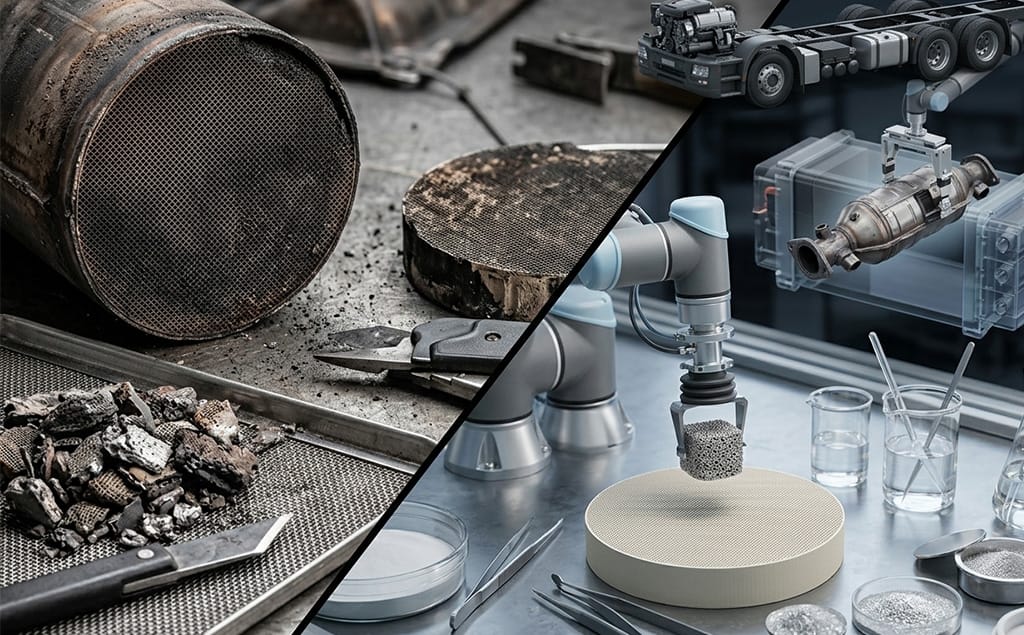
- Recyclingfähigkeit: The NEXT-GEN-CAT project, for instance, investigated the recyclability of TWCs, examining end-of-life scenarios and using LCA to determine the environmental impact of developed materials [1][5]. Pyro-metallurgical treatment (smelting in an inert atmosphere) was explored for efficient PGM recovery from spent catalysts [1][5]. Future research will likely focus on more energy-efficient and environmentally friendly recycling processes for both PGMs and base metals.
Proaktive Lösungen und Spekulationen: Über die aktuelle Forschung hinaus könnten zukünftige Richtungen Folgendes umfassen:
- Intelligente Katalysatoren: Katalysatoren, die ihre Eigenschaften (z. B. Oberflächenstruktur, Sauerstoffspeicherkapazität) dynamisch an die Abgasbedingungen in Echtzeit anpassen können, möglicherweise unter Verwendung eingebetteter Sensoren und KI-gesteuerter Steuerungssysteme.
- Integrierte Abgasnachbehandlungssysteme: Ein Übergang zu kompakteren, multifunktionalen Abgassystemen, die die TWC-Funktionalität mit anderen Emissionskontrolltechnologien (z. B. selektive katalytische Reduktion von NOx, fortschrittliche Partikelfilter) in einer einzigen, hochoptimierten Einheit kombinieren.
- Additive Fertigung: Der Einsatz von 3D-Druck oder anderen additiven Fertigungsverfahren zur Herstellung hochgradig individueller und optimierter Substrat- und Washcoat-Strukturen ermöglicht eine beispiellose Kontrolle über Porengrößenverteilung, Kanalgeometrie und Katalysatorplatzierung. Dies könnte zu einem deutlich verbesserten Massentransfer und einer höheren katalytischen Effizienz führen.
- Bioinspirierte Katalyse: Erforschung katalytischer Mechanismen in biologischen Systemen zur Entwicklung neuartiger, hocheffizienter und potenziell nachhaltigerer Katalysatoren.
Die laufenden Innovationen in der Materialwissenschaft und der chemischen Verfahrenstechnik werden die Grenzen der Leistungsfähigkeit von Dreiwegekatalysatoren weiter verschieben und dafür sorgen, dass Benzinfahrzeuge immer strengere Umweltziele erreichen und gleichzeitig ihren ökologischen Fußabdruck minimieren können.