1. Introducción a los convertidores catalíticos de 3 vías en vehículos de gasolina
The automotive industry’s relentless pursuit of reduced environmental impact has positioned the 3-way catalytic converter (TWC) as a cornerstone technology for controlling harmful emissions from gasoline internal combustion engines. This report delves into the intricate material science and engineering behind these critical components, focusing specifically on their application in gasoline vehicles. The TWC is a sophisticated chemical reactor designed to simultaneously mitigate three primary pollutants found in engine exhaust: carbon monoxide (CO), unburnt hydrocarbons (HC), and nitrogen oxides (NOx) [1][5].
Operating within a tightly controlled environment, the TWC functions optimally when the engine’s air-fuel ratio is maintained near the stoichiometric point, precisely regulated by a lambda sensor in a closed-loop feedback system [5]. This precise control is crucial because the catalyst must facilitate both oxidation (for CO and HC) and reduction (for NOx) reactions concurrently. The evolution of TWCs has progressed from simpler oxidation catalysts to dual-bed systems, culminating in the highly efficient single-bed TWCs prevalent today, which are designed for thermal stability and rapid activation, often mounted close to the exhaust manifold [1][3]. The continuous tightening of global emission standards for CO, HC, NOx, and particulate matter is a primary driver for ongoing advancements in catalyst design and material innovation [1][6].
2. Materiales y propiedades del sustrato catalítico
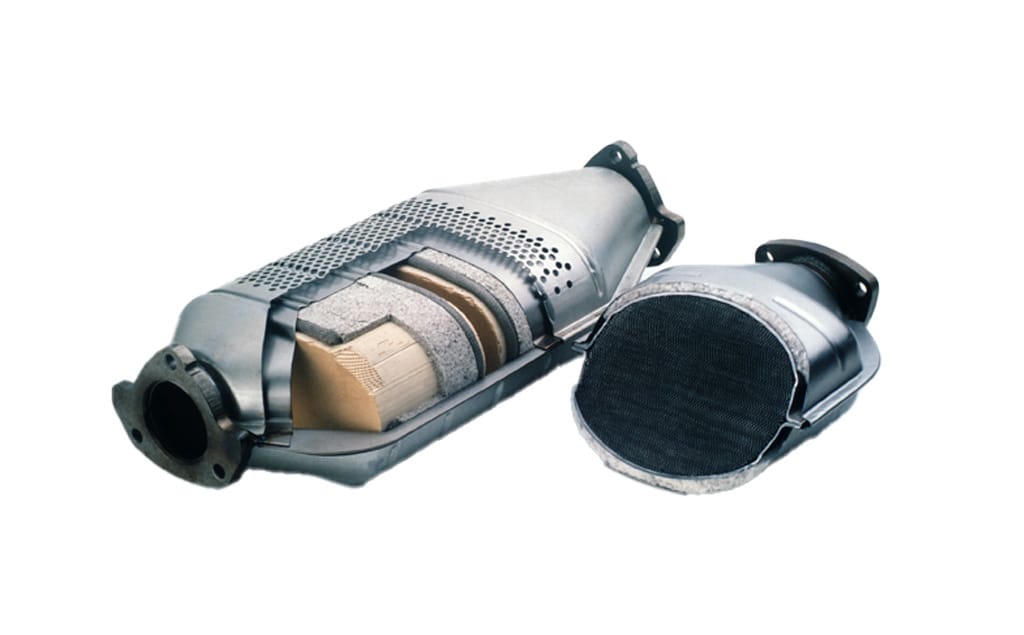
The foundation of a 3-way catalytic converter is its monolithic substrate, which provides the structural support for the catalytically active materials. While metallic substrates are also used, ceramic honeycomb structures, primarily made from cordierite, are the most common choice due to their advantageous properties [6]. Cordierite is a magnesium iron aluminum cyclosilicate mineral with the chemical formula (Mg,Fe)₂Al₄Si₅O₁₈.
Su singular estructura cristalina permite la formación de una matriz altamente porosa, similar a un panal, con miles de canales paralelos. La estructura física del sustrato de cordierita es crucial para su funcionamiento. Generalmente presenta una alta densidad celular (células por pulgada cuadrada, cpsi), lo que se traduce en una gran superficie geométrica dentro de un volumen compacto. Esto maximiza el contacto entre los gases de escape y la capa de recubrimiento catalítico.
Las propiedades clave que hacen de la cordierita un material de sustrato ideal incluyen:
- Thermal Stability: Excelente resistencia al choque térmico, soportando cambios rápidos de temperatura ambiente a más de 1000°C.
- Baja expansión térmica: Previene tensiones y grietas debidas a gradientes de temperatura.
- Resistencia mecánica: Suficientemente robusto para soportar vibraciones e impactos.
- Gran superficie: Favorece una aplicación eficaz del revestimiento de lavado.
- Baja caída de presión: Los canales rectos preservan el rendimiento del motor al minimizar la resistencia al flujo de escape.
Design parameters like length and cell density are often optimized using simulation software such as Solidworks [7].
3. Formulaciones de recubrimientos de lavado y funciones funcionales
El washcoat es una capa de óxido poroso que se aplica al sustrato y que permite una alta dispersión y estabilidad de los metales preciosos.
- Gamma-alúmina (γ-Al2O3):Gran superficie (100–200 m²/g), favorece la dispersión de metales preciosos.
- Ceria-Zirconia (CeO₂-ZrO₂):Ceria (CeO₂) is indispensable for its remarkable oxygen storage capacity (OSC)[1][2]. It undergoes reversible redox reactions:2CeO₂ ⇌ Ce₂O₃ + ½O₂The addition of zirconia (ZrO₂) forms a solid solution, CeO₂-ZrO₂, enhancing thermal stability and oxygen mobility. Ceria-zirconia-yttria mixed oxides (CZY) are considered the industry standard .
- Otros estabilizadores:El óxido de lantano (La₂O₃), el óxido de bario (BaO) y el óxido de neodimio (Nd₂O₃) mejoran la estabilidad de la superficie y la resistencia al veneno.
The washcoat is applied as a slurry and then calcined, forming a highly porous, rough surface that maximizes the contact area for the exhaust gases and provides a stable platform for the precious metals. Some advanced TWC designs utilize double-layer washcoats, where different precious metals (e.g., Pd/Pt in one layer and Rh in another) are supported on specific ceria- or zirconia-based oxides to prevent sintering and optimize their individual catalytic functions [1][3]. The development of mesoporous oxide supports with optimal pore geometries is an ongoing area of research, aiming to reduce catalyst size and weight while significantly decreasing the required precious metal loadings [7].
4. Catalizadores de metales preciosos: composición y mecanismos
El corazón catalítico de un TWC se basa en metales del grupo del platino (PGM):
- Platino (Pt): Cataliza la oxidación:
- CO + ½O₂ → CO₂
- CₓHᵧ + (x + y/4)O₂ → xCO₂ + y/2 H₂O
- Paladio (Pd): Cataliza la oxidación y la reducción moderada de NOx. Funciona bien a bajas temperaturas y tiene capacidad de almacenamiento de oxígeno.
- Rodio (Rh): Crucial para la reducción de NOx:
- 2NO + 2CO → N₂ + 2CO₂
- 2NO₂ + 4CO₂ → N₂ + 4CO₂
- 2NOₓ → N₂ + xO₂
The typical ratios of these PGMs vary depending on the specific application, engine type, and emission targets, but a common formulation might involve a higher proportion of palladium, followed by platinum, and a smaller but critical amount of rhodium. For instance, the platinum-based segment alone held over 40% of the market share in 2024 [6]. The chemical forms of these metals on the washcoat are typically highly dispersed nanoparticles, which maximize the active surface area for reactions. Modified impregnation procedures, such as using toluene, can produce well-dispersed Pt nanoparticles on various hydrophobic materials, showing good activity for CO and propane oxidation [1][2].
The reliance on PGMs presents significant cost and supply chain challenges due to their scarcity and price volatility [1][6]. This has driven extensive research into reducing PGM content or developing entirely PGM-free alternatives. While iridium, ruthenium, and osmium are also PGMs, they are generally not suitable for TWC conditions due to the volatility or toxicity of their oxide forms under exhaust conditions, effectively limiting the choice to Pt, Pd, and Rh [1].
5. Materiales de carcasa y embalaje
Más allá del núcleo catalítico, la integridad estructural y la gestión térmica del convertidor catalítico de 3 vías están garantizadas por los materiales de su carcasa y embalaje. Estos componentes están diseñados para proteger el frágil sustrato cerámico, aislarlo de temperaturas extremas y proporcionar un punto de montaje seguro dentro del sistema de escape del vehículo.
- Carcasa externa (carcasa): La carcasa exterior normalmente está construida a partir de acero inoxidable, often featuring a double-layered design with an integrated heat shield [9]. Stainless steel is chosen for its excellent corrosion resistance, particularly against the corrosive exhaust gases and external environmental factors, and its ability to withstand high temperatures. The double-layered shell serves multiple functions:
- Integridad estructural: Proporciona protección mecánica robusta para el bloque catalizador interno, protegiéndolo de los residuos de la carretera, los impactos y las vibraciones.
- Aislamiento térmico: El espacio de aire entre las capas dobles, o la presencia de un escudo térmico, ayuda a reducir la radiación de calor del catalizador caliente, protegiendo los componentes circundantes del vehículo y reduciendo el riesgo de quemaduras.
- Prevención de la piel oxidada: It prevents the formation of an oxide skin on the catalyst surface, which could otherwise block the catalytic sites and reduce efficiency [9].
- Montaje: Proporciona las bridas y conexiones necesarias para la integración en el sistema de escape.
- Estera intumescente interna: Entre el sustrato cerámico y la carcasa de acero inoxidable, hay un esteras intumescentes El material se empaqueta. Esta estera suele estar hecha de fibras cerámicas (p. ej., fibras de alúmina y sílice), diseñadas para expandirse significativamente al calentarse. Sus funciones son cruciales para la durabilidad y el rendimiento del convertidor:
- Protección mecánica y amortiguación: Actúa como amortiguador, protegiendo el frágil sustrato cerámico de las vibraciones y tensiones mecánicas causadas por el movimiento del vehículo y las pulsaciones del escape. Esto evita que el sustrato se agriete o se rompa.
- Aislamiento térmico: La estera proporciona un aislamiento térmico adicional, reduciendo la pérdida de calor del catalizador y ayudándolo a alcanzar su temperatura de funcionamiento más rápidamente (temperatura de encendido).
- Montaje seguro: A medida que se expande al calentarse, la estera intumescente ejerce una fuerza de compresión sobre el ladrillo cerámico, sujetándolo firmemente en su lugar dentro de la carcasa de acero y evitando que se mueva o traquetee.
- Caza de focas: It also provides a seal, preventing exhaust gases from bypassing the catalyst brick and ensuring that all gases flow through the active catalytic channels. Other vibration damping layers, such as metal mesh pads or ceramic gaskets, may also be used [9].
La cuidadosa selección e integración de estos materiales de carcasa y embalaje son esenciales para la confiabilidad y el rendimiento a largo plazo del convertidor catalítico de 3 vías, garantizando que pueda soportar el duro entorno operativo de un sistema de escape de un automóvil.
6. Consideraciones integradas sobre rendimiento, durabilidad y costos del material
La eficacia de un convertidor catalítico de 3 vías es consecuencia directa de la interacción sinérgica entre todos los materiales que lo componen: el sustrato, el revestimiento, los metales preciosos y la carcasa. Su rendimiento conjunto determina la actividad catalítica general, la durabilidad térmica, la robustez mecánica y, en última instancia, la rentabilidad de todo el sistema.
Actividad y eficiencia catalítica: The primary goal is to achieve high conversion efficiency for CO, HC, and NOx across a wide range of operating conditions. This is largely driven by the precious metals (Pt, Pd, Rh) and their dispersion on the high-surface-area washcoat [1]. The washcoat’s oxygen storage capacity, provided by ceria-zirconia, is crucial for maintaining high efficiency under fluctuating air-fuel ratios, acting as an oxygen buffer [1][2]. Computer models are extensively used to optimize catalyst loadings and layouts, enabling high performance even with reduced PGM content [1][3].
Durabilidad térmica: Las temperaturas de escape de los automóviles pueden alcanzar más de 1000 °C, lo que hace que la durabilidad térmica sea una preocupación primordial.
- Sustrato: Cordierite’s low thermal expansion and high thermal shock resistance prevent cracking and structural degradation [6].
- Capa de lavado: The incorporation of zirconia into ceria (CeO₂-ZrO₂) significantly enhances the thermal stability of the oxygen storage component, preventing sintering and loss of surface area [7]. Advanced washcoat designs, such as double layers, can also help prevent sintering of PGMs at high temperatures [1][3].
- Metales preciosos: PGM sintering (agglomeration of nanoparticles into larger, less active particles) is a major cause of catalyst deactivation at high temperatures. The washcoat’s ability to disperse and stabilize PGMs is critical. Novel perovskite-based catalysts, for example, have shown superior thermal stability and resistance to activity loss even after hydrothermal aging at 1273K(1000°C), compared to standard dispersed metal catalysts [3][8]. This enhanced stability is often attributed to the substitution of palladium into the perovskite structure, which makes it less prone to sintering [8].
Robustez mecánica: El convertidor debe soportar tensiones mecánicas importantes, incluidas vibraciones del motor y de la carretera, así como impactos físicos.
- Alojamiento: The stainless steel shell provides the primary structural integrity and protection [9].
- Estera intumescente: This material is vital for cushioning the brittle ceramic substrate, absorbing vibrations, and securely holding the catalyst brick in place, preventing mechanical damage [9].
Costo-efectividad: El costo es un factor clave en la fabricación de automóviles. El factor de costo más significativo en un TWC es el contenido de metales preciosos [6]. The market for automotive three-way catalytic converters was valued at USD 11.2 billion in 2024, with the platinum-based segment alone projected to exceed USD 7 billion by 2034 [6].
- Volatilidad del precio de PGM: The fluctuating prices and secure supply of platinum, palladium, and rhodium directly impact manufacturing costs [6].
- Innovación tecnológica: Manufacturers are continuously innovating to enhance fuel economy and reduce PGM loadings while maintaining or improving conversion efficiency and durability [6]. Projects like PROMETHEUS aim to reduce PGM content, potentially cutting production costs by up to 50% while maintaining or enhancing performance [1][4].
- Optimización del proceso de fabricación: The design and preparation techniques for catalyst supports, such as cost-effective methods for creating mesoporous materials, also contribute to overall cost reduction [7].
- Durabilidad vs. Costo: There is a constant trade-off between achieving high durability (which often requires more robust, sometimes more expensive, materials or higher PGM loadings) and managing production costs. The development of more thermally stable catalysts, like perovskites, can extend the converter’s lifespan, offering long-term cost benefits despite potentially higher initial material costs [3][8].
The overall market growth for TWCs is driven by increasing vehicle sales, stricter emissions regulations, and the demand for fuel-efficient vehicles, all of which necessitate continuous material and process innovation [6]. On-road monitoring of TWC performance, often via oxygen storage capacity measurements, further ensures that these complex material systems meet real-world emission targets throughout their operational life [3].
7. Materiales emergentes y direcciones futuras
The landscape of catalytic converter technology is continuously evolving, driven by increasingly stringent global emission standards and the imperative to reduce reliance on expensive and scarce Platinum Group Metals (PGMs) [1][6]. Future directions in 3-way catalytic converters focus on novel materials, advanced manufacturing techniques, and integrated systems to achieve superior performance, enhanced durability, and improved sustainability.
Reducción de la dependencia de PGM y catalizadores no PGM: The high cost and limited supply of Pt, Pd, and Rh are major motivators for research into PGM-free or low-PGM alternatives [1][6].
- Óxidos de metales de transición: Materiales como zeolita, óxido de níquel y otros óxidos metálicos are being extensively explored as potential replacements for PGMs [1]. These materials offer lower cost and greater abundance.
- Catalizadores basados en perovskita: Óxidos metálicos complejos con estructuras de perovskita (por ejemplo, ABO3 Son una clase prometedora de catalizadores no PGM. Por ejemplo, dopado con cobre Perovskitas LaCo₁−xCuxO₃ are under investigation as PGM-free catalysts for TWCs [1][4]. These materials can exhibit high thermal stability and catalytic activity, sometimes even surpassing traditional PGM catalysts in specific conditions [3][8]. Mechanochemical synthesis, including high-energy ball milling, is being used to create such perovskites [1].
- Integración de la nanotecnología: Projects like NEXT-GEN-CAT have focused on incorporating low-cost transition metals into advanced ceramic substrates using nanotechnology to develop efficient catalysts [1][5]. Prototypes with low-PGM and no-PGM formulations have demonstrated compliance with Euro III emission standards, showcasing the viability of these approaches [1][5].
Desarrollo avanzado de capa de lavado: Washcoat and catalyst development remain critical focus areas [1].
- Soportes de óxido mesoporoso: Research continues into developing mesoporous oxide supports with optimized pore geometries. These structures can significantly increase the active surface area and improve the dispersion of catalytic components, potentially allowing for further reductions in metal loadings while maintaining or enhancing performance [7].
- Nuevos métodos de preparación: Se están explorando métodos avanzados de preparación para crear catalizadores más eficaces y duraderos. Estos incluyen:
- Tratamiento ultrasónico combinado con galvanoplastia: Para la deposición y dispersión precisa de materiales activos.
- Método del citrato: Un método común de tipo sol-gel para sintetizar óxidos metálicos mixtos con alta homogeneidad.
- Oxidación electrolítica de plasma (PEO): For creating porous oxide layers on metallic substrates, which can then be functionalized with catalytic materials [1].
Abordar las futuras regulaciones sobre emisiones: Global emission standards are becoming progressively stricter, pushing the boundaries of current TWC technology [1][6].
- Emisiones de arranque en frío: Un desafío importante es el período de arranque en frío, donde el catalizador aún no ha alcanzado su temperatura de encendido y es en gran medida ineficaz. Las futuras investigaciones en materiales buscan desarrollar catalizadores que se activen a temperaturas mucho más bajas o que se integren con catalizadores calentados eléctricamente (EHC) o trampas de hidrocarburos para mitigar las emisiones del arranque en frío.
- Emisiones en condiciones reales de conducción (RDE): Regulations are increasingly focusing on real-world driving emissions rather than just laboratory tests. This necessitates catalysts that perform robustly and efficiently across a wider range of temperatures, speeds, and load conditions. On-road monitoring of oxygen storage capacity is already a step in this direction [3].
- Control de materia particulada (PM): Si bien los TWC se centran principalmente en los contaminantes gaseosos, las reglamentaciones futuras pueden requerir soluciones integradas para PM, lo que podría conducir a una adopción más amplia de filtros de partículas de gasolina (GPF) junto con los TWC, o al desarrollo de catalizadores con capacidades inherentes de reducción de PM.
Sostenibilidad y Economía Circular: The transition to “green” mobility and the increasing focus on sustainability are driving efforts in recyclability and life cycle assessment (LCA) [1][5].
- Reciclabilidad: The NEXT-GEN-CAT project, for instance, investigated the recyclability of TWCs, examining end-of-life scenarios and using LCA to determine the environmental impact of developed materials [1][5]. Pyro-metallurgical treatment (smelting in an inert atmosphere) was explored for efficient PGM recovery from spent catalysts [1][5]. Future research will likely focus on more energy-efficient and environmentally friendly recycling processes for both PGMs and base metals.
Soluciones proactivas y especulación: Más allá de la investigación actual, las direcciones futuras podrían incluir:
- Catalizadores inteligentes: Catalizadores que pueden ajustar dinámicamente sus propiedades (por ejemplo, estructura de la superficie, capacidad de almacenamiento de oxígeno) en respuesta a las condiciones de escape en tiempo real, potencialmente utilizando sensores integrados y sistemas de control impulsados por IA.
- Sistemas integrados de postratamiento de gases de escape: Una transición hacia sistemas de escape más compactos y multifuncionales que combinan la funcionalidad TWC con otras tecnologías de control de emisiones (por ejemplo, reducción catalítica selectiva para NOx, filtros de partículas avanzados) en una única unidad altamente optimizada.
- Fabricación aditiva: El uso de la impresión 3D u otras técnicas de fabricación aditiva para crear estructuras de sustrato y revestimiento altamente personalizadas y optimizadas permite un control sin precedentes sobre la distribución del tamaño de poro, la geometría del canal y la colocación del catalizador. Esto podría mejorar significativamente la transferencia de masa y la eficiencia catalítica.
- Catálisis bioinspirada: Exploración de los mecanismos catalíticos encontrados en los sistemas biológicos para diseñar catalizadores nuevos, altamente eficientes y potencialmente más sostenibles.
La innovación continua en la ciencia de los materiales y la ingeniería química seguirá ampliando los límites del rendimiento de los convertidores catalíticos de tres vías, lo que garantizará que los vehículos de gasolina puedan cumplir objetivos ambientales cada vez más estrictos y, al mismo tiempo, minimizar su huella ecológica.objetivos ambientales cada vez más estrictos y, al mismo tiempo, minimizar su huella ecológica.