三元触媒コンバーター:成功に不可欠な3つの金属

三元触媒コンバーター:成功に不可欠な3つの金属
Learn the technical roles of platinum, palladium, and rhodium in a three way catalytic converter. This guide covers emission chemistry, recycling, and market value.

目次

導入

The modern automotive landscape depends on the 三元触媒コンバーター. This device represents a pinnacle of chemical engineering. It resides within the exhaust system of nearly every internal combustion vehicle on the road today. Its primary mission is simple yet profound. It neutralizes toxic gases before they enter our atmosphere. Without this technology, urban air quality would be catastrophic. The 三元触媒コンバーター specifically targets three major pollutants. These are carbon monoxide (CO), unburned hydrocarbons (HC), and nitrogen oxides (NOx).

To perform this task, the device utilizes a group of rare elements. These are the Platinum Group Metals (PGMs). Platinum, palladium, and rhodium serve as the active agents. They act as catalysts in complex chemical reactions. A catalyst triggers a reaction without being consumed. This article provides a comprehensive technical analysis of these metals. We will explore their chemical roles, economic value, and environmental necessity.

The Evolution of Emission Control Technology

Engineers did not invent the three way catalytic converter overnight. It evolved over decades of research. In the early 1970s, air pollution reached dangerous levels in major cities. Governments responded with strict regulations. The U.S. Clean Air Act of 1970 was a turning point. Early converters were “two-way” devices. They only oxidized carbon monoxide and hydrocarbons. They ignored nitrogen oxides. By the 1980s, the 三元触媒コンバーター emerged. This new design used rhodium to tackle NOx. This innovation revolutionized the industry. Today, these devices are more efficient than ever. They convert over 90% of harmful engine emissions into harmless gases.

触媒コンバータの歴史——三方向の進化03
触媒コンバータの歴史 - 三つの進化

Global Emission Standards

Different regions have different rules. In Europe, we have the “Euro” standards. Euro 1 started in 1992. It made the 三元触媒コンバーター mandatory for all gasoline cars. We are now at Euro 6. This standard is incredibly strict. It requires advanced catalyst formulations. In the United States, the EPA sets the rules. Tier 1, Tier 2, and Tier 3 standards have pushed the industry forward. Each new standard requires more precious metals. It also requires better engine management. The 三元触媒コンバーター must now work for the entire life of the car. This is often defined as 150,000 miles.

排出ガス基準と触媒コンバータ設計への影響を理解する

Detailed Anatomy of the Three Way Catalytic Converter

三元触媒コンバーター is a sophisticated assembly. It must withstand extreme heat and chemical stress. The structure consists of several critical layers.

The Stainless Steel Housing

The outer shell uses high-grade stainless steel. This material resists rust and physical damage. It protects the delicate internal components from road debris and weather. It also handles the thermal expansion of the internal parts.

The Ceramic Substrate

Inside the shell lies a ceramic monolith. Most manufacturers use cordierite for this purpose. Cordierite is a magnesium aluminum silicate. It has a very low thermal expansion coefficient. This prevents the substrate from cracking during rapid temperature changes. The substrate features a honeycomb pattern. This pattern contains thousands of tiny channels. This design provides a massive surface area. A larger surface area allows more exhaust gas to contact the catalyst. The “cell density” is measured in cells per square inch (CPSI). Most modern cars use 400 to 600 CPSI.

The Washcoat Layer

The washcoat is a porous material. It covers the walls of the honeycomb channels. It usually consists of aluminum oxide (Al2O3). The washcoat creates a rough, irregular surface. This further increases the effective surface area. It also contains stabilizers like ceria (CeO2) and zirconia (ZrO2). These stabilizers store oxygen. They release oxygen when the engine runs “rich” (too much fuel). They absorb oxygen when the engine runs “lean” (too much air). This oxygen storage capacity (OSC) is vital for the 三元触媒コンバーター.

The Precious Metal Loading

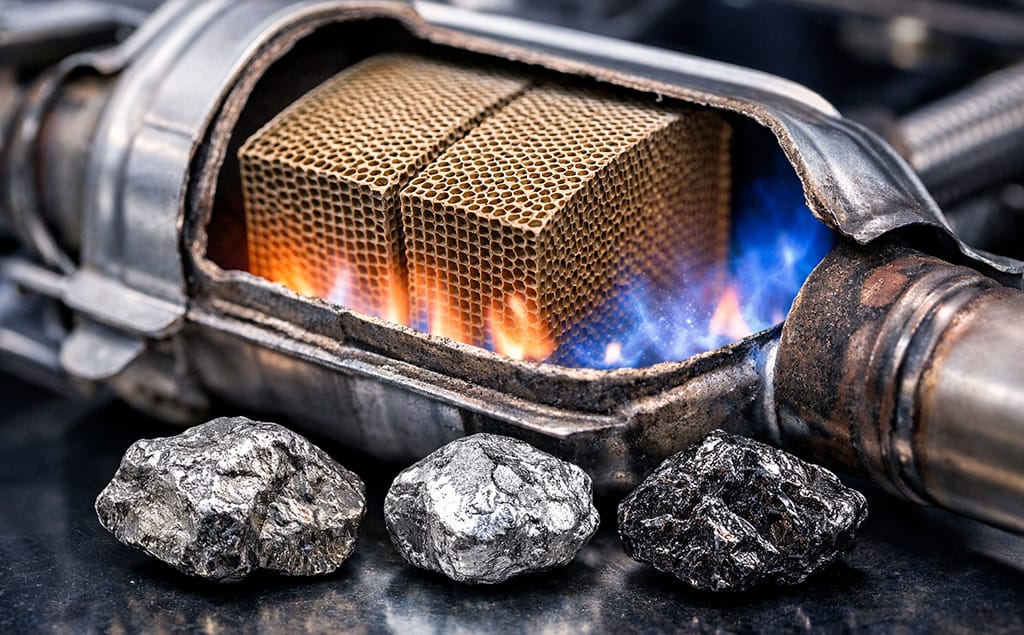
The final layer consists of the PGMs. Platinum, palladium, and rhodium are dispersed across the washcoat. They exist as microscopic particles. This ensures maximum exposure to the exhaust stream. The ratio of these metals varies by engine type and emission goals. Manufacturers use “loading” to describe the amount of metal. This is usually measured in grams per cubic foot.

触媒コンバーターの内部構造(部品と貴金属)

The Core Chemistry: Oxidation and Reduction

その 三元触媒コンバーター performs two primary types of reactions. These are reduction and oxidation. These reactions happen simultaneously within the same device.

The Reduction of Nitrogen Oxides

Rhodium drives the reduction process. Nitrogen oxides (NOx) are a major component of smog. They also cause acid rain. Rhodium attacks the NOx molecules. It breaks the chemical bonds between nitrogen and oxygen. The oxygen atoms stay on the catalyst surface. The nitrogen atoms pair up to form N2 gas. N2 makes up 78% of our atmosphere. It is completely harmless. This reaction is most efficient when the engine is at the “stoichiometric” point.

The Oxidation of Carbon Monoxide

Platinum and palladium handle oxidation. Carbon monoxide (CO) is a deadly, odorless gas. The catalyst takes the oxygen atoms released during reduction. It attaches them to the CO molecules. This creates carbon dioxide (CO2). While CO2 is a greenhouse gas, it is not acutely toxic like CO. This reaction requires a high temperature to start.

The Oxidation of Hydrocarbons

Unburned hydrocarbons (HC) result from incomplete combustion. They contribute to ground-level ozone. Platinum and palladium oxidize these molecules as well. They break the HC chains. They combine the carbon with oxygen to form CO2. They combine the hydrogen with oxygen to form water vapor (H2O). This process is essential for meeting “Total Hydrocarbon” (THC) limits.

Platinum (Pt): The Reliable Oxidation Agent

Platinum is perhaps the most famous PGM. It has a long history in jewelry and industry. In a 三元触媒コンバーター, it is a workhorse for oxidation.

Performance in Diesel Systems

Diesel engines operate differently than gasoline engines. They always have an excess of oxygen. They also run at lower exhaust temperatures. Platinum is the ideal catalyst for these conditions. It initiates oxidation at lower temperatures than palladium. This “light-off” temperature is critical. It determines how quickly the converter starts working after the engine starts.

Chemical Stability

Platinum is highly resistant to chemical “poisoning.” It can handle small amounts of sulfur in the fuel. This durability makes it a preferred choice for heavy-duty applications. In gasoline engines, it often works in tandem with palladium to provide a balanced performance. It is also used in “Four-Way” catalysts for gasoline direct injection (GDI) engines.

Palladium (Pd): The High-Temperature Specialist

Palladium has seen a massive rise in automotive use. It is now the primary oxidation catalyst for gasoline engines.

Thermal Resilience

Gasoline engines generate intense heat. Exhaust temperatures can exceed 900 degrees Celsius. Palladium possesses incredible thermal stability. It does not degrade easily under these conditions. It resists “sintering.” Sintering is a process where small metal particles melt together. This reduces the active surface area. Palladium stays finely dispersed even at high heat.

Reactivity and Cost

Palladium is more reactive than platinum for certain hydrocarbon species. This makes it very efficient for modern gasoline engines. For many years, palladium was significantly cheaper than platinum. This led manufacturers to switch their formulations. However, the high demand has now made palladium prices very competitive with platinum. Today, palladium is the dominant metal in the three way catalytic converter market.

Rhodium (Rh): The Essential Reduction Catalyst

Rhodium is the rarest of the three metals. It is also the most critical for the “three-way” function. Without rhodium, we could not effectively control NOx emissions.

Unique Catalytic Properties

Rhodium has a unique ability to split NOx molecules. Neither platinum nor palladium can do this with the same efficiency. It is the only metal that can reliably meet modern NOx standards. Because it is so effective, manufacturers only need a small amount. However, even a small amount is expensive due to its extreme rarity.

Rarity and Value

Rhodium is a byproduct of platinum and nickel mining. Global production is very low. Only about 30 tonnes are produced annually. This scarcity leads to massive price volatility. Rhodium is often five to ten times more expensive than gold. This makes it the most valuable component of the 三元触媒コンバーター. It is the “bottleneck” for global catalyst production.

触媒コンバーターにはどれくらいのロジウムが含まれていますか?

Comparison Table of PGM Properties

The following table summarizes the key differences between the three metals.

財産プラチナ(Pt)パラジウム(Pd)ロジウム(Rh)
Primary Task酸化酸化削減
対象汚染物質CO, HCCO, HCNOx
Thermal Stability適度非常に高い高い
Poison Resistance高い適度高い
Common EngineDiesel / GasolineガソリンGasoline (TWC)
Relative Rarity高い高いExtremely High

Factors Affecting Catalyst Efficiency

Several factors influence how well a 三元触媒コンバーター performs.

Air-Fuel Ratio (Lambda)

その 三元触媒コンバーター works best at the “stoichiometric” point. This is the perfect balance of fuel and air. For gasoline, this ratio is 14.7 parts air to 1 part fuel. Modern cars use oxygen sensors to maintain this balance. If the engine runs too rich, there is not enough oxygen for oxidation. If it runs too lean, there is too much oxygen for reduction. The device needs a precise window to function. This is called the “Lambda Window.”

Operating Temperature

Catalysts do not work when they are cold. They need to reach a “light-off” temperature. This is usually around 250 to 300 degrees Celsius. Manufacturers place converters close to the engine to heat them up quickly. Some modern cars even use electric heaters for the catalyst. This is especially important for hybrid vehicles.

Space Velocity

Space velocity refers to how fast the exhaust gas flows through the converter. If the flow is too fast, the gases do not have enough time to react. Engineers size the 三元触媒コンバーター based on the engine’s displacement. A larger engine requires a larger converter.

The Economic Reality of PGMs

The high cost of PGMs impacts the entire automotive supply chain.

Market Volatility

PGM prices fluctuate based on global events. Most mining occurs in South Africa and Russia. Political instability in these regions causes immediate price spikes. For example, palladium prices tripled in a single year due to supply concerns. This volatility makes it hard for car companies to plan.

Impact on Vehicle Cost

The precious metal content can add hundreds of dollars to the cost of a new car. For luxury vehicles or large trucks, this cost is even higher. Manufacturers constantly look for ways to “thrift” or reduce the amount of PGMs used. They use advanced washcoat technology to make every microgram of metal count.

The Problem of Theft

The high value of rhodium and palladium has led to a global epidemic of catalytic converter theft. Thieves can remove a converter in less than a minute. They sell them to unscrupulous scrap yards for the metal content. This has forced many owners to install protective shields on their vehicles. Insurance companies have also seen a surge in claims.

Sustainability and the Circular Economy

Because PGMs are so rare, recycling is not just an option. It is a necessity.

The Recycling Process

Old converters are a “secondary mine.” Recyclers collect millions of units every year. They remove the ceramic honeycomb and grind it into powder. They use high-temperature smelting or chemical leaching to extract the metals. This process is highly efficient. It recovers over 95% of the platinum, palladium, and rhodium.

Environmental Benefits of Recycling

Mining new PGMs is incredibly destructive. It requires moving tons of earth for a few grams of metal. It uses massive amounts of water and energy. Recycling, by contrast, has a much smaller footprint. It reduces the need for new mines. It supports a circular economy where materials are reused indefinitely. The carbon footprint of recycled PGM is 90% lower than mined PGM.

PGM Usage and Recycling Statistics

The following data shows the scale of the PGM industry in the automotive sector.

金属Annual Automotive Demand (Tonnes)% From Recycled Sources
白金~9530%
パラジウム~31035%
ロジウム~3240%

Challenges in Modern Emission Control

As emission laws get stricter, the 三元触媒コンバーター faces new challenges.

Cold Start Emissions

Most emissions occur in the first 60 seconds after a cold start. Engineers are developing “close-coupled” converters. These sit directly on the exhaust manifold. They heat up almost instantly. They also use “hydrocarbon traps.” These materials soak up HC when cold and release them once the catalyst is hot.

Sulfur Poisoning

Sulfur in fuel is the enemy of the 三元触媒コンバーター. It bonds to the active sites of the PGMs. This blocks the chemical reactions. Most developed countries now mandate “ultra-low sulfur” fuel. This has significantly extended the life of modern converters.

Real-World Driving Emissions (RDE)

Regulators now test cars on actual roads, not just in labs. This requires the 三元触媒コンバーター to work under all conditions. This includes heavy acceleration and high speeds. This has led to more complex catalyst formulations and larger units.

The Future: Hybridization and Hydrogen

The transition to cleaner energy will change the role of PGMs.

Hybrid Vehicles

Hybrid cars still have internal combustion engines. They actually put more stress on the 三元触媒コンバーター. The engine turns off and on frequently. This causes the catalyst to cool down. To solve this, hybrids often use higher PGM loadings. They also use advanced thermal management systems.

Hydrogen Fuel Cells

Hydrogen fuel cell vehicles (FCEVs) are an emerging technology. They do not have an exhaust system. However, they still need platinum. The fuel cell uses platinum to split hydrogen molecules and generate electricity. This ensures that platinum will remain a vital automotive metal even after gasoline engines disappear.

Battery Electric Vehicles (BEVs)

BEVs do not use PGMs for propulsion. As the world shifts to BEVs, the demand for the 三元触媒コンバーター will eventually decline. However, this transition will take decades. Millions of internal combustion vehicles will remain on the road for a long time.

Deep Dive: The Washcoat Stabilizers

The washcoat is more than just a carrier. It is a chemical reactor. It contains “Oxygen Storage Components” (OSC). Ceria (CeO2) is the most important. It can switch between Ce4+ and Ce3+. When the exhaust is lean, it stores oxygen. When the exhaust is rich, it releases oxygen. This stabilizes the chemistry inside the three way catalytic converter. Zirconia (ZrO2) is added to ceria to improve its thermal stability. This prevents the ceria from losing its storage capacity at high temperatures.

The Role of Oxygen Sensors

三元触媒コンバーター cannot work alone. It needs a “Lambda Sensor.” This sensor sits before the converter. It measures the oxygen level in the exhaust. It sends a signal to the engine’s computer. The computer then adjusts the fuel injection. This keeps the engine in the narrow “Lambda Window.” Some cars have a second sensor after the converter. This sensor monitors the health of the three way catalytic converter. If the second sensor sees too much oxygen, it means the catalyst is failing.

Case Study: The Rhodium Price Spike

In 2021, rhodium prices reached $30,000 per ounce. This was a historic high. Several factors caused this. First, mining in South Africa was disrupted by the pandemic. Second, China implemented the “China 6” emission standard. This standard required much more rhodium in every 三元触媒コンバーター. The sudden surge in demand met a limited supply. This caused the price to explode. Car companies had to pay billions in extra costs. This event highlighted the fragility of the PGM supply chain.

結論

その 三元触媒コンバーター is a silent hero of environmental protection. It relies on the extraordinary properties of platinum, palladium, and rhodium. These metals facilitate the complex chemistry needed to clean our air. Platinum and palladium drive the oxidation of carbon monoxide and hydrocarbons. Rhodium enables the reduction of nitrogen oxides. Together, they mitigate the impact of the internal combustion engine. While the economic cost of these metals is high, the environmental benefit is priceless. Recycling provides a sustainable path forward. It ensures we can continue to benefit from these rare elements. As automotive technology evolves, the 三元触媒コンバーター will remain a cornerstone of global emission control.

Get Our Offer

Fill out the form below and we will contact you within 24 hours.

心配しないでください。すぐに上司に連絡してください。

急いで閉じないで、今すぐ弊社の上司に直接ご相談ください。通常 1 時間以内に返信いたします。