1. はじめに
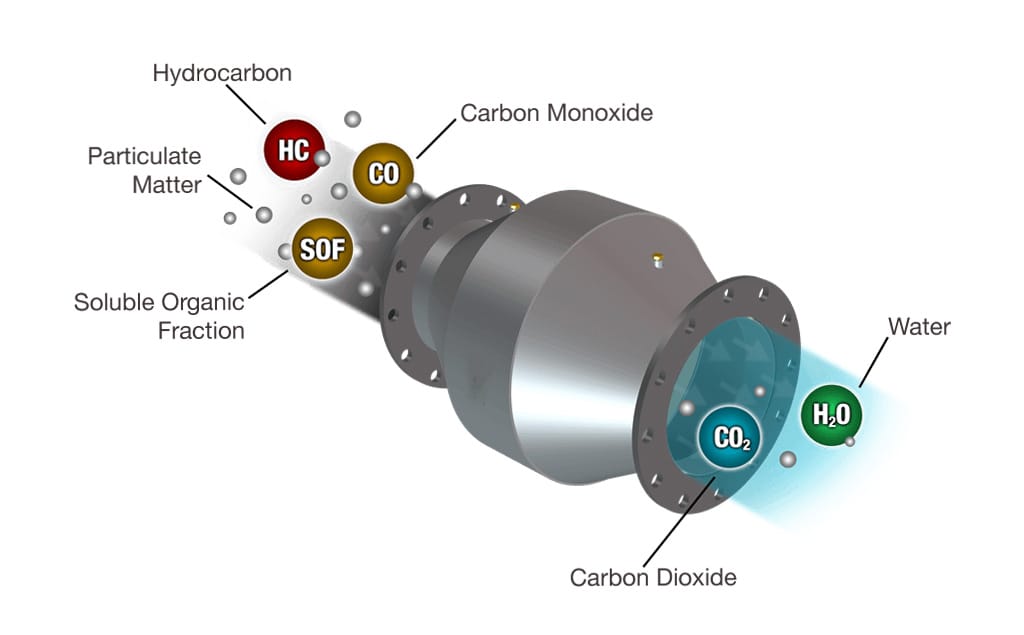
その 三元触媒コンバーター stands as a cornerstone of modern automotive emission control. It performs a vital task. It converts toxic exhaust gases into harmless substances. These gases include carbon monoxide (CO), hydrocarbons (HC), and nitrogen oxides (NOx). Engineers rely on coating loading to dictate the efficiency of these reactions. Coating loading refers to the density of the washcoat and the concentration of precious metals. This parameter determines how the 三元触媒コンバーター interacts with engine exhaust.
A precise balance in coating loading is essential. If the loading is too low, the vehicle fails emission tests. If the loading is too high, costs skyrocket and engine performance suffers. This article provides a deep technical analysis of how coating loading affects every aspect of the 三元触媒コンバーター. We will examine chemical activity, physical flow dynamics, and long-term durability.
2. Chemical Composition and the Role of the Washcoat
Every 三元触媒コンバーター features a complex internal structure. The substrate serves as the skeleton. The washcoat acts as the skin. The precious metals function as the active cells.
2.1 The Purpose of the Washcoat
The washcoat is a porous ceramic layer. It typically consists of aluminum oxide ($Al{2}O{3}$), cerium oxide ($CeO{2}$), and zirconium oxide ($ZrO{2}$). Manufacturers apply this slurry to the substrate channels. The washcoat creates a massive internal surface area. A single 三元触媒コンバーター can have a surface area equivalent to several football fields. This vast area provides a stage for chemical reactions.
2.2 Precious Metal Distribution
Precious metals reside within the washcoat structure. Palladium (Pd), Rhodium (Rh), and Platinum (Pt) are the primary players. Loading levels define the “active site” density. Each active site represents a location where a gas molecule can react. Higher loading means more active sites. However, the distribution must remain uniform. Poor distribution leads to “hot spots” and reduced efficiency.
3. How Loading Influences Conversion Efficiency
The primary goal of a 三元触媒コンバーター is conversion. Loading directly impacts the speed and completeness of this process.
3.1 Analyzing Non-Linear Performance Gains
Increasing the precious metal loading improves the conversion rate. However, this relationship is not linear. In the early stages of loading, performance gains are rapid. As the concentration increases, the benefit begins to taper off.
- The Plateau Effect: Once the loading reaches a specific threshold (e.g., 80 g/$ft^{3}$), the system hits a plateau.
- Saturation Limits: At this point, the reaction is no longer “kinetically limited.” Instead, it becomes “diffusion limited.”
- Waste of Resources: Adding more metal beyond this point increases cost without improving air quality.
3.2 Cold Start and Light-Off Temperature
Cold starts generate the majority of a vehicle’s total emissions. The 三元触媒コンバーター is cold when the engine starts. It cannot catalyze reactions until it reaches a “light-off” temperature (typically around $250^{\circ}C$ to $300^{\circ}C$).
- Loading Impact: Higher metal loadings lower the light-off temperature.
- Thermal Activation: A catalyst with high loading ignites the chemical reaction sooner.
- Emission Compliance: This rapid activation is crucial for meeting stringent environmental regulations.
4. Specific Roles of Palladium and Rhodium
あ 三元触媒コンバーター uses different metals for different tasks. The loading of each metal must be precisely tuned.
4.1 Palladium (Pd) and Hydrocarbon Control
Palladium is an oxidation specialist. It handles CO and HC.
- Oxygen Storage: High Pd loading enhances the Oxygen Storage Capacity (OSC).
- Chemical Buffering: It helps the 三元触媒コンバーター survive brief periods of “rich” or “lean” fuel mixtures.
- 耐久性: Pd offers excellent thermal stability under high-heat conditions.
4.2 Rhodium (Rh) and NOx Reduction
Rhodium is the most expensive and critical metal for reducing NOx.
- The Reduction Process: Rhodium breaks the bonds of nitrogen oxides. It releases pure nitrogen and oxygen.
- High-Speed Performance: Increased Rh loading ensures the converter works during high-speed driving.
- Sensitivity: Rhodium is sensitive to the surrounding chemical environment. Proper loading protects its activity.
| Loading Component | 主な機能 | Performance Benefit |
|---|---|---|
| High Washcoat Amount | Increases Surface Area | Provides more space for metals |
| High Palladium (Pd) | HC/CO Oxidation | Lowers light-off temperature |
| High Rhodium (Rh) | NOx Reduction | Improves efficiency under high load |
| Oxygen Storage (OSC) | Air-Fuel Balancing | Stabilizes the “lambda” window |
5. Physical Dynamics: Pressure Drop and Backpressure
その 三元触媒コンバーター is a physical barrier in the exhaust path. Coating loading changes the shape of this barrier.
5.1 Washcoat Thickness and Channel Diameter
As the manufacturer adds more washcoat, the layer on the channel walls grows thicker.
- OFA Reduction: This reduces the Open Frontal Area (OFA).
- Airflow Resistance: Thicker coatings narrow the “pipes” through which gas flows.
- Backpressure Rise: Narrower channels increase exhaust backpressure. This forces the engine to push harder to expel gas.
5.2 Impact on Engine Performance
High backpressure is an enemy of efficiency.
- Fuel Economy: Increased backpressure lowers the vehicle’s miles per gallon.
- Power Loss: The engine loses horsepower because it cannot “breathe” effectively.
- Turbocharger Stress: ターボチャージャー付きエンジンでは、背圧が高くなるとタービンの熱と摩耗が増加します。
6. Mass Transfer and Internal Resistance
排気ガスは流路の中心からウォッシュコートの細孔へと移動する必要があります。これを物質移動と呼びます。
6.1 「無駄な材料」問題
ウォッシュコートの負荷が高すぎると、層が厚くなりすぎます($>30\ \mu m$)。
- 拡散限界: ガス分子は厚いコーティングの底まで到達できません。
- 非アクティブなレイヤー: コーティングのベースにある貴金属は排気ガスに触れることはありません。
- 経済の非効率性: 製造業者は役に立たない金属にお金を支払います。
6.2 細孔構造の最適化
モダンな 三元触媒コンバーター 設計は細孔構造に重点を置いています。エンジニアはガスがより深層まで到達できるように「マクロ細孔」を作成します。しかし、高負荷をかけるとこれらの細孔が詰まってしまい、建築上の利点が損なわれることがよくあります。
7. Durability and Long-Term Stability
あ 三元触媒コンバーター 150,000マイル以上は機能する必要があります。触媒の経年劣化への対応は、触媒の負荷レベルによって左右されます。
7.1 焼結のメカニズム
焼結は、高温によって金属粒子が移動し、凝集するときに発生します。
- 表面積の損失: 凝集により、全体の有効表面積が減少します。
- パラドックスの読み込み: ある程度の荷重をかけると安定性が向上しますが、過剰な荷重をかけると焼結が促進されます。
- 水熱老化: 高い湿度と熱により、この劣化が加速されます。
7.2 中毒と不活性化
排気ガスにはリンや硫黄などの「毒物」が含まれています。
- サイトのブロック: これらの毒は活性部位に結合します。
- ロードバッファ: 初期負荷を高くすると「バッファー」が確保され、 三元触媒コンバーター 排出基準を満たしながらも、いくつかの施設を閉鎖する。
8. Advanced Strategies: Zone Coating and cGPF
コスト、背圧、効率の間の矛盾を解決するために、業界では高度なコーティング戦略が採用されています。
8.1 ゾーンコーティングのロジック
メーカーは全体をコーティングしない 三元触媒コンバーター 基質を均等に。
- フロントゾーン: 最初の1~2インチに高濃度の貴金属を塗布することで、迅速な着火を実現します。
- 後方ゾーン: 残りの長さには低い荷重をかけます。これにより、変換を完了しながらコストを削減できます。
- 効率: ゾーンコーティングは、貴金属 1 グラムあたりの最高のパフォーマンスを提供します。
8.2 TWCコーティングガソリン微粒子フィルター(cGPF)
現代の直噴エンジンは煤を排出します。cGPFはこの煤を捕集し、 三元触媒コンバーター ガスを処理するためのコーティング。
- 積載チャレンジ: フィルターのパスは標準の基板よりもはるかに狭くなります。
- プレッシャーリスク: cGPF の負荷が高いと、極端な圧力低下が発生する場合があります。
- 繊細なバランス: Engineers must use very low washcoat loadings (often $<100\ g/L$) to maintain engine health.
9. Conclusion: The Future of Coating Optimization
その 三元触媒コンバーター クリーンエアを実現する最も効果的なツールであり続けています。コーティングの充填量は、その設計において最も重要な変数です。充填量が多いほど化学活性が向上し、着火温度が低下することが分かっています。また、過剰な充填量は背圧によってエンジンに悪影響を与え、物質移動抵抗によって材料の無駄が増えることも判明しました。
将来、メーカーはより精密なコーティング技術を採用し、原子レベルの金属分布に焦点を当てるようになるだろう。これにより、 三元触媒コンバーター より少ない貴金属でより高い効率を達成すること。完璧な積載バランスの達成は単なる技術的な目標ではなく、経済的にも環境的にも不可欠な要素です。