1. 가솔린 차량용 3원 촉매 변환기 소개
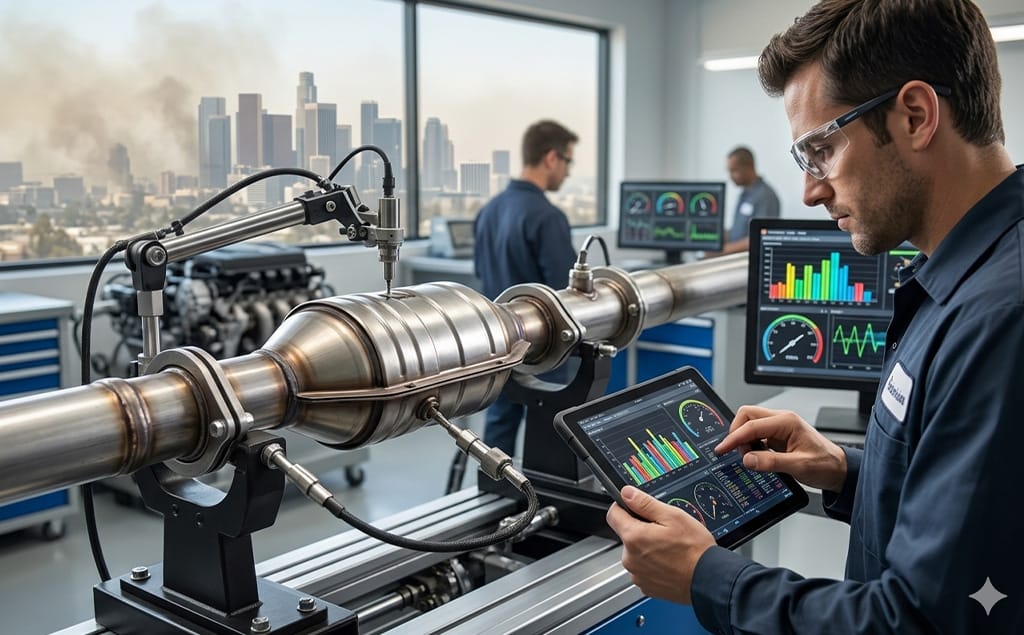
The automotive industry’s relentless pursuit of reduced environmental impact has positioned the 3-way catalytic converter (TWC) as a cornerstone technology for controlling harmful emissions from gasoline internal combustion engines. This report delves into the intricate material science and engineering behind these critical components, focusing specifically on their application in gasoline vehicles. The TWC is a sophisticated chemical reactor designed to simultaneously mitigate three primary pollutants found in engine exhaust: carbon monoxide (CO), unburnt hydrocarbons (HC), and nitrogen oxides (NOx) [1][5].
Operating within a tightly controlled environment, the TWC functions optimally when the engine’s air-fuel ratio is maintained near the stoichiometric point, precisely regulated by a lambda sensor in a closed-loop feedback system [5]. This precise control is crucial because the catalyst must facilitate both oxidation (for CO and HC) and reduction (for NOx) reactions concurrently. The evolution of TWCs has progressed from simpler oxidation catalysts to dual-bed systems, culminating in the highly efficient single-bed TWCs prevalent today, which are designed for thermal stability and rapid activation, often mounted close to the exhaust manifold [1][3]. The continuous tightening of global emission standards for CO, HC, NOx, and particulate matter is a primary driver for ongoing advancements in catalyst design and material innovation [1][6].
2. 촉매 기질 재료 및 특성
The foundation of a 3-way catalytic converter is its monolithic substrate, which provides the structural support for the catalytically active materials. While metallic substrates are also used, ceramic honeycomb structures, primarily made from cordierite, are the most common choice due to their advantageous properties [6]. Cordierite is a magnesium iron aluminum cyclosilicate mineral with the chemical formula (Mg,Fe)₂Al₄Si₅O₁₈.
독특한 결정 구조는 수천 개의 평행한 채널을 가진 매우 다공성의 벌집 모양 매트릭스를 형성합니다. 코디어라이트 기질의 물리적 구조는 그 기능에 매우 중요합니다. 일반적으로 높은 셀 밀도(제곱인치당 셀 수, cpsi)를 특징으로 하며, 이는 컴팩트한 부피 내에서 넓은 기하학적 표면적을 의미합니다. 이는 배기 가스와 촉매 워시코트 간의 접촉을 극대화합니다.
코디에라이트를 이상적인 기질 재료로 만드는 주요 특성은 다음과 같습니다.
- 열 안정성: 뛰어난 열 충격 저항성으로 주변 온도에서 1000°C 이상의 온도까지 급격한 변화를 견뎌냅니다.
- 낮은 열팽창: 온도 구배로 인한 응력과 균열을 방지합니다.
- 기계적 강도: 진동과 충격을 견딜 수 있을 만큼 견고합니다.
- 높은 표면적: 효과적인 워시코트 도포를 지원합니다.
- 낮은 압력 강하: 직선형 채널은 배기 흐름 저항을 최소화하여 엔진 성능을 유지합니다.
Design parameters like length and cell density are often optimized using simulation software such as Solidworks [7].
3. 워시코트 제형 및 기능적 역할
워시코트는 기판에 적용되는 다공성 산화물 층으로, 귀금속의 높은 분산과 안정성을 가능하게 합니다.
- 감마-알루미나(γ-Al2O3): 높은 표면적(100–200 m²/g)으로 귀금속 분산을 지원합니다.
- 세리아-지르코니아(CeO2-ZrO2):Ceria (CeO₂) is indispensable for its remarkable oxygen storage capacity (OSC)[1][2]. It undergoes reversible redox reactions:2CeO₂ ⇌ Ce₂O₃ + ½O₂The addition of zirconia (ZrO₂) forms a solid solution, CeO₂-ZrO₂, enhancing thermal stability and oxygen mobility. Ceria-zirconia-yttria mixed oxides (CZY) are considered the industry standard .
- 기타 안정제: 산화란탄(La₂O₃), 산화바륨(BaO), 산화네오디뮴(Nd₂O₃)은 표면 안정성과 내독성을 향상시킵니다.
The washcoat is applied as a slurry and then calcined, forming a highly porous, rough surface that maximizes the contact area for the exhaust gases and provides a stable platform for the precious metals. Some advanced TWC designs utilize double-layer washcoats, where different precious metals (e.g., Pd/Pt in one layer and Rh in another) are supported on specific ceria- or zirconia-based oxides to prevent sintering and optimize their individual catalytic functions [1][3]. The development of mesoporous oxide supports with optimal pore geometries is an ongoing area of research, aiming to reduce catalyst size and weight while significantly decreasing the required precious metal loadings [7].
4. 귀금속 촉매: 구성 및 메커니즘
TWC의 촉매 핵심은 백금족 금속(PGM)에 의존합니다.
- 플래티넘(Pt): 산화를 촉진합니다:
- CO + ½O₂ → CO₂
- CₓHᵧ + (x + y/4)O₂ → xCO₂ + y/2 H2O
- 팔라듐(Pd): 산화와 적당한 NOx 환원을 모두 촉진합니다. 낮은 온도에서도 성능이 우수하며 산소 저장 용량을 가지고 있습니다.
- 로듐(Rh): NOx 감소에 중요한 요소:
- 2NO + 2CO → N₂ + 2CO₂
- 2NO₂ + 4CO₂ → N₂ + 4CO₂
- 2NOₓ → N₂ + xO₂
The typical ratios of these PGMs vary depending on the specific application, engine type, and emission targets, but a common formulation might involve a higher proportion of palladium, followed by platinum, and a smaller but critical amount of rhodium. For instance, the platinum-based segment alone held over 40% of the market share in 2024 [6]. The chemical forms of these metals on the washcoat are typically highly dispersed nanoparticles, which maximize the active surface area for reactions. Modified impregnation procedures, such as using toluene, can produce well-dispersed Pt nanoparticles on various hydrophobic materials, showing good activity for CO and propane oxidation [1][2].
The reliance on PGMs presents significant cost and supply chain challenges due to their scarcity and price volatility [1][6]. This has driven extensive research into reducing PGM content or developing entirely PGM-free alternatives. While iridium, ruthenium, and osmium are also PGMs, they are generally not suitable for TWC conditions due to the volatility or toxicity of their oxide forms under exhaust conditions, effectively limiting the choice to Pt, Pd, and Rh [1].
5. 하우징 및 포장재
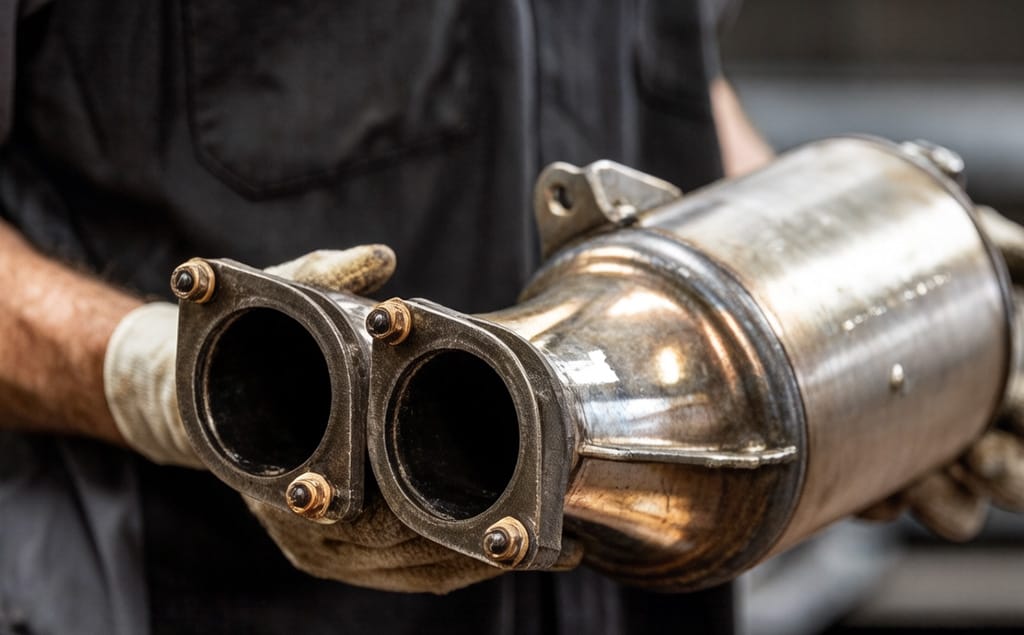
촉매 코어 외에도, 3원 촉매 변환기의 구조적 무결성과 열 관리는 하우징 및 패키징 소재를 통해 보장됩니다. 이러한 구성 요소는 취약한 세라믹 기판을 보호하고, 극한 온도로부터 단열하며, 차량 배기 시스템 내에서 안정적인 장착 지점을 제공하도록 설계되었습니다.
- 외부 하우징(셸): 외부 하우징은 일반적으로 다음으로 구성됩니다. 스테인리스 스틸, often featuring a double-layered design with an integrated heat shield [9]. Stainless steel is chosen for its excellent corrosion resistance, particularly against the corrosive exhaust gases and external environmental factors, and its ability to withstand high temperatures. The double-layered shell serves multiple functions:
- 구조적 무결성: 이 제품은 내부 촉매 벽돌에 견고한 기계적 보호 기능을 제공하여 도로 잔해물, 충격 및 진동으로부터 보호합니다.
- 열 절연: 이중 층 사이의 공기 간격이나 방열판이 있으면 뜨거운 촉매에서 나오는 열 복사를 줄이는 데 도움이 되며, 주변 차량 구성 요소를 보호하고 화상 위험을 줄입니다.
- 산화피부 예방: It prevents the formation of an oxide skin on the catalyst surface, which could otherwise block the catalytic sites and reduce efficiency [9].
- 설치: 배기 시스템에 통합하는 데 필요한 플랜지와 연결부를 제공합니다.
- 내부 팽창 매트: 세라믹 기판과 스테인리스 스틸 하우징 사이에는 팽창성 매트 재료가 포장되어 있습니다. 이 매트는 일반적으로 가열 시 크게 팽창하도록 설계된 세라믹 섬유(예: 알루미나-실리카 섬유)로 만들어집니다. 이 매트의 기능은 변환기의 내구성과 성능에 매우 중요합니다.
- 기계적 보호 및 완충: 충격 흡수 장치 역할을 하여 차량의 움직임과 배기 맥동으로 인한 진동과 기계적 응력으로부터 취성 세라믹 기판을 완충시켜 기판의 균열이나 파손을 방지합니다.
- 열 절연: 매트는 추가적인 열 절연 기능을 제공하여 촉매의 열 손실을 줄이고 작동 온도(점화 온도)에 더 빨리 도달하도록 돕습니다.
- 안전한 장착: 가열하면 팽창하는 팽창성 매트가 세라믹 벽돌에 압축력을 가해 강철 케이스 내에서 세라믹 벽돌을 단단히 고정하고 움직이거나 덜거덕거리는 것을 방지합니다.
- 밀봉: It also provides a seal, preventing exhaust gases from bypassing the catalyst brick and ensuring that all gases flow through the active catalytic channels. Other vibration damping layers, such as metal mesh pads or ceramic gaskets, may also be used [9].
이러한 하우징 및 패키징 소재의 신중한 선택과 통합은 3방향 촉매 변환기의 장기적인 신뢰성과 성능에 필수적이며, 자동차 배기 시스템의 혹독한 작동 환경을 견딜 수 있도록 보장합니다.
6. 통합 재료 성능, 내구성 및 비용 고려 사항
3원 촉매 변환기의 효율은 기판, 워시코트, 귀금속, 그리고 하우징 등 모든 구성 재료 간의 시너지적 상호작용의 직접적인 결과입니다. 이러한 재료들의 종합적인 성능은 전반적인 촉매 활성, 열적 내구성, 기계적 견고성, 그리고 궁극적으로 전체 시스템의 비용 효율성을 좌우합니다.
촉매 활성 및 효율: The primary goal is to achieve high conversion efficiency for CO, HC, and NOx across a wide range of operating conditions. This is largely driven by the precious metals (Pt, Pd, Rh) and their dispersion on the high-surface-area washcoat [1]. The washcoat’s oxygen storage capacity, provided by ceria-zirconia, is crucial for maintaining high efficiency under fluctuating air-fuel ratios, acting as an oxygen buffer [1][2]. Computer models are extensively used to optimize catalyst loadings and layouts, enabling high performance even with reduced PGM content [1][3].
열 내구성: 자동차 배기 온도는 1000°C를 넘을 수 있으므로 열 내구성이 가장 중요한 문제입니다.
- 기질: Cordierite’s low thermal expansion and high thermal shock resistance prevent cracking and structural degradation [6].
- 워시코트: The incorporation of zirconia into ceria (CeO₂-ZrO₂) significantly enhances the thermal stability of the oxygen storage component, preventing sintering and loss of surface area [7]. Advanced washcoat designs, such as double layers, can also help prevent sintering of PGMs at high temperatures [1][3].
- 귀금속: PGM sintering (agglomeration of nanoparticles into larger, less active particles) is a major cause of catalyst deactivation at high temperatures. The washcoat’s ability to disperse and stabilize PGMs is critical. Novel perovskite-based catalysts, for example, have shown superior thermal stability and resistance to activity loss even after hydrothermal aging at 1273K(1000°C), compared to standard dispersed metal catalysts [3][8]. This enhanced stability is often attributed to the substitution of palladium into the perovskite structure, which makes it less prone to sintering [8].
기계적 견고성: 변환기는 엔진과 도로의 진동을 포함한 상당한 기계적 응력은 물론 물리적 충격도 견뎌야 합니다.
- 주택: The stainless steel shell provides the primary structural integrity and protection [9].
- 팽창성 매트: This material is vital for cushioning the brittle ceramic substrate, absorbing vibrations, and securely holding the catalyst brick in place, preventing mechanical damage [9].
비용 효율성: 비용은 자동차 제조의 주요 동인입니다. TWC에서 가장 중요한 비용 요소는 다음과 같습니다. 귀금속 함량 [6]. The market for automotive three-way catalytic converters was valued at USD 11.2 billion in 2024, with the platinum-based segment alone projected to exceed USD 7 billion by 2034 [6].
- PGM 가격 변동성: The fluctuating prices and secure supply of platinum, palladium, and rhodium directly impact manufacturing costs [6].
- 기술 혁신: Manufacturers are continuously innovating to enhance fuel economy and reduce PGM loadings while maintaining or improving conversion efficiency and durability [6]. Projects like PROMETHEUS aim to reduce PGM content, potentially cutting production costs by up to 50% while maintaining or enhancing performance [1][4].
- 제조 공정 최적화: The design and preparation techniques for catalyst supports, such as cost-effective methods for creating mesoporous materials, also contribute to overall cost reduction [7].
- 내구성 대 비용: There is a constant trade-off between achieving high durability (which often requires more robust, sometimes more expensive, materials or higher PGM loadings) and managing production costs. The development of more thermally stable catalysts, like perovskites, can extend the converter’s lifespan, offering long-term cost benefits despite potentially higher initial material costs [3][8].
The overall market growth for TWCs is driven by increasing vehicle sales, stricter emissions regulations, and the demand for fuel-efficient vehicles, all of which necessitate continuous material and process innovation [6]. On-road monitoring of TWC performance, often via oxygen storage capacity measurements, further ensures that these complex material systems meet real-world emission targets throughout their operational life [3].
7. 신소재 및 미래 방향
The landscape of catalytic converter technology is continuously evolving, driven by increasingly stringent global emission standards and the imperative to reduce reliance on expensive and scarce Platinum Group Metals (PGMs) [1][6]. Future directions in 3-way catalytic converters focus on novel materials, advanced manufacturing techniques, and integrated systems to achieve superior performance, enhanced durability, and improved sustainability.
PGM 의존도 및 비 PGM 촉매 감소: The high cost and limited supply of Pt, Pd, and Rh are major motivators for research into PGM-free or low-PGM alternatives [1][6].
- 전이 금속 산화물: 다음과 같은 재료 제올라이트, 산화니켈 및 기타 금속 산화물 are being extensively explored as potential replacements for PGMs [1]. These materials offer lower cost and greater abundance.
- 페로브스카이트 기반 촉매: 페로브스카이트 구조를 갖는 복합 금속 산화물(예: ABO3 유망한 비PGM 촉매군입니다. 예를 들어, 구리 도핑 LaCo₁−xCuxO₃ 페로브스카이트 are under investigation as PGM-free catalysts for TWCs [1][4]. These materials can exhibit high thermal stability and catalytic activity, sometimes even surpassing traditional PGM catalysts in specific conditions [3][8]. Mechanochemical synthesis, including high-energy ball milling, is being used to create such perovskites [1].
- 나노기술 통합: Projects like NEXT-GEN-CAT have focused on incorporating low-cost transition metals into advanced ceramic substrates using nanotechnology to develop efficient catalysts [1][5]. Prototypes with low-PGM and no-PGM formulations have demonstrated compliance with Euro III emission standards, showcasing the viability of these approaches [1][5].
고급 워시코트 개발: Washcoat and catalyst development remain critical focus areas [1].
- 중공성 산화물 지지체: Research continues into developing mesoporous oxide supports with optimized pore geometries. These structures can significantly increase the active surface area and improve the dispersion of catalytic components, potentially allowing for further reductions in metal loadings while maintaining or enhancing performance [7].
- 새로운 제조 방법: 더욱 효과적이고 내구성 있는 촉매를 만들기 위해 첨단 제조 방법이 연구되고 있습니다. 여기에는 다음이 포함됩니다.
- 전기 도금과 결합된 초음파 처리: 활성 물질의 정밀한 증착 및 분산을 위해.
- 시트르산 방법: 높은 균질성을 지닌 혼합 금속 산화물을 합성하기 위한 일반적인 졸-겔 유형 방법입니다.
- 플라스마 전해 산화(PEO): For creating porous oxide layers on metallic substrates, which can then be functionalized with catalytic materials [1].
미래 배출 규제 대응: Global emission standards are becoming progressively stricter, pushing the boundaries of current TWC technology [1][6].
- 냉간 시동 배출: 중요한 과제는 촉매가 아직 점화 온도에 도달하지 않아 거의 효과가 없는 "콜드 스타트" 기간입니다. 미래 소재 연구는 훨씬 낮은 온도에서 활성화되거나 전기 가열 촉매(EHC) 또는 탄화수소 트랩과 통합되어 콜드 스타트 배출을 완화하는 촉매를 개발하는 것을 목표로 합니다.
- 실제 주행 배출량(RDE): Regulations are increasingly focusing on real-world driving emissions rather than just laboratory tests. This necessitates catalysts that perform robustly and efficiently across a wider range of temperatures, speeds, and load conditions. On-road monitoring of oxygen storage capacity is already a step in this direction [3].
- 미세먼지(PM) 제어: TWC는 주로 기체 오염물질을 대상으로 하지만, 향후 규제에서는 PM에 대한 통합 솔루션이 요구될 수 있으며, 이는 TWC와 함께 가솔린 미립자 필터(GPF)를 더 널리 채택하거나, PM 감소 기능이 내재된 촉매를 개발하는 것으로 이어질 가능성이 있습니다.
지속 가능성과 순환 경제: The transition to “green” mobility and the increasing focus on sustainability are driving efforts in recyclability and life cycle assessment (LCA) [1][5].
- 재활용 가능성: The NEXT-GEN-CAT project, for instance, investigated the recyclability of TWCs, examining end-of-life scenarios and using LCA to determine the environmental impact of developed materials [1][5]. Pyro-metallurgical treatment (smelting in an inert atmosphere) was explored for efficient PGM recovery from spent catalysts [1][5]. Future research will likely focus on more energy-efficient and environmentally friendly recycling processes for both PGMs and base metals.
사전 예방적 해결책 및 추측: 현재 연구 외에 향후 방향은 다음과 같습니다.
- 스마트 촉매: 실시간 배기 조건에 따라 속성(예: 표면 구조, 산소 저장 용량)을 동적으로 조정할 수 있는 촉매로, 내장된 센서와 AI 기반 제어 시스템을 사용할 가능성이 있습니다.
- 통합 배기 후처리 시스템: TWC 기능과 다른 배출 제어 기술(예: NOx에 대한 선택적 촉매 환원, 고급 미립자 필터)을 단일의 고도로 최적화된 장치로 결합한 보다 컴팩트하고 다기능적인 배기 시스템으로의 전환입니다.
- 적층 제조: 3D 프린팅이나 기타 적층 제조 기술을 활용하여 고도로 맞춤화되고 최적화된 기판 및 워시코트 구조를 제작함으로써 기공 크기 분포, 채널 구조 및 촉매 배치에 대한 전례 없는 제어를 가능하게 합니다. 이를 통해 물질 전달 및 촉매 효율을 크게 향상시킬 수 있습니다.
- 생물학적 영감 촉매: 생물학적 시스템에서 발견되는 촉매 메커니즘을 탐구하여 새롭고 효율성이 높으며 잠재적으로 지속 가능성이 더 높은 촉매를 설계합니다.
재료 과학과 화학 공학의 지속적인 혁신은 3방향 촉매 변환기 성능의 경계를 넓혀 가솔린 차량이 생태 발자국을 최소화하는 동시에 점점 더 엄격해지는 환경 목표를 충족할 수 있도록 할 것입니다.