Introduction to SCR Technology
Selective Catalytic Reduction (SCR) has become one of the most effective and widely adopted technologies for controlling nitrogen oxide (NOx) emissions. NOx is a major contributor to smog, acid rain, and respiratory health issues, making its reduction a key target of global environmental policies. SCR systems are now common in vehicles, power plants, marine vessels, and industrial boilers, where they play a crucial role in reducing environmental impact and ensuring compliance with stringent emissions regulations.
What Is SCR and How Does It Work?
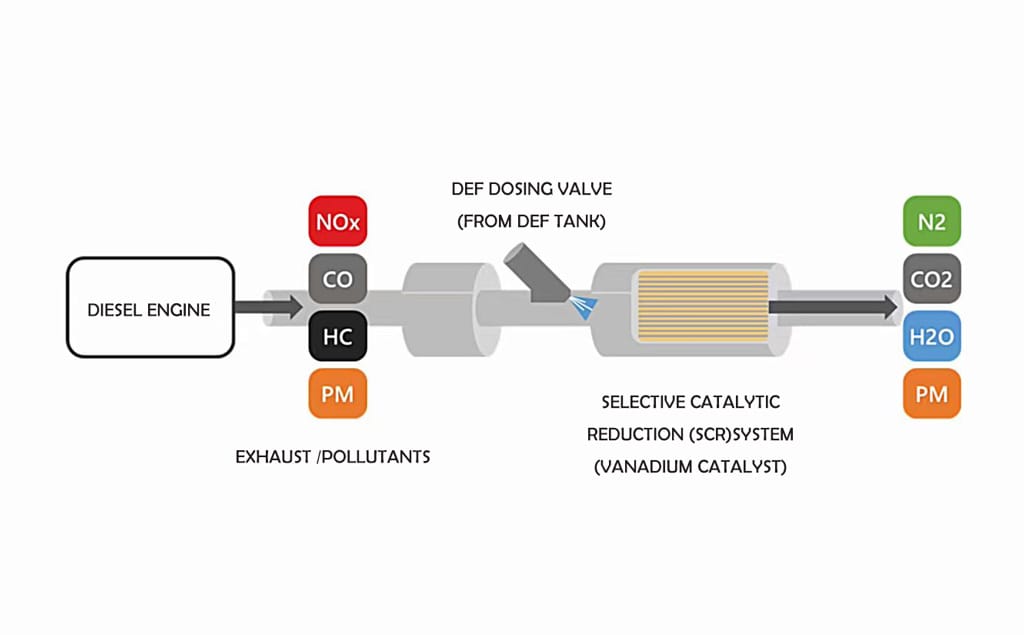
SCR works by injecting a urea-based solution, commonly known as Diesel Exhaust Fluid (DEF) or AdBlue®, into the exhaust stream. The fluid decomposes into ammonia (NH3), which reacts with NOx in the presence of a catalyst. The chemical reaction converts harmful NOx into harmless nitrogen (N2) and water vapor (H2O), which are then released into the atmosphere.
The general reaction can be summarized as:
4NO + 4NH₃ + O₂ → 4N₂ + 6H₂O
This process is highly selective, targeting NOx emissions specifically, without interfering with other exhaust gases.
SCR System Components
An SCR system typically consists of:
- DEF Tank and Pump – Stores and supplies the reductant.
- Dosing Module – Precisely injects DEF into the exhaust flow.
- SCR Catalyst – Provides the surface for chemical reactions.
- Sensors and Control Unit – Monitors exhaust conditions to optimize injection.
These parts work together to ensure consistent NOx reduction under varying engine loads and temperatures.
Benefits of SCR Systems
- High NOx Reduction Efficiency – Can cut NOx emissions by up to 90%.
- Improved Fuel Economy – Engines can operate at higher efficiency since aftertreatment manages emissions.
- Regulatory Compliance – Meets global emission standards (Euro VI, EPA Tier 4, China VI, etc.).
- Versatility – Used across transportation, power generation, and marine industries.
SCR vs. Other Emission Control Technologies
SCR is often compared with other emission reduction methods:
- Diesel Particulate Filters (DPF) – Trap particulate matter but do not reduce NOx.
- Exhaust Gas Recirculation (EGR) – Recirculates exhaust gas to lower combustion temperature, reducing NOx but often less effective than SCR.
- Three-Way Catalysts (TWC) – Common in gasoline vehicles but not sufficient for diesel NOx levels.
Compared to these, SCR provides the most reliable long-term NOx reduction, especially under high-load conditions.
Challenges and Limitations of SCR
Despite its advantages, SCR systems face some challenges:
- DEF Supply and Storage – Requires regular refilling of DEF, which may be inconvenient in remote areas.
- Temperature Sensitivity – Works best between 200–400°C; efficiency drops at low exhaust temperatures.
- Initial Cost – Installation and system complexity add to vehicle or equipment cost.
- Maintenance Needs – Requires monitoring of DEF quality and catalyst condition.
Future of SCR Technology
As emission standards become stricter worldwide, SCR continues to evolve:
- Advanced Catalysts – Copper- and iron-based catalysts are being developed for higher efficiency at lower temperatures.
- Integration with Hybrid Systems – SCR is expected to complement hybrid and hydrogen engines where combustion still generates NOx.
- Smarter Controls – AI-driven dosing strategies are emerging to optimize DEF use and improve durability.
- Euro VII and Beyond – Upcoming regulations will demand near-zero NOx emissions, pushing SCR technology into even more refined designs.
Frequently Asked Questions (FAQ)
1. Does SCR affect fuel economy?
Yes. By allowing engines to run at higher efficiency, SCR systems can actually improve fuel economy compared to EGR-heavy approaches.
2. How often do I need to refill DEF?
It depends on vehicle usage, but generally DEF consumption is about 2–3% of fuel consumption.
3. Is SCR required by law?
In most regions, yes. Heavy-duty diesel vehicles and power plants must use SCR or equivalent technologies to meet emissions regulations.
4. Can SCR systems be retrofitted?
Yes. Older vehicles and industrial equipment can often be retrofitted with SCR systems to comply with modern emission standards.
5. What happens if the DEF tank is empty?
Most vehicles are programmed to reduce power or prevent restarting until the DEF tank is refilled, ensuring compliance.
Conclusion
Selective Catalytic Reduction is a cornerstone technology for reducing NOx emissions across industries. With its ability to cut harmful emissions by up to 90%, improve fuel efficiency, and ensure compliance with stringent regulations, SCR remains the most effective pathway toward cleaner air and a healthier environment. As technology advances, SCR will continue to play a leading role in sustainable transportation and industrial operations.