การแนะนำ
The quality of the ceramic honeycomb substrate pretty much dictates how well a catalytic converter works. It’s what holds the precious metals and coatings that clean up harmful emissions.Since emissions laws are getting stricter everywhere, everyone is looking for customized substrate options to get better efficiency without losing out on durability.
Buyers ask us all the time if ceramic honeycomb substrates can be made to specific CPSI targets like 200, 300, or 400. Yes, they can. Current manufacturing tech can easily handle custom cell densities, shapes, and sizes to fit whatever your project demands.
Understanding how cell density influences catalyst performance helps buyers select the most suitable substrate for their ตัวเร่งปฏิกิริยาสามทาง applications.
What Is a Ceramic Honeycomb Substrate?
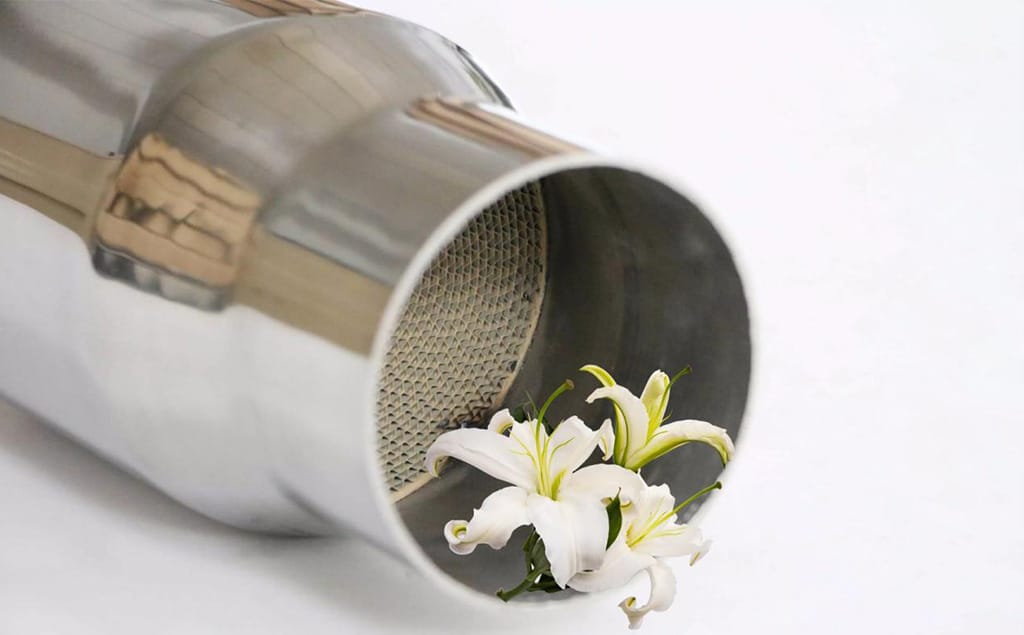
A ceramic honeycomb substrate is a highly engineered structure made primarily from cordierite ceramic. It contains hundreds of parallel channels arranged in a honeycomb pattern. These channels create a large surface area while maintaining efficient exhaust gas flow.
Manufacturers apply a washcoat layer and precious metal catalysts onto the channel walls. When exhaust gases pass through the substrate, chemical reactions occur that convert harmful pollutants into less harmful substances.
ใน ตัวเร่งปฏิกิริยาสามทาง, the substrate supports three essential reactions:
- Oxidation of carbon monoxide (CO) into carbon dioxide (CO₂)
- Oxidation of hydrocarbons (HC) into water and carbon dioxide
- Reduction of nitrogen oxides (NOx) into nitrogen and oxygen
The efficiency of these reactions depends significantly on substrate design and cell density.
Can Ceramic Honeycomb Substrates Be Customized?
Yes. Professional manufacturers offer extensive customization options for ceramic honeycomb substrates.
Common customization options include:
| พารามิเตอร์ | Available Options |
|---|---|
| Cell Density | 100, 200, 300, 400, 600 CPSI |
| รูปร่าง | Round, Oval, Racetrack, Square, Custom |
| Diameter | Customized |
| Length | Customized |
| Wall Thickness | 0.05–0.20 mm |
| Coating Compatibility | Three-way catalyst, DOC, VOC catalyst |
| บรรจุภัณฑ์ | Customer Requirements |
This flexibility allows customers to optimize substrate performance for specific engines, exhaust systems, industrial equipment, and emission standards.
Understanding Cell Density in Three Way Catalytic Converter Applications
Cell density refers to the number of channels per square inch (CPSI) within the substrate.
Higher CPSI values create more surface area for catalytic reactions. However, they can also increase exhaust flow resistance if not properly engineered.
The most commonly requested cell densities include 200 CPSI, 300 CPSI, and 400 CPSI.
200 CPSI
A 200 CPSI substrate features larger channels and lower flow restriction.
Advantages:
- Lower back pressure
- Better exhaust flow
- Suitable for high-performance engines
- Improved durability under harsh conditions
Applications:
- Performance vehicles
- Heavy-duty engines
- Industrial exhaust treatment systems
300 CPSI
A 300 CPSI substrate provides a balance between catalyst efficiency and exhaust flow.
Advantages:
- Good catalytic conversion efficiency
- Moderate back pressure
- Suitable for many OEM applications
Applications:
- Passenger vehicles
- Light commercial vehicles
- General emission control systems
400 CPSI
A 400 CPSI substrate offers a significantly larger catalytic surface area.
Advantages:
- Higher conversion efficiency
- Better emission reduction
- Enhanced precious metal utilization
Applications:
- Modern vehicles
- Stringent emission standards
- พรีเมียม ตัวเร่งปฏิกิริยาสามทาง systems
Cell Density Comparison Table
| คุณสมบัติ | 200 CPSI | 300 CPSI | 400 CPSI |
|---|---|---|---|
| พื้นที่ผิว | ปานกลาง | สูง | สูงมาก |
| Back Pressure | Low | ปานกลาง | Slightly Higher |
| Catalyst Efficiency | ดี | Better | ยอดเยี่ยม |
| การไหลของไอเสีย | ยอดเยี่ยม | Very Good | ดี |
| การควบคุมการปล่อยมลพิษ | ดี | Very Good | ยอดเยี่ยม |
| Typical Use | Performance Vehicles | OEM Vehicles | Advanced Emission Systems |
Selecting the correct CPSI requires balancing emission performance and exhaust flow characteristics.
Why Ultra-Thin Wall Design Matters
Cell density alone does not determine substrate performance.
Wall thickness plays an equally important role.
Modern honeycomb ceramic substrates often use ultra-thin wall technology. Thin walls increase the open frontal area and reduce exhaust flow resistance.
Benefits include:
- Faster catalyst light-off
- Improved fuel efficiency
- Lower back pressure
- Enhanced catalytic conversion
- Better engine responsiveness
Combining high CPSI with thin wall construction allows manufacturers to achieve superior performance without sacrificing exhaust flow.
Material Advantages of Cordierite Ceramic
Most premium honeycomb ceramic substrates use high-purity cordierite material.
Cordierite offers several advantages that make it ideal for ตัวเร่งปฏิกิริยาสามทาง applications.
Low Thermal Expansion
The thermal expansion coefficient remains below:
≤ 1.0 × 10⁻⁶/℃ (25–800℃)
This property minimizes thermal stress during rapid temperature changes.
Excellent Thermal Shock Resistance
High-quality cordierite substrates can withstand sudden temperature transitions from 800℃ to room temperature without cracking.
This capability protects the catalyst during:
- Cold engine starts
- Rapid acceleration
- Emergency shutdowns
- Regeneration cycles
High Mechanical Strength
The substrate must survive:
- Converter assembly processes
- Vehicle vibration
- Road impacts
- Continuous thermal cycling
Premium products achieve crushing strengths above 10 MPa, ensuring long-term reliability.
The Importance of Washcoat Adhesion
Washcoat adhesion directly affects catalyst lifespan.
The porous structure of a ceramic honeycomb substrate supports catalyst coating attachment. A water absorption rate between 15% and 25% generally provides excellent washcoat retention.
Strong adhesion offers several benefits:
- Reduces precious metal loss
- Improves catalytic efficiency
- Extends service life
- Enhances durability under vibration
Poor adhesion can cause catalyst peeling, which significantly reduces the effectiveness of a ตัวเร่งปฏิกิริยาสามทาง.
How to Identify a High-Quality Honeycomb Ceramic Substrate
Buyers should evaluate several key factors before selecting a supplier.
1. Visual Inspection
Check for:
- Uniform cell structure
- Straight channels
- No visible cracks
- No collapsed cells
- No blocked passages
Structural defects can reduce catalytic efficiency and increase back pressure.
2. Thermal Shock Performance
Request test data demonstrating resistance to temperature changes exceeding 800℃.
3. Mechanical Strength
Verify longitudinal crushing strength of at least 10 MPa.
4. Material Purity
Confirm the use of high-purity cordierite ceramic.
5. Water Absorption Performance
The optimal range remains between 15% and 25%.
6. Manufacturing Certification
Choose manufacturers with recognized quality systems such as IATF 16949 certification.
These certifications indicate consistent manufacturing processes and strict quality control standards.
Choosing the Right Substrate for Different Emission Systems
Different emission systems require different substrate configurations.
Automotive Three Way Catalytic Converter
Recommended:
- 300 CPSI
- 400 CPSI
- Thin-wall construction
Benefits:
- High conversion efficiency
- Compliance with global emission standards
ตัวเร่งปฏิกิริยาออกซิเดชันดีเซล (DOC)
Recommended:
- 200 CPSI
- 300 CPSI
Benefits:
- Lower pressure drop
- Efficient oxidation performance
Industrial VOC Treatment
Recommended:
- Custom CPSI configurations
Benefits:
- Optimized pollutant destruction
- Flexible system design
Future Trends in Honeycomb Ceramic Substrate Technology
As global regulations become more demanding, substrate technology continues to evolve.
Key trends include:
- Higher cell density designs
- Thinner wall structures
- Improved thermal shock resistance
- Advanced catalyst coating technologies
- Enhanced precious metal utilization
Manufacturers continue to develop substrates that help ตัวเร่งปฏิกิริยาสามทาง systems achieve lower emissions while maintaining excellent durability and engine performance.
Industry Standards and Regulatory References
The performance requirements for a ตัวเร่งปฏิกิริยาสามทาง continue to evolve as emission regulations become more stringent worldwide. Manufacturers often refer to standards and technical resources published by the U.S. Environmental Protection Agency (สำนักงานปกป้องสิ่งแวดล้อมแห่งสหรัฐอเมริกา), SAE International, and the European Environment Agency (EEA) when developing advanced catalyst substrate technologies.
บทสรุป
Yes, our ceramic honeycomb substrates support custom cell densities (200/300/400 CPSI) as well as tailored shapes, sizes, wall thicknesses, and catalyst compatibilities.
สำหรับ ตัวเร่งปฏิกิริยาสามทาง applications, selecting the proper CPSI is critical.Basically, lower cell density gives you better exhaust flow, but higher density gives you better catalyst efficiency. Because we use top-quality cordierite, the substrates have ultra-thin walls, great thermal shock resistance, and strong mechanical properties. The coating sticks incredibly well too, so they really hold up over time.
If you’re looking for a supplier, you’ve got to double-check their materials, factory backing, and tech specs inside out. It’s the only way we can promise foolproof emissions control and hit every single eco-standard out there.