การแนะนำ
If you work around catalytic converters long enough, you’ll notice one thing very clearly — people always ask the same question: which metal actually matters most?
Platinum, palladium, rhodium.
These three don’t just sit inside a ตัวเร่งปฏิกิริยาสามทาง for decoration. Each one behaves differently once exhaust gas hits the washcoat. And in real engineering work, that difference matters more than most textbooks explain.
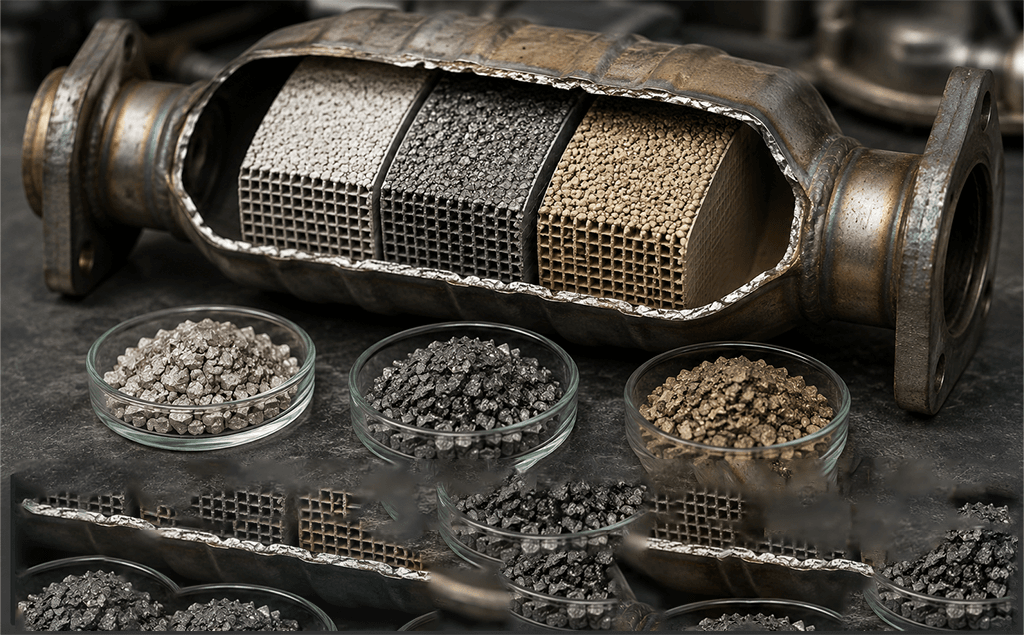
I’ve seen cases where two converters look identical from the outside, but the internal พีจีเอ็ม mix completely changes both performance and scrap value. That gap is where most misunderstandings happen.
So instead of treating them as “precious metals list,” it makes more sense to look at how they actually behave inside a working catalytic system.
What a Three Way Catalytic Converter Actually Does
เอ ตัวเร่งปฏิกิริยาสามทาง is not doing one reaction. It is doing three reactions at the same time, under unstable conditions.
Inside the exhaust flow, you always have:
- CO (carbon monoxide)
- HC (unburned hydrocarbons)
- NOx (nitrogen oxides)
The converter has to clean all of them in one pass.
So the system basically runs three jobs in parallel:
- CO → CO₂
- HC → CO₂ + H₂O
- NOx → N₂
Sounds simple on paper. In reality, it only works when temperature, oxygen balance, and catalyst surface activity are all aligned. That’s why the choice of metals matters so much.
Why Only Platinum Group Metals Work Here
People sometimes ask why manufacturers don’t use cheaper metals.
The short answer: they tried. It doesn’t hold.
Inside a ตัวเร่งปฏิกิริยาสามทาง, the environment is brutal. Temperature swings from cold start to 800°C or higher in minutes. Oxygen levels jump constantly. Sulfur compounds show up without warning depending on fuel quality.
Most base metals just collapse under that condition.
Platinum group metals survive because they don’t “break” in the normal sense. They deactivate slowly, and they can recover activity after thermal cycles.
That’s the key difference.
Platinum vs Palladium vs Rhodium (Real Engineering View)
Let’s skip textbook definitions. Here is how they actually behave in real converter systems.
| โลหะ | What it really does in practice | Where it struggles |
|---|---|---|
| แพลตตินัม (Pt) | Stable oxidation workhorse | Not the fastest |
| แพลเลเดียม (Pd) | Fast oxidation in gasoline exhaust | Sensitive to sulfur |
| โรเดียม (Rh) | NOx reduction specialist | Expensive, limited supply |
That’s the simplest way to think about it.
Not equal roles. Not interchangeable in real operation.
Platinum Inside a Three Way Catalytic Converter
Platinum has been in catalytic systems the longest. There’s a reason for that — it behaves predictably.
In oxidation reactions, it converts CO and hydrocarbons steadily. It doesn’t spike performance, but it also doesn’t fail suddenly.
In real production environments, engineers like that stability.
But there’s a trade-off. Platinum is not the most active metal for gasoline oxidation anymore. Palladium often reacts faster under similar conditions, especially at lower temperatures.
So what’s happening in modern converters is not replacement, but redistribution of roles.
Platinum is still there. Just not always leading.
Palladium: The “Efficiency First” Metal
Palladium started replacing platinum in a lot of gasoline catalytic systems mainly because it reacts faster.
At low exhaust temperatures, especially during cold start conditions, palladium can light off reactions earlier. That directly improves emissions compliance.
That’s why OEMs started pushing Pd-heavy formulations.
But there’s a weakness that shows up in real-world fuel systems:
Sulfur.
Even small contamination can poison palladium surfaces. Once that happens, activity drops and recovery is not always complete.
So engineers usually balance it instead of relying on it alone.
Rhodium: Small Amount, Massive Impact
Rhodium is a different story entirely.
It doesn’t care about oxidation. It is not there for CO or HC.
Its job is NOx reduction, and that reaction is difficult to stabilize under oxygen-rich exhaust conditions.
This is why rhodium is almost irreplaceable in a ตัวเร่งปฏิกิริยาสามทาง.
Even when loading is extremely low (sometimes only fractions of a gram), removing it breaks emissions compliance immediately.
That’s also why its market price behaves differently compared to platinum or palladium — supply is tight, and there is no easy substitute pathway.
Simple Reality: You Don’t Choose One Metal
In real catalytic converter design, nobody “chooses platinum or palladium or rhodium.”
They combine them.
Because each one fills a gap the others cannot cover.
A typical gasoline converter looks like this in practice:
| โลหะ | Typical Range |
|---|---|
| พอยต์ | 1–3 g |
| พีดี | 1–5 g |
| อาร์เอช | 0.1–0.5 g |
But those numbers shift constantly depending on emission regulations and raw material pricing.
OEM engineers adjust ratios almost like tuning a chemical balance, not selecting materials.
Why Scrap Value Depends So Much on These Metals
From a recycling perspective, the three way catalytic converter is basically a metal storage system.
But the value is not evenly distributed.
Rhodium can dominate value even in tiny amounts.
Palladium drives mid-range pricing swings.
Platinum adds baseline stability.
This is why two converters that look identical can have completely different three way catalytic converter scrap values.
In real recycling work, external appearance is almost irrelevant. Internal loading matters much more.
Recovery Process (How the Metals Come Back)
Once a converter reaches end-of-life, the recycling process doesn’t treat it like a normal metal scrap.
It goes through:
- decanning (removing steel shell)
- crushing ceramic substrate
- homogenization sampling
- smelting or leaching
- refining to separate Pt, Pd, Rh
Recovery rates in industrial systems are usually above 95%.
That number matters. Because at scale, even a 1–2% loss translates into large economic differences.
This is also why professional recycling facilities dominate this field — small inefficiencies don’t survive economically.
Market Behavior: Why Prices Feel “Unstable”
If you track platinum group metals over time, you’ll notice something strange:
They don’t move together.
Rhodium spikes sharply.
Palladium reacts to automotive demand cycles.
Platinum moves slower, more like a baseline industrial metal.
This mismatch creates constant adjustments inside catalytic converter design.
OEMs are not just designing for emissions anymore. They are also designing for cost volatility.
That’s why converter formulations from five years ago already look outdated today.
One Misunderstanding in the Industry
A common mistake is thinking:
“Higher precious metal content = better converter.”
Not always true.
What actually matters is:
- dispersion on washcoat
- oxygen storage balance (ceria effect)
- thermal stability
- real driving emission behavior
You can overload metals and still get poor conversion efficiency if the structure is wrong.
That’s why converter design is more chemistry engineering than material stacking.
บทสรุป
Platinum, palladium, and rhodium are not competing inside a ตัวเร่งปฏิกิริยาสามทาง.
They are cooperating under very specific roles.
Platinum gives stability.
Palladium gives reaction speed.
Rhodium handles NOx reduction, where no real substitute exists.
The real insight is this: performance doesn’t come from one metal, but from how the system balances all three under real exhaust conditions.
And from a recycling point of view, that same balance is what determines scrap value, recovery efficiency, and market pricing.
Once you understand that structure, catalytic converters stop looking like “metal parts” and start looking like controlled chemical systems that just happen to sit inside a car.