Introduction
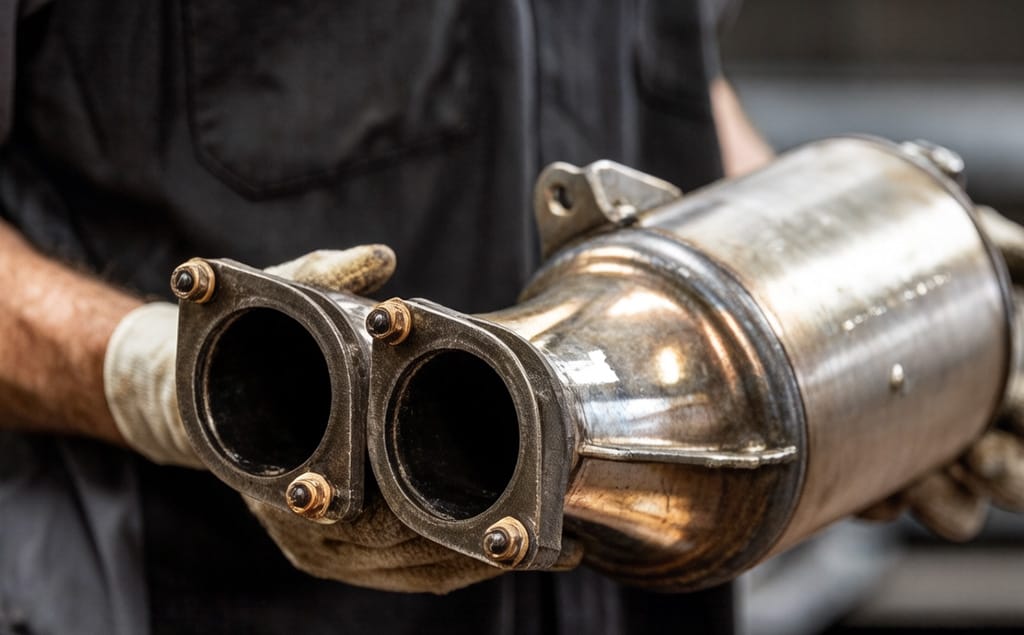
The global push for cleaner energy makes emission control a top priority for engineers. The three way catalytic converter remains the most critical component in this effort. This device facilitates chemical reactions to neutralize toxic exhaust gases. In gasoline engines, this technology is standard and highly effective. However, natural gas engines present a different set of obstacles. Methane (CH4) is a potent greenhouse gas and resists oxidation more than other hydrocarbons.
This article examines the technical mechanisms of the three way catalytic converter. We focus specifically on improving light-off performance for methane-rich exhaust. You will learn how oxygen storage, temperature management, and fuel-air oscillations dictate efficiency. By understanding these scientific principles, operators can significantly reduce the environmental footprint of stationary and mobile engines.
Fundamental Principles of the Three Way Catalytic Converter
A three way catalytic converter operates on the principle of simultaneous oxidation and reduction. It targets three primary pollutants: Carbon Monoxide (CO), Nitrogen Oxides (NOx), and Unburned Hydrocarbons (HC). When engineers apply this to stationary natural gas engines, they often call the process Non-Selective Catalytic Reduction (NSCR).
The catalyst requires a very specific environment to function. The engine must maintain a stoichiometric air-to-fuel ratio (AFR). This means the exhaust contains just enough oxygen to burn the fuel completely. If the mixture is too “lean” (excess oxygen), NOx reduction fails. If the mixture is too “rich” (excess fuel), CO and HC oxidation fails. The three way catalytic converter acts as a chemical balancing act. It transforms CH4, CO, and NOx into Carbon Dioxide (CO2), Water (H2O), and Nitrogen (N2).

Methane vs. Gasoline Hydrocarbons: The Efficiency Gap
We must distinguish between different types of hydrocarbons to understand catalyst performance. Gasoline exhaust contains complex molecules like propene (C3H6). Natural gas exhaust consists mostly of methane (CH4).
Data shows that the three way catalytic converter handles propene with ease. Under warmed-up conditions, propene conversion reaches nearly 100% at the stoichiometric point. Methane behaves differently. Its maximum conversion rarely exceeds 60% in standard configurations. Furthermore, the peak efficiency for methane occurs on the “rich” side of stoichiometry. This shift creates a major challenge for standard engine control systems.
The following table compares the behavior of these two compounds within a three way catalytic converter:
| Performance Metric | Propene (Gasoline) | Methane (Natural Gas) |
|---|---|---|
| Peak Conversion Window | Precisely Stoichiometric | Rich of Stoichiometry |
| Maximum Conversion Rate | >98% | ~60% |
| Light-Off Temperature | Low (approx. 250°C) | High (approx. 450°C+) |
| Inhibition Sensitivity | Low | High (Inhibited by NO and CO) |
| Primary Reaction Path | Direct Oxidation | Steam Reforming/Oxidation |
Chemical Reaction Pathways for Methane Control
The three way catalytic converter uses two main pathways to destroy methane. The first is direct oxidation. In this reaction, methane reacts with oxygen to form CO2 and water.
Equation (1): CH4 + 2O2 → CO2 + 2H2O
The second pathway is steam reforming. This occurs when methane reacts with water vapor on the catalyst surface.
Equation (2): CH4 + H2O → CO + 3H2
Steam reforming is vital under “rich” conditions where oxygen is scarce. However, methane is a stable molecule. The carbon-hydrogen bonds in methane are very strong. Breaking these bonds requires more energy than breaking bonds in propene. Consequently, the three way catalytic converter needs a higher “light-off” temperature to start these reactions. If the catalyst stays cool, methane passes through the exhaust pipe into the atmosphere.
Overcoming CO and NO Inhibition
Scientific research identifies Carbon Monoxide (CO) and Nitric Oxide (NO) as “inhibitors.” These molecules compete with methane for active sites on the catalyst. Imagine the catalyst surface as a series of parking spots. CO and NO molecules park in these spots more easily than methane.
When NO occupies the active sites, methane conversion drops rapidly. This usually happens on the “lean” side of the stoichiometric window. On the “rich” side, CO becomes the primary inhibitor. The three way catalytic converter reaches its maximum methane conversion only when CO is completely oxidized. Research by experts like Ferri (2018) confirms this crossover point. To improve performance, we must “free” these active sites from CO and NO.
The Power of Air-Fuel Ratio (AFR) Oscillation
Static engine operation is often detrimental to the three way catalytic converter. If the oxygen level remains constant, the catalyst becomes “saturated.” However, modern engine controllers use AFR oscillation. They intentionally swing the mixture between slightly rich and slightly lean.
This oscillation provides three major benefits for the three way catalytic converter:
- Increased Conversion: It boosts the maximum methane destruction rate.
- Wider Window: It expands the AFR range where the catalyst is effective.
- Better Light-Off: It helps the catalyst reach functional temperatures faster.
When the amplitude of the oscillation increases, CO levels drop during the transition. This shift allows the three way catalytic converter to bypass the inhibition effects of CO and NO. The oxygen storage components (like Ceria) inside the catalyst act as a buffer. They soak up oxygen during lean phases and release it during rich phases.
Substrate Design and Heat Retention
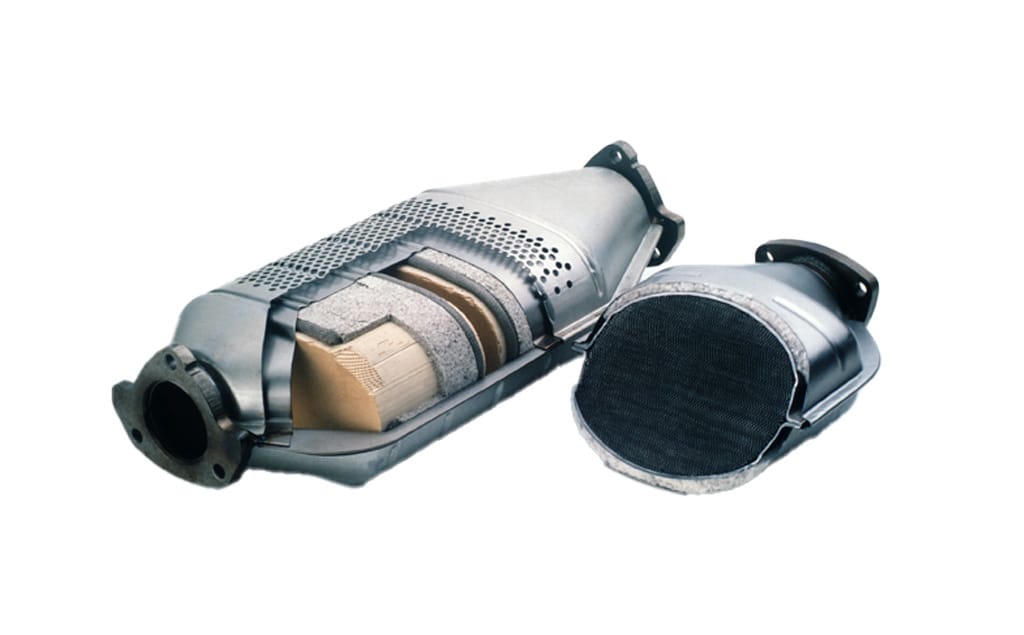
The physical structure of the three way catalytic converter affects its light-off speed. Most catalysts use a ceramic honeycomb substrate. The thickness of these cell walls determines the “thermal mass.”
A high thermal mass takes a long time to heat up. Engineers now favor thin-wall substrates. These designs allow the three way catalytic converter to reach 50% efficiency (the light-off point) in seconds rather than minutes. Furthermore, increasing the “cell density” (cells per square inch) provides more surface area. More surface area means more active sites for methane to react.
Advanced Washcoat Chemistry
The “washcoat” is the functional heart of the three way catalytic converter. It is a porous layer containing precious metals. For methane control, Palladium (Pd) is the superior choice. Palladium has a high affinity for methane molecules.
However, Palladium can suffer from “sintering” at high temperatures. Sintering causes small metal particles to clump together. This reduces the effective surface area of the three way catalytic converter. To prevent this, manufacturers add Rhodium (Rh) and stabilizers like Lanthanum. These additives ensure the catalyst maintains its performance for over 100,000 miles.
Impact of Sulfur Poisoning on TWC Performance
Sulfur is a natural enemy of the three way catalytic converter. Even small amounts of sulfur in fuel can deactivate Palladium sites. Sulfur molecules bond strongly to the metal. This prevents methane from reaching the catalyst.
To combat sulfur, the three way catalytic converter requires periodic “desulfation.” This involves running the engine at very high temperatures in a rich environment. The heat and lack of oxygen force the sulfur to release from the catalyst. Without this maintenance, the methane light-off performance will degrade permanently.
Thermal Management Strategies for Cold Starts
The majority of emissions occur during the first 60 seconds of engine operation. During this “cold start” phase, the three way catalytic converter is too cold to work. Engineers use several strategies to solve this.
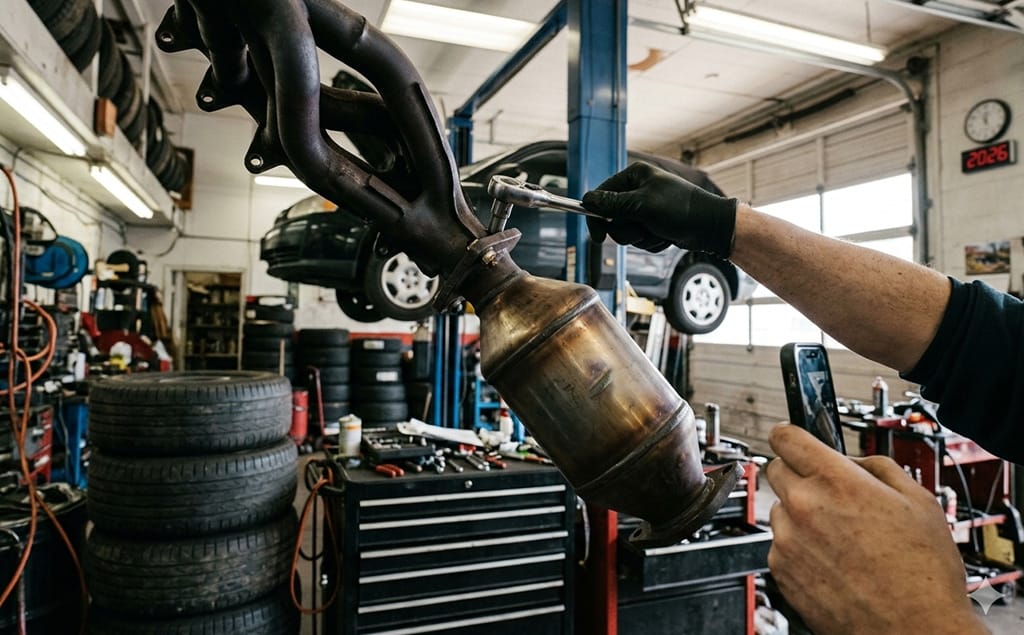
- Close-Coupled Catalysts: Technicians mount the three way catalytic converter directly to the exhaust manifold. This captures maximum heat from the engine.
- Retarded Spark Timing: The engine computer delays the spark. This causes the combustion to continue as the exhaust valves open. It sends a wave of intense heat into the catalyst.
- Insulated Exhaust Pipes: Double-walled pipes prevent heat from escaping before it reaches the three way catalytic converter.
Comparing Catalyst Substrate Materials
Different applications require different materials. The following table lists the pros and cons of substrate types used in a three way catalytic converter:
| Material Type | Advantages | Disadvantages |
|---|---|---|
| Cordierite (Ceramic) | Excellent thermal shock resistance; Low cost. | Higher thermal mass; Brittle. |
| Metallic Foil | Very thin walls; Rapid light-off; Low backpressure. | High cost; Vulnerable to high-temp warping. |
| Silicon Carbide | Extremely high temperature limit. | Very heavy; Expensive. |

The Role of Oxygen Storage Capacity (OSC)
Inside the three way catalytic converter, Ceria-Zirconia compounds store oxygen. This is known as Oxygen Storage Capacity (OSC). OSC is vital for managing the AFR oscillations discussed earlier.
When the engine runs “rich,” the OSC releases oxygen to oxidize CO and methane. When the engine runs “lean,” the OSC absorbs excess oxygen to allow NOx reduction. A healthy three way catalytic converter must have a high OSC. As a catalyst ages, its ability to store oxygen declines. Engine computers monitor this through “downstream” oxygen sensors. If the OSC falls below a threshold, the “Check Engine” light activates.
Future Trends: Electrically Heated Catalysts (EHC)
The next generation of the three way catalytic converter may include internal heaters. Electrically Heated Catalysts (EHC) use the car’s battery to warm the substrate before the engine even turns over.
This technology virtually eliminates cold-start methane emissions. In a natural gas vehicle, an EHC ensures the three way catalytic converter is ready the moment the driver turns the key. While EHC units add cost and complexity, they may become mandatory to meet future “Zero-Emission” regulations.
Optimizing Stationary Engines for NSCR
Stationary engines, such as those used in power plants, face unique challenges. They often run at a constant speed for weeks. This makes the three way catalytic converter prone to fouling.
Operators must use precision AFR controllers. These controllers use “wideband” oxygen sensors to maintain a perfect stoichiometric balance. They also simulate the AFR oscillations found in automotive engines. By fine-tuning these oscillations, power plant operators can meet strict NOx and methane limits without sacrificing fuel efficiency.
Summary of Improved Techniques
To maximize the efficiency of your three way catalytic converter, you must integrate several strategies:
- Maintain the engine at stoichiometry but use controlled AFR oscillations.
- Prioritize Palladium-based washcoats for superior methane activation.
- Minimize the distance between the engine and the catalyst to preserve heat.
- Use thin-wall substrates to lower the light-off temperature.
- Monitor and manage sulfur levels in the fuel source.
The Science of Active Site Competition
Methane molecules are “lazy.” They do not like to react. In contrast, CO molecules are “aggressive.” They bond to the catalyst surface with great force. This chemical reality dictates the design of the three way catalytic converter.
Engineers design the washcoat to have “islands” of different metals. Some islands focus on catching CO. Others focus on activating methane. This “zonal” coating helps the three way catalytic converter process different gases simultaneously without as much interference. By segregating the chemical reactions, the catalyst achieves higher overall throughput.
Analyzing the “Ferri 2018” Study Results
The research by Ferri in 2018 provided a breakthrough for three way catalytic converter optimization. The study showed that methane conversion is not just about temperature. It is about the ratio of Oxygen to Carbon Monoxide (RO2/nM).
When the ratio equals 1.0, the catalyst performs best. If the ratio drops, CO poisoning takes over. If the ratio rises, NO poisoning takes over. This discovery allows software engineers to write better code for engine control units (ECUs). The ECU now “aims” for this specific ratio to keep the three way catalytic converter in its sweet spot.
Conclusion
The three way catalytic converter is an engineering marvel. It manages a complex web of chemical reactions within a split second. For natural gas engines, the challenge of methane conversion is significant. However, through techniques like AFR oscillation, thermal management, and advanced washcoat chemistry, we can overcome these hurdles.
Improving light-off performance is the key to a cleaner future. As we move toward tighter emission standards, the three way catalytic converter will continue to evolve. It remains our most effective tool for balancing industrial power with environmental protection. By applying the five proven upgrades mentioned in this guide, you can ensure your engine operates at peak environmental efficiency.