Introduction: Why Emission Compliance Matters More Than Ever
Global emissions regulations are accelerating. From Europe’s Euro 6 → Euro 7, to US EPA Tier 3 / CARB, and China VI / VII, regulators demand lower NOx, PM, PN, CO and HC limits, longer durability, and real-world performance. Vehicle manufacturers, distributors and aftermarket importers face the same hard questions: how to meet stricter limits, improve catalyst durability under repeated high-temperature cycles, pick the right substrate (CPSI), balance cost vs precious-metal loading vs performance, and ensure long-term reliability across regions and fuel qualities.
3WayCatalyst provides a full product line — TWC, DPF, GPF, SCR, DOC, catalyst carriers and substrates — for OEM projects, aftermarket distributors, retrofit/upgrades and global fleets (Europe, North America, Middle East, Latin America, Southeast Asia).
1. Global Emissions Standards — Quick Overview
- Europe (Euro 6 → Euro 7)
- Timeline: Euro 6d-TEMP → Euro 6d → Euro 7 (implementation wave 2025–2026).
- Focus: NOx, PN (particle number), extended durability and real driving emissions (RDE).
- Test protocols: WLTP + RDE.
- Typical technologies: TWC, GPF, DOC + DPF + SCR + ASC.
- Typical substrate densities: 600 / 900 cpsi for higher surface area needs.
- North America (EPA / CARB)
- EPA Tier 3 emission caps and CARB certification (OBD/evaporative diagnostics).
- Differences between federal and CARB-compliant parts (CARB often tighter).
- Solutions: direct-fit converters (OEM-style) and universal converters; stainless housings for durability; higher precious metal loadings for cold-start and long-term conversion.
- China & Asia-Pacific (China VI / VII, other APAC rules)
- Emphasis on diesel PM and NOx control; growing adoption of GPFs for GDI engines.
- SCR tech (V₂O₅/TiO₂) for heavy NOx control; adaptations for variable fuel sulfur content and high ambient temperatures.

2. Core Emission Control Products (what 3WayCatalyst supplies)
- Three-Way Catalysts (TWC)
- Pt/Pd/Rh optimized loadings; ceramic and metallic substrates (400–900 cpsi); high oxygen storage capacity (OSC) and durable washcoat.
- Applications: passenger cars, light trucks, motorcycles.
- Diesel Particulate Filters (DPF)
- Substrate materials: cordierite, SiC (silicon carbide), aluminum titanate.
- Typical PM filtration ≥ 95%. Supports passive and active regeneration. Optional DOC coatings to help oxidation.
- Gasoline Particulate Filters (GPF)
- Particle number (PN) reductions > 95%. Low backpressure designs to protect driveability. Important for Euro 6d / Euro 7 compliance on GDI engines.
- Selective Catalytic Reduction (SCR)
- Vanadia/TiO₂ (V₂O₅/TiO₂) coatings for high NOx conversion, including at lower exhaust temps.
- Ammonia Slip Catalysts (ASC) included to control ammonia slip downstream.
- Catalyst Carriers & Substrates
- Ceramic monoliths (200–1200 cpsi), metallic foil substrates.
- Customizable coatings, high specific surface area washcoats and tailored precious-metal distributions.
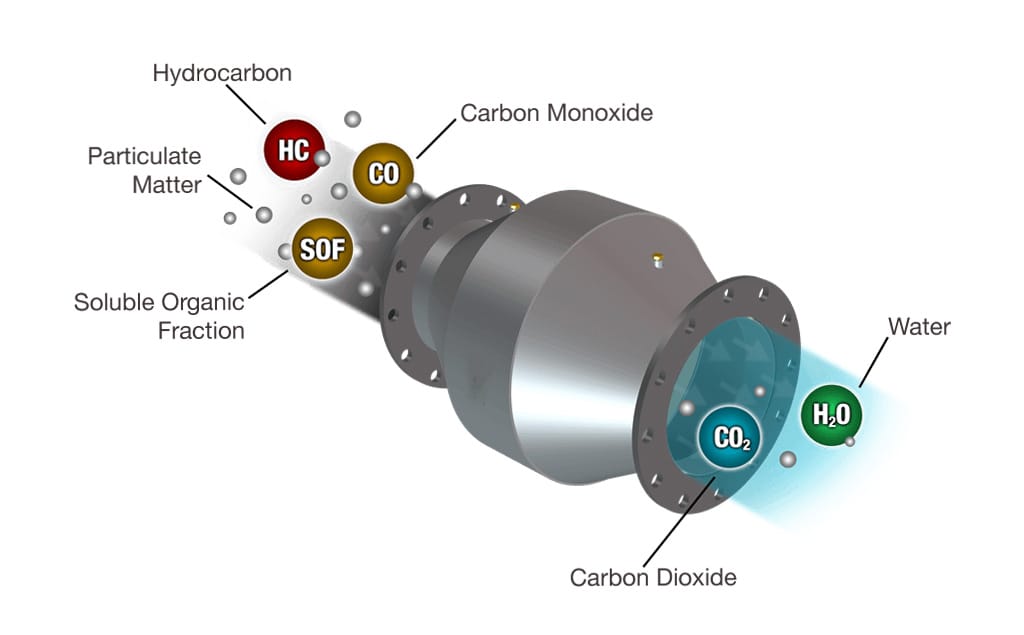
3. CPSI Density: Technical Differences & Vehicle Matching
(Using the uploaded CPSI data as the basis for the table below.)
3.1 Key technical differences by CPSI
| Characteristic | Low density (200–300 cpsi) | Standard (400 cpsi) | High density (600–900+ cpsi) |
|---|---|---|---|
| Pores per square inch (CPSI) | Low | Industry standard | High |
| Channel diameter | Large | Medium | Small |
| Geometric surface area (GSA) | Smaller | Medium | Larger — more reaction surface |
| Wall thickness | Thicker | Typical (e.g., ~6 mil) | Thinner (e.g., 2–4 mil) |
| Exhaust backpressure | Very low | Moderate | Higher (but thin-wall tech reduces this) |
3.2 Recommended CPSI → vehicle / application mapping
| CPSI range | Typical vehicle / application | Benefits | Common product uses |
|---|---|---|---|
| 200–300 cpsi (low density) | Large-displacement engines, heavy light-trucks, pickup trucks, some aftermarket universal converters | Very low backpressure, excellent flow for high flow rate engines | TWC for big engines, universal converters |
| 400 cpsi (standard) | Most passenger cars (small → mid engines), many light commercial vehicles | Balanced cost vs performance; easier coating uniformity | TWC, some GPF cores for moderate PN control |
| 600 cpsi (high) | Modern GDI passenger cars, Euro 6d vehicles, medium performance applications | Higher surface area for conversion and PN control | TWC, GPF, low-temp active catalyst coatings |
| 900–1200 cpsi (very high / ultra) | High-efficiency luxury, hybrid/plug-in hybrid low-temperature exhausts, vehicles targeting tight Euro 7 limits | Very high conversion efficiency and PN control, smaller footprints | High-performance TWC, advanced GPF, low-temp catalysts |
| DPF (porous block / SiC) | Diesel commercial vehicles, buses, some heavy off-road machinery | >95% PM capture; designed for regeneration | DPF, DOC+DPF assemblies |
| SCR (monolith or honeycomb with V₂O₅/TiO₂) | Heavy trucks, buses, fleet vehicles in regulated NOx regions | Very high NOx reduction; tailored low-temp performance | SCR modules, urea dosing integrated systems |
4. Regional Product Tailoring (examples)
- Europe: Euro 6d / Euro 7 ready — GPF for GDI engines, DPF+SCR for diesel, certification support, EU warehousing. Typical substrate density: 600 / 900 cpsi for the latest regulations.
- North America: EPA & CARB offerings — CARB-compliant high-load TWCs, cold-start strategies, robust stainless housings for cold climates.
- Middle East & Africa: High-temperature resistant catalysts, high-sulfur fuel compatibility, bus and fleet solutions designed for 40–55°C ambient conditions.
- Latin America & Southeast Asia: Multi-fuel compatibility, cost-sensitive aftermarket lines, product ranges for light commercial vehicles and taxis.
5. Who 3WayCatalyst Serves
- OEMs — substrate customization, catalyst coating services, engineering integration, PPAP / APQP documentation and sampling.
- Aftermarket importers & distributors — direct-fit and universal converters, DPF/GPF wholesale, private-label capability, regional stock strategies.
- Retrofit & upgrade projects — Euro 2→4→6 upgrade kits, bus/truck aftertreatment retrofits, off-road machinery emission upgrades.
6. Factory Capabilities & Competitive Advantages
- Experience: 15+ years in catalyst formulation and aftertreatment systems.
- Global reach: Partners in 35+ countries.
- End-to-end production: substrate procurement → coating → assembly.
- Quality: ISO/TS certified processes and incoming/outgoing inspection.
- Speed: Rapid customization — prototype coating runs and samples in 7–15 days.
- Scale: Facility 15,000 m²; 8 automated coating & assembly lines; annual capacity ~1.8 million units across TWC, DPF, GPF, SCR.
- Core technical strengths: CPSI customization (200–1200 cpsi), Pt/Pd/Rh ratio optimization, high-OSC washcoat engineering.
7. Practical Selection Guidance (how to choose substrate & product)
- Match CPSI to engine flow & emission target
- High flow, big engines → low CPSI (200–300) to keep backpressure low.
- Tight conversion / PN targets or compact packaging → high CPSI (600–900+).
- Balance precious metal loading vs cost
- Use modeling + dyno data to optimize Pt/Pd/Rh mix for cold-start vs steady-state conversion.
- Consider regional fuel & temperature
- High sulfur fuels and high ambient temps require modified washcoats and sometimes different catalyst chemistries (e.g., V₂O₅ content for SCR).
- Durability design
- Repeated high-temperature cycles (e.g., highway + city) need robust washcoats, strong adhesion, and metallic substrate options for thermal shock resistance.
8. Conclusion — Why partner with 3WayCatalyst
Emission compliance will remain a top industry driver for the next decade. With a full product portfolio (TWC, DPF, GPF, SCR, DOC, carriers, substrates), regional expertise, rapid customization and factory-direct pricing, 3WayCatalyst is positioned as a long-term global partner for OEMs, distributors and retrofit programs.