Indledning
The automotive and industrial manufacturing sectors constantly push components to their absolute physical limits. Within the emissions control sector, engineers face a critical choice when designing a high-performance or heavy-duty trevejskatalysator. Engineers face a direct choice between ceramic and metallic monoliths, where the internal core functions as the physical host for the precious metal coating. As a cornerstone of emission control, the washcoat maintains the critical chemical reactions required to neutralize harmful exhaust.
Selecting the wrong internal core architecture leads directly to premature component failure. This decision impacts:
- Udstødningsmodtryk
- Engine output
- Long-term emission compliance
This comprehensive technical guide analyzes the structural design, thermal properties, and operational durability of ceramic and metallic cores. We examine how these variables impact a trevejskatalysator under intense operating conditions.
Technical Overview: The Core of a Three Way Catalytic Converter
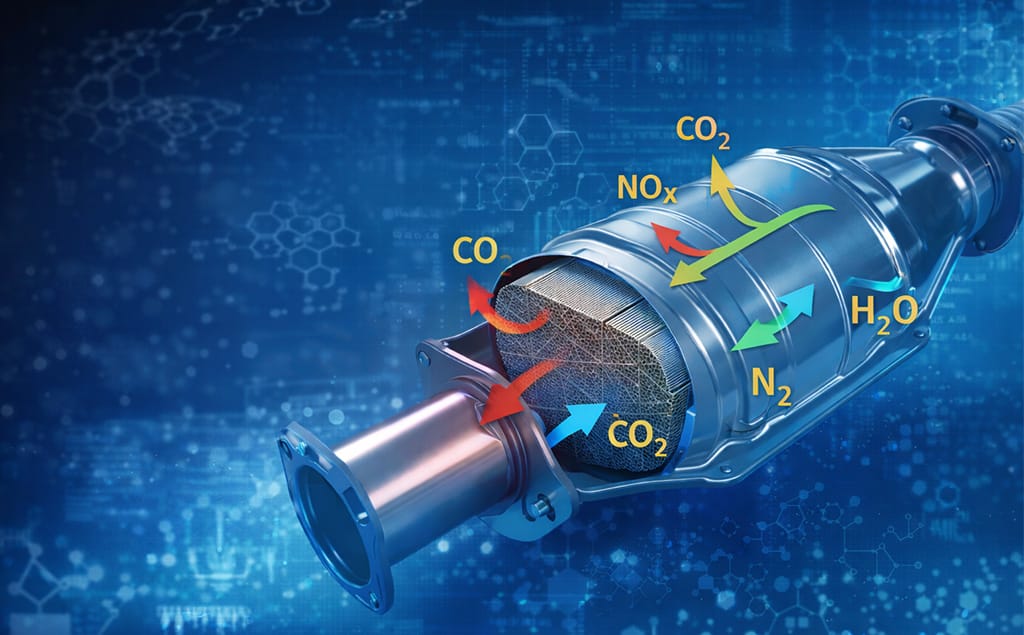
EN trevejskatalysator serves as a vital emissions control device. It simultaneously targets:
- Carbon monoxide ($CO$)
- Unburned hydrocarbons ($HC$)
- Nitrogen oxides ($NO_x$)
The system relies on precise chemical reactions to neutralize these gases. To achieve maximum chemical efficiency, the exhaust gas must pass through an internal substrate structure. This structure maximizes the active surface area coated with platinum, palladium, and rhodium.
Engineers use two primary materials to build these internal structures:
- Keramiske substrater: Synthetic cordierite ($2\text{MgO}\cdot2\text{Al}_2\text{O}_3\cdot5\text{SiO}_2$) represents the industry standard for mass-produced passenger cars.
- Metalliske substrater: Ultra-thin, corrugated stainless steel alloys containing aluminum and yttrium (such as FeCrAl) fulfill high-demand roles.
Tweaking the geometry of these materials alters how the exhaust flows and how heat distributes throughout the core. That’s why picking the right material is what sets the real operating limits for the exhaust system
Core Structural Mechanics and Geometry
At their core, the varying mechanical profiles of ceramic and metal designs are dictated by differences in wall thickness and internal open area.
Ceramic Substrate Core (Thicker Walls, More Restrictive)
┌───┬───┬───┐
│   │   │   │  ◄── Cell Wall: 0.10 mm
├───┼───┼───┤
│   │   │   │  ◄── Open Frontal Area: ~65% to 70%
└───┴───┴───┘
High-pressure environments demand a minimum structural thickness in ceramics to stave off mechanical failure. Standard cordierite channels require cell walls measuring roughly $0.10\text{ mm}$ ($0.004\text{ inches}$). These thick walls reduce the total open frontal area (OFA) of the core to approximately 65% to 70%. The remaining cross-section acts as a solid physical barrier to moving exhaust gas.
Metallic Substrate Core (Ultra-Thin Walls, High Flow)
├───├───├───┤
│   │   │   │  ◄── Cell Wall: 0.03 mm
├───├───├───┤
│   │   │   │  ◄── Open Frontal Area: ~85% to 90%
└───┴───┴───┘
Conversely, Premium corrugated stainless steel foils maintain robust structural stability even at extremely down-gauged thicknesses. Metallic substrate foils measure just $0.03\text{ mm}$ ($0.0012\text{ inches}$) thick. This reduction in material thickness expands the open frontal area to 85% to 90%. As a direct result, a metallic trevejskatalysator core provides a clear, high-flow path for moving exhaust gases.
Comprehensive Substrate Property Comparison
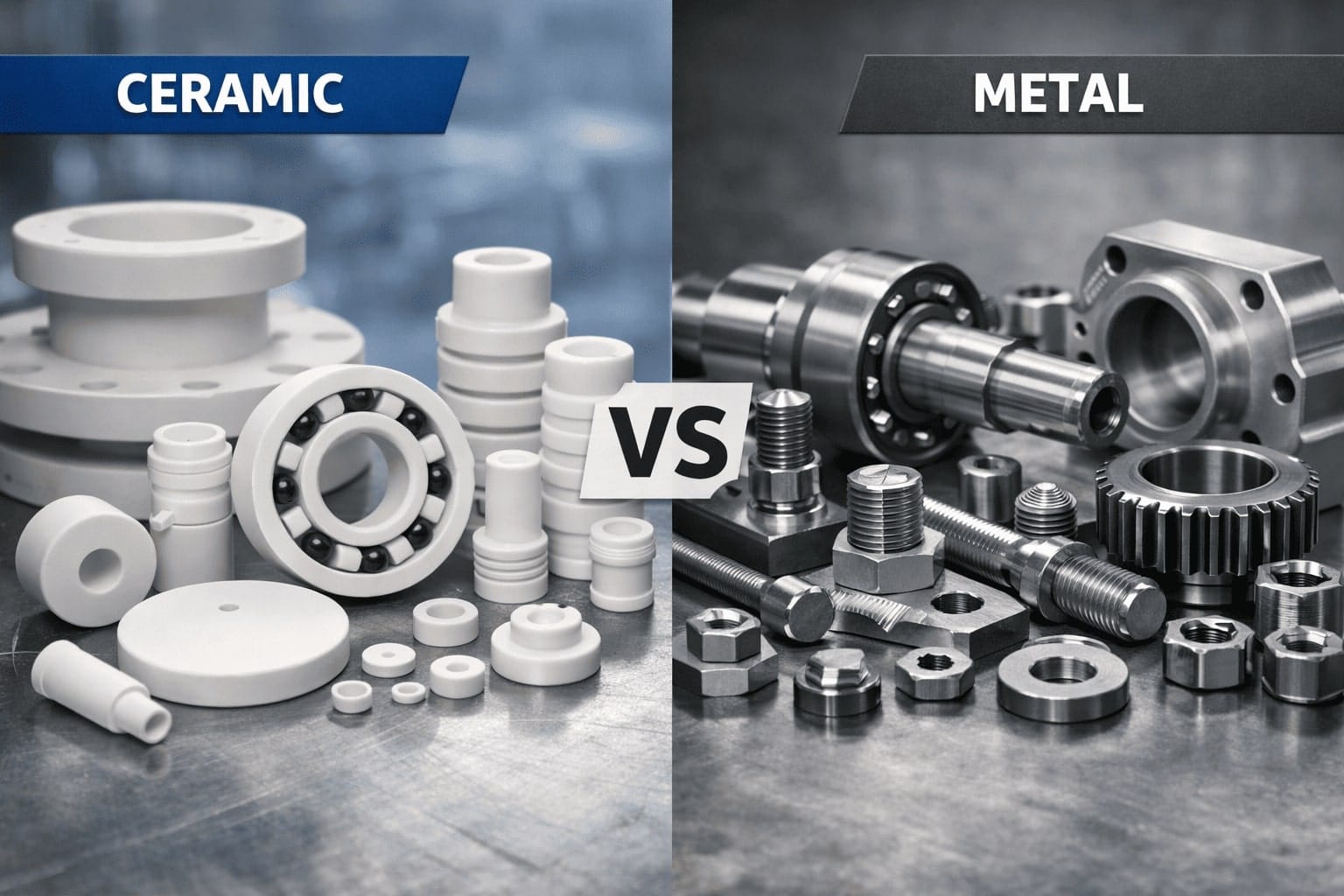
The table below outlines the core properties of metallic and ceramic materials inside an automotive trevejskatalysator:
| Material Property | Metallic Substrate Core | Ceramic Substrate Core (Cordierite) |
|---|---|---|
| Primary Base Material | FeCrAl Stainless Steel Alloy | Synthetic Cordierite Ceramic |
| Standard Foil/Wall Thickness | $0.03\text{ mm}$ ($0.0012\text{ in}$) | $0.10\text{ mm}$ ($0.004\text{ in}$) |
| Open Frontal Area (OFA) | 85% to 90% (Ultra-High Flow) | 65% to 70% (Standard Restriction) |
| Standard Channel Density | 100 to 300 Cells Per Square Inch | 400 to 600 Cells Per Square Inch |
| Thermal Conductivity | High ($10\text{–}16\text{ W/m}\cdot\text{K}$) | Low ($1\text{–}2\text{ W/m}\cdot\text{K}$) |
| Thermal Shock Resistance | Høj (Resists rapid thermal cycles) | Moderat (Prone to cracking) |
| Mechanical Impact Resistance | Høj (Ductile, absorbs vibration) | Lav (Brittle, shatters under shock) |
| Exhaust Backpressure Level | Lav (Optimizes engine horsepower) | Higher (Standard OEM restriction) |
| Primary Target Market | Racing, Heavy-Duty Diesel, Mining | Passenger Vehicles, Budget OEM |
Why Metallic Substrates Excel in High-Performance Roles
Lower Backpressure for Enhanced Horsepower
Minimizing exhaust restriction is critical to maximizing horsepower in racing and high-performance applications. Elevated backpressure spikes pumping losses during the exhaust stroke, directly dragging down the engine’s overall volumetric efficiency.
Because metallic substrate walls are thin, they feature a large open area. This layout minimizes backpressure inside a trevejskatalysator. High-performance tuning benefits directly from this free-flowing exhaust path. The engine expels spent combustion gases rapidly, drawing in a fresh air-fuel charge without restriction.
Rapid Catalyst Light-Off Speed
EN trevejskatalysator does not neutralize harmful emissions immediately after a cold engine start. The precious metals require a minimum internal operating temperature to trigger the oxidation and reduction processes. Technicians refer to this threshold—typically hovering around $482^{\circ}\text{F}$ to $572^{\circ}\text{F}$ ($250^{\circ}\text{C}$ to $300^{\circ}\text{C}$)—as the catalyst “light-off” temperature.
Metallic cores possess high thermal conductivity compared to ceramics. The thin metal foils absorb heat from the initial exhaust pulses instantly. This rapid heat absorption brings the precious metal washcoat to light-off temperature within seconds. This quick thermal response cuts cold-start emissions, which represent a significant portion of total vehicle tailpipe pollution.
Cold Exhaust Gas ──► High Conductivity Metallic Foil ──► Instant Heat Retention ──► Faster Light-Off
High Structural Resistance to Vibration
Performancetuning, offroad-racing og tung industri udsætter udstødningskomponenter for intense mekaniske vibrationer. Keramiske kerner mangler duktilitet. Under konstante, hårde chassisvibrationer kan en keramisk kerne udvikle mikrofrakturer langs sine ydre støttekanter. Med tiden udvides disse revner, hvilket får den keramiske klods til at gå i stykker og tilstoppe udstødningssystemet.
Metalliske substrater undgår denne fejltilstand gennem fleksibel konstruktion. Arbejderne vikler eller låser de tynde rustfri stålfolier sammen til et tæt hus. Derefter loddes indsatsen til en robust stålskal. Den integrerede enhed er konstrueret til at deformeres mikroelastisk under belastning og giver lige præcis nok til at absorbere intens mekanisk påvirkning og chassisinduceret vibration uden strukturfejl.
Why Ceramic Substrates Dominate Standard Passenger Cars
Dynamik i lavprisproduktion
Keramiske cordieritsubstrater dominerer ca. 95% af det globale forbrugerbilmarked. Den primære årsag til denne dominans er lave produktionsomkostninger. Fabrikker ekstruderer keramiske mursten i store mængder ved hjælp af automatiserede maskiner. Denne fremstillingsmetode holder enhedsomkostningerne langt under prisen for viklede og loddede metalfolier. Til almindelig daglig kørsel, hvor motorer kører ved moderate omdrejninger, giver keramiske kerner pålidelig emissionskontrol til en omkostningseffektiv pris.
Høj isolering og varmebevaring
Mens metaller overfører varme hurtigt, fungerer keramik som effektive varmeisolatorer. Denne egenskab giver en specifik fordel under længerevarende tomgang eller bykørsel med mange stop-and-go-bevægelser. Når en keramisk trevejskatalysator når sin ideelle driftstemperatur, bevarer cordieritstenen denne kernevarme. Kernen forbliver varm, selv når udstødningsgastemperaturen falder ved et trafiklys. Denne isolering forhindrer katalysatoren i at køle ned til under dens aktiveringstærskel, hvilket opretholder en stabil emissionskontrol.
Heavy-Duty Industrial Applications: A Critical Analysis
Kommerciel lastbiltransport, byggeri og minedrift i dybe brønde sætter emissionssystemerne i disse tunge industrisektorer under ekstrem driftsbelastning. Disse anvendelser involverer lange driftscyklusser under høj belastning, hvilket genererer høje interne temperaturer.
[Heavy Machinery Engine] ──► Continuous High Load ──► Thermal Stress & Heavy Vibration ──► Metallic Substrate Survives
Keramiske materialer støder på store holdbarhedsproblemer i disse krævende miljøer på grund af specifikke materialebegrænsninger:
- Termisk chok: Når tunge motorer skifter frem og tilbage fra kold tomgang til fuld belastning, svinger temperaturerne utroligt hurtigt. Denne ujævne varme får indersiden af den keramiske kerne til at udvide sig med forskellige hastigheder, hvilket nemt kan revne hele strukturen.
- Partikelakkumulering: Tunge dieselmotorer producerer kulstofsod. Denne sod kan tilstoppe de små, tætte kanaler i en standard 400 CPSI keramisk kerne. Den resulterende blokering øger udstødningsmodtrykket og fanger varme, hvilket kan smelte underlaget.
Metalliske substrater løser disse industrielle problemer gennem et åbent kanaldesign og høj holdbarhed. Deres tyndvæggede kanaler med lavere densitet (såsom 100 eller 200 CPSI) lader sodpartikler passere rent til nedstrøms partikelfiltre. Dette design minimerer strukturel vedligeholdelse og nedetid for kommercielle flåder.
Hybrid Industrial Solutions
I stedet for at stole på et enkelt materiale, anvender moderne industriingeniører ofte hybride materialeløsninger. Disse konfigurationer kombinerer styrkerne ved både keramiske og metalkomponenter i et enkelt emissionssystem.
For eksempel kan ingeniører placere en holdbar metallisk substratkerne opstrøms, tæt på motorens udstødningsmanifold. Denne forreste kerne håndterer de indledende højtemperaturudstødningspulser, modstår termisk chok og opnår hurtig slukningseffekt.
Når man kommer længere nedstrøms, og udstødningstemperaturen stabiliserer sig, er der en keramisk matrixkerne med høj densitet. Ved at bruge dette bagerste keramiske stykke får man masser af overfladeareal til den sidste smule oprydning, og det hjælper faktisk med at sænke de samlede produktionsomkostninger.
Step-by-Step Selection Framework
Når man designer eller udskifter en trevejskatalysator, brug denne strukturelle tekniske ramme til at vælge det rette underlag:
[Substrate Selection Flowchart]
  │
  ├──► Operating Environment?
  │      ├──► Extreme Shock / Off-Road / Heavy Mining ──► METALLIC
  │      └──► Standard Highway / Urban Commuting ─────────► CERAMIC
  │
  ├──► Exhaust Temperature Profile?
  │      ├──► Rapid Thermal Fluctuations ────────────────► METALLIC
  │      └──► Sustained, Monitored Temps ────────────────► CERAMIC
  │
  └──► Engine Performance Goal?
         ├──► Maximize Horsepower / Low Backpressure ────► METALLIC
         └──► Standard Emission Compliance / Low Budget ──► CERAMIC
1. Evaluer mekaniske vibrations- og stødniveauer
Analyser det fysiske miljø, hvor køretøjet eller maskineriet opererer. Hvis køretøjet kører på glatte asfaltveje, skal du vælge en keramisk substratkerne. Hvis køretøjet opererer i terrængående miljøer, minefelter eller ujævne byggeområder, skal du vælge en metallisk substratkerne til at håndtere de mekaniske påvirkninger.
2. Analysér den termiske cyklusprofil
Gennemgå de forventede temperaturændringer for anvendelsen. Hvis motoren går i tomgang i lange perioder og kræver høj intern varmetilbageholdelse, skal du vælge en keramisk kerne. Til motorer, der udsættes for hyppige, hurtige cyklusser fra koldstart til fuld belastning, anbefales metalliske substrater kraftigt for at eliminere termisk chok-revnedannelse helt.
3. Bestem udstødningsstrøm og modtryksgrænser
Tjek motorplatformens ydeevnekrav. Hvis du roder med højtydende tuning eller kraftige turbodieselmotorer, er du nødt til at vælge metalliske underlag. Deres barberbladstynde folievægge maksimerer det åbne frontareal, hvilket reducerer modtrykket og holder din motor kørende med maksimal effekt.
Konklusion
Valg af det rigtige indvendige kernemateriale til en trevejskatalysator kræver en balance mellem holdbarhed, termisk ydeevne og produktionsomkostninger. Keramiske cordieritkerner er fortsat et pålideligt og omkostningseffektivt valg til almindelige personbiler, der kører under normale daglige kørselsforhold. Deres høje produktionsvolumen og solide varmeisolering sikrer, at forbrugerbiler overholder kravene til en rimelig pris.
Når det er sagt, uanset om du bruger højtydende racerbiler, tunge kommercielle maskiner eller krævende industrielt udstyr, er metalliske kerner vejen frem for ægte holdbarhed. Mindre modtryk fra den tyndvæggede rustfri stålopsætning er simpelthen lig med langt flere hestekræfter. Det tyndvæggede rustfri ståldesign betyder mindre modtryk - og det er sådan, du opnår store hestekræftgevinster. Tyndvægget rustfrit stål betyder mindre modtryk og langt flere hestekræfter. Derudover er denne opsætning robust nok til at modstå temperaturchok og konstante vibrationer. Vælg det rigtige kernedesign. For flådeadministratorer og tunere er det sådan, du opnår langvarig holdbarhed og total ro i sindet med hensyn til emissioner.