Wstęp
The automotive and industrial manufacturing sectors constantly push components to their absolute physical limits. Within the emissions control sector, engineers face a critical choice when designing a high-performance or heavy-duty katalizator trójdrożny. Engineers face a direct choice between ceramic and metallic monoliths, where the internal core functions as the physical host for the precious metal coating. As a cornerstone of emission control, the washcoat maintains the critical chemical reactions required to neutralize harmful exhaust.
Selecting the wrong internal core architecture leads directly to premature component failure. This decision impacts:
- Przeciwciśnienie wydechowe
- Engine output
- Long-term emission compliance
This comprehensive technical guide analyzes the structural design, thermal properties, and operational durability of ceramic and metallic cores. We examine how these variables impact a katalizator trójdrożny under intense operating conditions.
Technical Overview: The Core of a Three Way Catalytic Converter
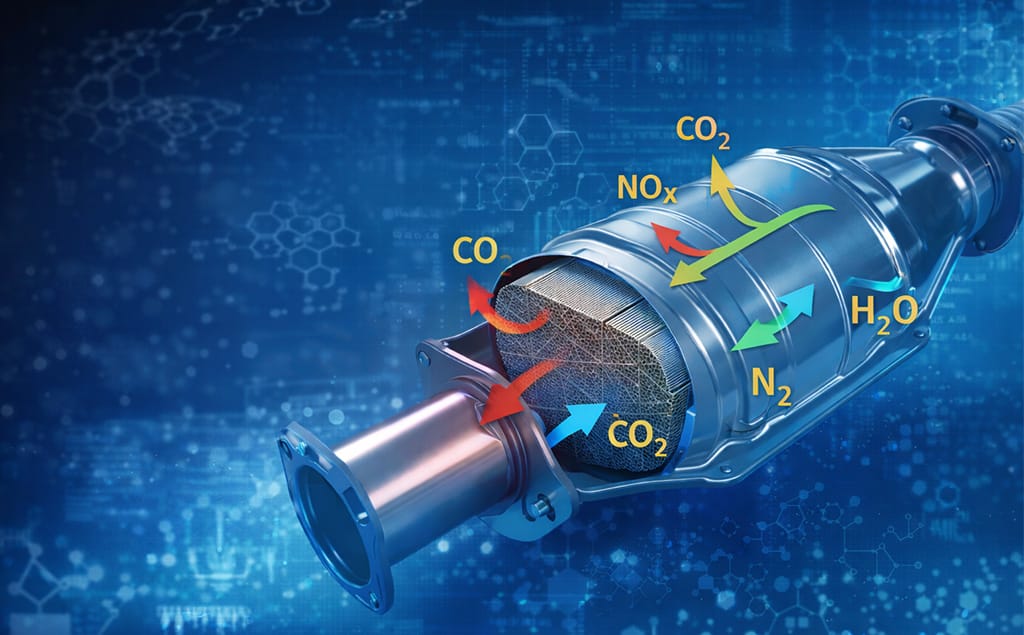
A katalizator trójdrożny serves as a vital emissions control device. It simultaneously targets:
- Carbon monoxide ($CO$)
- Unburned hydrocarbons ($HC$)
- Nitrogen oxides ($NO_x$)
The system relies on precise chemical reactions to neutralize these gases. To achieve maximum chemical efficiency, the exhaust gas must pass through an internal substrate structure. This structure maximizes the active surface area coated with platinum, palladium, and rhodium.
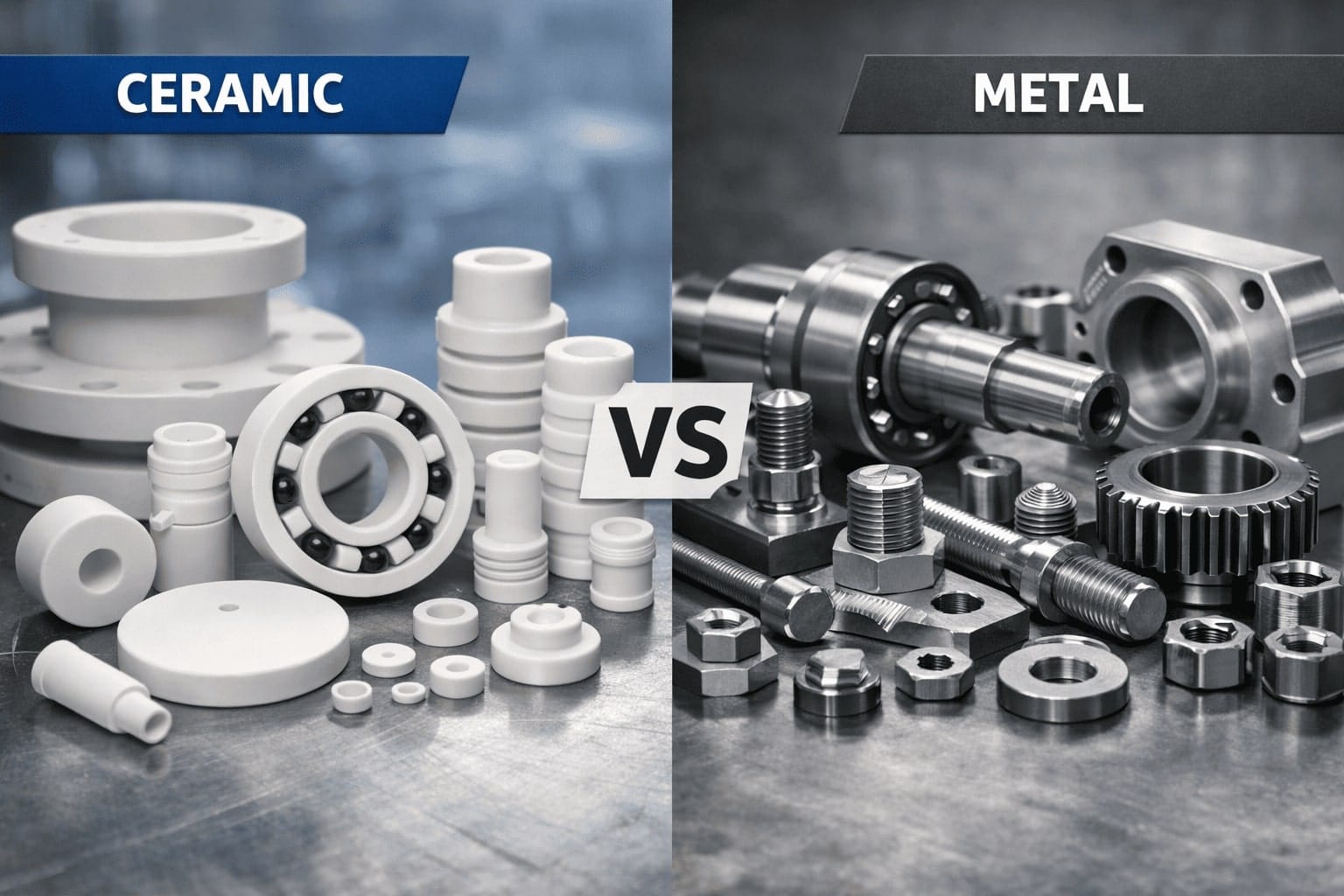
Engineers use two primary materials to build these internal structures:
- Podłoża ceramiczne: Synthetic cordierite ($2\text{MgO}\cdot2\text{Al}_2\text{O}_3\cdot5\text{SiO}_2$) represents the industry standard for mass-produced passenger cars.
- Podłoża metalowe: Ultra-thin, corrugated stainless steel alloys containing aluminum and yttrium (such as FeCrAl) fulfill high-demand roles.
Tweaking the geometry of these materials alters how the exhaust flows and how heat distributes throughout the core. That’s why picking the right material is what sets the real operating limits for the exhaust system
Core Structural Mechanics and Geometry
At their core, the varying mechanical profiles of ceramic and metal designs are dictated by differences in wall thickness and internal open area.
Ceramic Substrate Core (Thicker Walls, More Restrictive)
┌───┬───┬───┐
│   │   │   │  ◄── Cell Wall: 0.10 mm
├───┼───┼───┤
│   │   │   │  ◄── Open Frontal Area: ~65% to 70%
└───┴───┴───┘
High-pressure environments demand a minimum structural thickness in ceramics to stave off mechanical failure. Standard cordierite channels require cell walls measuring roughly $0.10\text{ mm}$ ($0.004\text{ inches}$). These thick walls reduce the total open frontal area (OFA) of the core to approximately 65% to 70%. The remaining cross-section acts as a solid physical barrier to moving exhaust gas.
Metallic Substrate Core (Ultra-Thin Walls, High Flow)
├───├───├───┤
│   │   │   │  ◄── Cell Wall: 0.03 mm
├───├───├───┤
│   │   │   │  ◄── Open Frontal Area: ~85% to 90%
└───┴───┴───┘
Conversely, Premium corrugated stainless steel foils maintain robust structural stability even at extremely down-gauged thicknesses. Metallic substrate foils measure just $0.03\text{ mm}$ ($0.0012\text{ inches}$) thick. This reduction in material thickness expands the open frontal area to 85% to 90%. As a direct result, a metallic katalizator trójdrożny core provides a clear, high-flow path for moving exhaust gases.
Comprehensive Substrate Property Comparison
The table below outlines the core properties of metallic and ceramic materials inside an automotive katalizator trójdrożny:
| Material Property | Metallic Substrate Core | Ceramic Substrate Core (Cordierite) |
|---|---|---|
| Podstawowy materiał bazowy | FeCrAl Stainless Steel Alloy | Synthetic Cordierite Ceramic |
| Standard Foil/Wall Thickness | $0.03\text{ mm}$ ($0.0012\text{ in}$) | $0.10\text{ mm}$ ($0.004\text{ in}$) |
| Open Frontal Area (OFA) | 85% to 90% (Ultra-High Flow) | 65% to 70% (Standard Restriction) |
| Standardowa gęstość kanałów | 100 to 300 Cells Per Square Inch | 400 to 600 Cells Per Square Inch |
| Thermal Conductivity | High ($10\text{–}16\text{ W/m}\cdot\text{K}$) | Low ($1\text{–}2\text{ W/m}\cdot\text{K}$) |
| Odporność na szok termiczny | Wysoki (Resists rapid thermal cycles) | Umiarkowany (Prone to cracking) |
| Mechanical Impact Resistance | Wysoki (Ductile, absorbs vibration) | Low (Brittle, shatters under shock) |
| Exhaust Backpressure Level | Low (Optimizes engine horsepower) | Higher (Standard OEM restriction) |
| Primary Target Market | Racing, Heavy-Duty Diesel, Mining | Passenger Vehicles, Budget OEM |
Why Metallic Substrates Excel in High-Performance Roles
Lower Backpressure for Enhanced Horsepower
Minimizing exhaust restriction is critical to maximizing horsepower in racing and high-performance applications. Elevated backpressure spikes pumping losses during the exhaust stroke, directly dragging down the engine’s overall volumetric efficiency.
Because metallic substrate walls are thin, they feature a large open area. This layout minimizes backpressure inside a katalizator trójdrożny. High-performance tuning benefits directly from this free-flowing exhaust path. The engine expels spent combustion gases rapidly, drawing in a fresh air-fuel charge without restriction.
Rapid Catalyst Light-Off Speed
A katalizator trójdrożny does not neutralize harmful emissions immediately after a cold engine start. The precious metals require a minimum internal operating temperature to trigger the oxidation and reduction processes. Technicians refer to this threshold—typically hovering around $482^{\circ}\text{F}$ to $572^{\circ}\text{F}$ ($250^{\circ}\text{C}$ to $300^{\circ}\text{C}$)—as the catalyst “light-off” temperature.
Metallic cores possess high thermal conductivity compared to ceramics. The thin metal foils absorb heat from the initial exhaust pulses instantly. This rapid heat absorption brings the precious metal washcoat to light-off temperature within seconds. This quick thermal response cuts cold-start emissions, which represent a significant portion of total vehicle tailpipe pollution.
Cold Exhaust Gas ──► High Conductivity Metallic Foil ──► Instant Heat Retention ──► Faster Light-Off
High Structural Resistance to Vibration
Performance tuning, off-road racing, and heavy industrial operations expose exhaust components to intense mechanical vibration. Ceramic cores lack ductility. Under constant, harsh chassis vibrations, a ceramic core can develop microfractures along its outer support edges. Over time, these cracks widen, causing the ceramic brick to break apart and clog the exhaust system.
Metallic substrates avoid this failure mode through flexible construction. Workers wind or interlock the thin stainless steel foils into a dense casing. Following this, the insert is brazed into a rugged steel shell. The integrated unit is engineered to deform micro-elastically under load, yielding just enough to absorb intense mechanical impact and chassis-induced vibration without structural failure.
Why Ceramic Substrates Dominate Standard Passenger Cars
Low-Cost Production Dynamics
Ceramic cordierite substrates dominate approximately 95% of the worldwide consumer automotive market. The primary reason for this dominance is low production cost. Factories extrude ceramic bricks in high volumes using automated machinery. This manufacturing approach keeps the unit cost far below that of wound and brazed metallic foils. For standard daily driving where engines run at moderate RPMs, ceramic cores provide reliable emissions control at a cost-effective price point.
High Insulation and Heat Retention
While metals transfer heat quickly, ceramics act as effective thermal insulators. This trait provides a specific advantage during extended idling or stop-and-go city driving. Once a ceramic three way catalytic converter reaches its ideal operating temperature, the cordierite brick retains that core heat. The core stays hot even when exhaust gas temperatures drop at a traffic light. This insulation prevents the catalyst from cooling down below its activation threshold, maintaining stable emissions control.
Heavy-Duty Industrial Applications: A Critical Analysis
Commercial trucking, construction, and deep-well mining place extreme operational stress on emission systems in these heavy industrial sectors. These applications involve long operational cycles under high load, generating high internal temperatures.
[Heavy Machinery Engine] ──► Continuous High Load ──► Thermal Stress & Heavy Vibration ──► Metallic Substrate Survives
Ceramic materials run into major durability issues in these heavy-duty environments due to specific material limitations:
- Wstrząs termiczny: When heavy engines switch back and forth from cold idling to running at full load, the temperatures bounce around crazy fast. This uneven heat makes the inside of the ceramic core expand at different rates, which can easily crack the whole structure.
- Particulate Accumulation: Heavy diesel engines produce carbon soot. This soot can clog the small, dense channels of a standard 400 CPSI ceramic core. The resulting blockage raises exhaust backpressure and traps heat, which can melt the substrate.
Podłoża metalowe rozwiązują te problemy przemysłowe dzięki otwartej konstrukcji kanałów i wysokiej trwałości. Ich cienkościenne kanały o niższej gęstości (np. 100 lub 200 CPSI) pozwalają cząstkom sadzy przedostać się do filtrów cząstek stałych znajdujących się dalej. Taka konstrukcja minimalizuje konieczność konserwacji konstrukcji i przestoje flot komercyjnych.
Hybrid Industrial Solutions
Zamiast polegać na jednym materiale, współcześni inżynierowie przemysłowi często stosują rozwiązania hybrydowe. Takie konfiguracje łączą zalety elementów ceramicznych i metalowych w ramach jednego systemu emisji.
Na przykład, inżynierowie mogą umieścić trwały metalowy rdzeń podłoża przed kolektorem wydechowym silnika, blisko kolektora wydechowego. Ten przedni rdzeń wychwytuje początkowe impulsy spalin o wysokiej temperaturze, jest odporny na szok termiczny i zapewnia szybkie odpalenie.
Gdy dotrzesz dalej i temperatura spalin się ustabilizuje, zobaczysz rdzeń z matrycą ceramiczną o wysokiej gęstości. Zastosowanie tego tylnego elementu ceramicznego zapewnia ogromną powierzchnię do ostatniego czyszczenia, a to z kolei pomaga obniżyć całkowite koszty produkcji.
Step-by-Step Selection Framework
Podczas projektowania lub wymiany katalizator trójdrożny, wykorzystaj poniższe ramy inżynierii konstrukcyjnej, aby wybrać odpowiednie podłoże:
[Substrate Selection Flowchart]
  │
  ├──► Operating Environment?
  │      ├──► Extreme Shock / Off-Road / Heavy Mining ──► METALLIC
  │      └──► Standard Highway / Urban Commuting ─────────► CERAMIC
  │
  ├──► Exhaust Temperature Profile?
  │      ├──► Rapid Thermal Fluctuations ────────────────► METALLIC
  │      └──► Sustained, Monitored Temps ────────────────► CERAMIC
  │
  └──► Engine Performance Goal?
         ├──► Maximize Horsepower / Low Backpressure ────► METALLIC
         └──► Standard Emission Compliance / Low Budget ──► CERAMIC
1. Oceń poziom drgań mechanicznych i wstrząsów
Przeanalizuj środowisko fizyczne, w którym pojazd lub maszyna pracuje. Jeśli pojazd porusza się po gładkich asfaltowych ulicach miasta, wybierz rdzeń z podłożem ceramicznym. Jeśli pojazd pracuje w terenie, na terenach górniczych lub w nierównych strefach budowy, wybierz rdzeń z podłożem metalowym, aby wytrzymać uderzenia mechaniczne.
2. Przeanalizuj profil cyklu termicznego
Należy sprawdzić przewidywane zmiany temperatury dla danego zastosowania. Jeśli silnik pracuje na biegu jałowym przez długi czas i wymaga wysokiego wewnętrznego zatrzymywania ciepła, należy wybrać rdzeń ceramiczny. W przypadku silników narażonych na częste, szybkie cykle od zimnego rozruchu do pracy z pełnym obciążeniem, zdecydowanie zaleca się stosowanie metalowych podłoży, aby całkowicie wyeliminować pęknięcia termiczne.
3. Określ limity przepływu spalin i przeciwciśnienia
Sprawdź wymagania dotyczące wydajności platformy silnika. Jeśli eksperymentujesz z tuningiem o wysokiej wydajności lub turbodoładowanymi silnikami wysokoprężnymi, musisz wybrać podłoża metalowe. Ich niezwykle cienkie ścianki z folii maksymalizują otwartą powierzchnię czołową, co redukuje przeciwciśnienie i utrzymuje silnik w pełnej mocy.
Wniosek
Wybór odpowiedniego materiału rdzenia wewnętrznego dla katalizator trójdrożny Wymaga to zrównoważenia trwałości, wydajności termicznej i kosztów produkcji. Ceramiczne rdzenie kordierytowe pozostają niezawodnym i ekonomicznym wyborem dla standardowych samochodów osobowych użytkowanych w normalnych warunkach codziennej jazdy. Ich duża produkcja i solidna izolacja termiczna zapewniają zgodność pojazdów osobowych z normami przy rozsądnej cenie.
Mimo to, jeśli jeździsz samochodami wyścigowymi o wysokiej wydajności, ciężkimi pojazdami użytkowymi lub wymagającymi podzespołami przemysłowymi, rdzenie metalowe to sposób na zapewnienie prawdziwej trwałości. Mniejsze przeciwciśnienie w układzie cienkościennej stali nierdzewnej oznacza po prostu znacznie większą moc. Konstrukcja z cienkościennej stali nierdzewnej oznacza mniejsze przeciwciśnienie – i w ten sposób uzyskujesz znaczący wzrost mocy. Cienkościenna stal nierdzewna oznacza mniejsze przeciwciśnienie i znacznie większą moc. Co więcej, ten układ jest wystarczająco wytrzymały, aby wytrzymać szok termiczny i ciągłe wibracje. Wybierz odpowiedni rdzeń. Dla menedżerów flot i tunerów to sposób na długotrwałą trwałość i całkowity spokój ducha w kwestii emisji.