導入
自動車および産業製造分野では、部品の物理的限界を常に追求している。排ガス制御分野において、エンジニアは高性能または高耐久性の設計において重要な選択を迫られる。 三元触媒コンバーターエンジニアは、セラミック製モノリスと金属製モノリスのどちらかを選択する必要があり、内部コアは貴金属コーティングの物理的なホストとして機能します。排ガス制御の要となるウォッシュコートは、有害な排気ガスを中和するために必要な重要な化学反応を維持します。
内部コアアーキテクチャの選択を誤ると、コンポーネントの早期故障に直結します。この決定は以下に影響を与えます。
- 排気背圧
- エンジン出力
- 長期的な排出規制遵守
この包括的な技術ガイドでは、セラミックおよび金属コアの構造設計、熱特性、および動作耐久性を分析します。これらの変数がどのように影響するかを検証します。 三元触媒コンバーター 過酷な運転条件下において。
技術概要:三元触媒コンバーターのコア部分
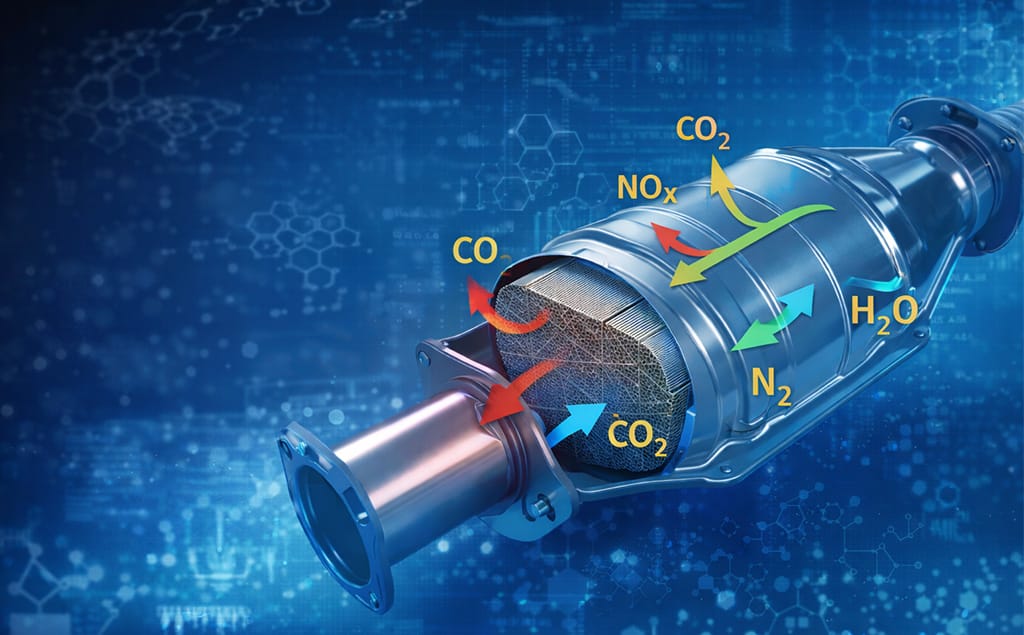
あ 三元触媒コンバーター 重要な排出ガス制御装置として機能します。同時に以下の対象を対象とします。
- 一酸化炭素(CO)
- 未燃焼炭化水素(HC)
- 窒素酸化物($NO_x$)
このシステムは、精密な化学反応を利用してこれらのガスを中和します。化学効率を最大限に高めるため、排気ガスは内部基板構造を通過する必要があります。この構造は、白金、パラジウム、ロジウムでコーティングされた活性表面積を最大化します。
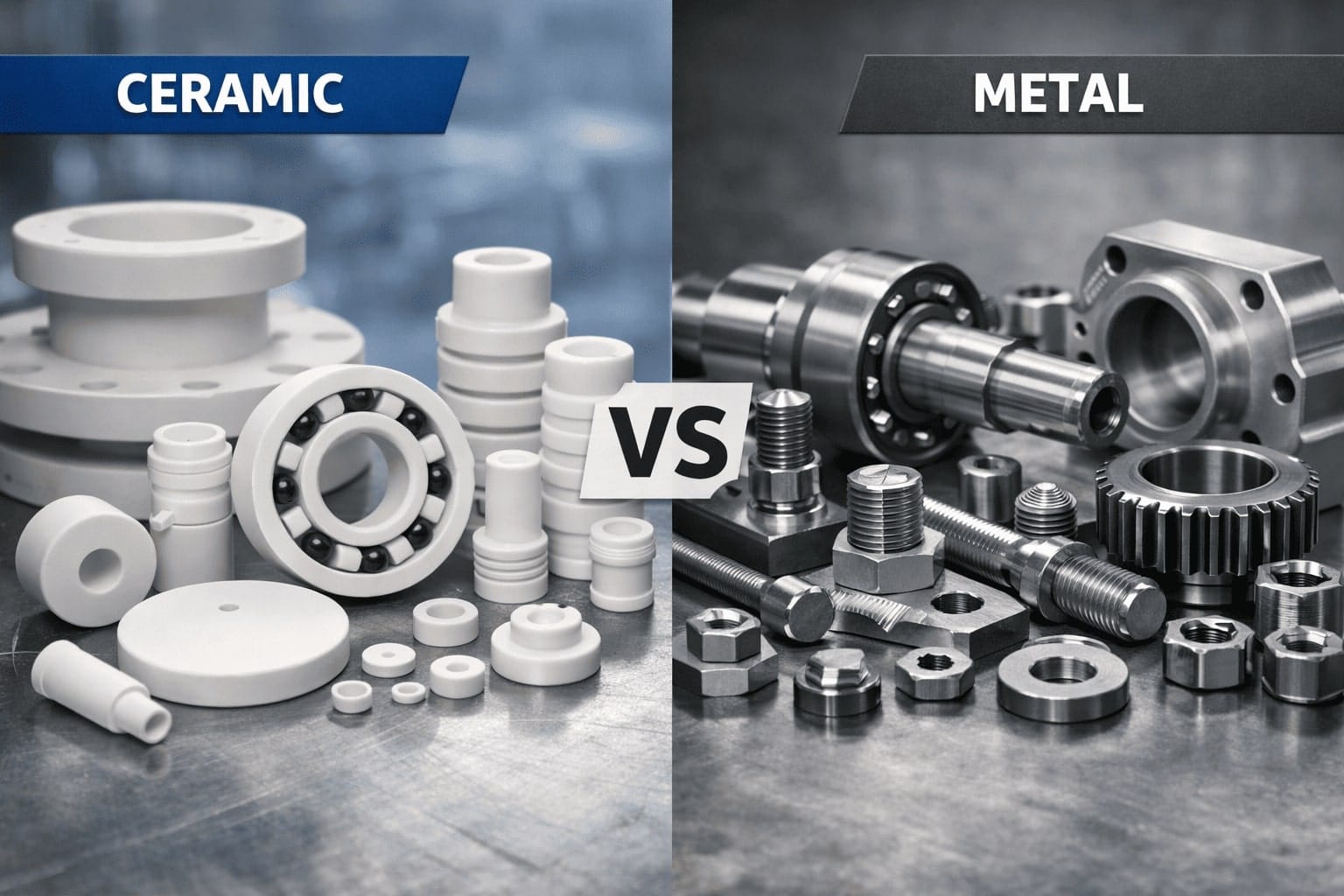
エンジニアはこれらの内部構造を構築するために主に2種類の材料を使用します。
- セラミック基板: 合成コーディエライト($2\text{MgO}\cdot2\text{Al}_2\text{O}_3\cdot5\text{SiO}_2$)は、量産乗用車の業界標準となっている。
- 金属基板: アルミニウムとイットリウムを含む極薄の波形ステンレス鋼合金(FeCrAlなど)は、高い需要に応える役割を担っている。
これらの材料の形状を微調整することで、排気の流れ方やコア全体への熱分布が変わります。そのため、適切な材料を選ぶことが、排気システムの実際の動作限界を決定づけるのです。
構造力学と幾何学の基礎
セラミック製および金属製の設計における機械的特性の違いは、根本的には壁の厚さと内部の開口面積の違いによって決まる。
セラミック基板コア(壁が厚く、抵抗が大きい)
┌───┬───┬───┐ │ │ │ │ ◄── 細胞壁: 0.10 mm ├───┼───┼───┤ │ │ │ │ ◄── 開放前面面積: 約65%~70% └───┴───┴───┘
高圧環境では、機械的破損を防ぐためにセラミックスに最低限の構造的厚さが求められる。標準的なコーディエライトチャネルでは、セル壁の厚さがおよそ 0.10 mm (0.004 インチ)これらの厚い壁により、コアの総開放前面面積(OFA)は約 65%~70%. The remaining cross-section acts as a solid physical barrier to moving exhaust gas.
Metallic Substrate Core (Ultra-Thin Walls, High Flow)
├───├───├───┤
│   │   │   │  ◄── Cell Wall: 0.03 mm
├───├───├───┤
│   │   │   │  ◄── Open Frontal Area: ~85% to 90%
└───┴───┴───┘
Conversely, Premium corrugated stainless steel foils maintain robust structural stability even at extremely down-gauged thicknesses. Metallic substrate foils measure just $0.03\text{ mm}$ ($0.0012\text{ inches}$) thick. This reduction in material thickness expands the open frontal area to 85% to 90%. As a direct result, a metallic 三元触媒コンバーター core provides a clear, high-flow path for moving exhaust gases.
Comprehensive Substrate Property Comparison
The table below outlines the core properties of metallic and ceramic materials inside an automotive 三元触媒コンバーター:
| Material Property | Metallic Substrate Core | Ceramic Substrate Core (Cordierite) |
|---|---|---|
| Primary Base Material | FeCrAl Stainless Steel Alloy | Synthetic Cordierite Ceramic |
| Standard Foil/Wall Thickness | $0.03\text{ mm}$ ($0.0012\text{ in}$) | $0.10\text{ mm}$ ($0.004\text{ in}$) |
| Open Frontal Area (OFA) | 85% to 90% (Ultra-High Flow) | 65%~70% (Standard Restriction) |
| Standard Channel Density | 100 to 300 Cells Per Square Inch | 400 to 600 Cells Per Square Inch |
| 熱伝導率 | High ($10\text{–}16\text{ W/m}\cdot\text{K}$) | Low ($1\text{–}2\text{ W/m}\cdot\text{K}$) |
| Thermal Shock Resistance | 高い (Resists rapid thermal cycles) | 適度 (Prone to cracking) |
| Mechanical Impact Resistance | 高い (Ductile, absorbs vibration) | 低い (Brittle, shatters under shock) |
| Exhaust Backpressure Level | 低い (Optimizes engine horsepower) | Higher (Standard OEM restriction) |
| Primary Target Market | Racing, Heavy-Duty Diesel, Mining | Passenger Vehicles, Budget OEM |
Why Metallic Substrates Excel in High-Performance Roles
Lower Backpressure for Enhanced Horsepower
Minimizing exhaust restriction is critical to maximizing horsepower in racing and high-performance applications. Elevated backpressure spikes pumping losses during the exhaust stroke, directly dragging down the engine’s overall volumetric efficiency.
Because metallic substrate walls are thin, they feature a large open area. This layout minimizes backpressure inside a 三元触媒コンバーター. High-performance tuning benefits directly from this free-flowing exhaust path. The engine expels spent combustion gases rapidly, drawing in a fresh air-fuel charge without restriction.
Rapid Catalyst Light-Off Speed
あ 三元触媒コンバーター does not neutralize harmful emissions immediately after a cold engine start. The precious metals require a minimum internal operating temperature to trigger the oxidation and reduction processes. Technicians refer to this threshold—typically hovering around $482^{\circ}\text{F}$ to $572^{\circ}\text{F}$ ($250^{\circ}\text{C}$ to $300^{\circ}\text{C}$)—as the catalyst “light-off” temperature.
Metallic cores possess high thermal conductivity compared to ceramics. The thin metal foils absorb heat from the initial exhaust pulses instantly. This rapid heat absorption brings the precious metal washcoat to light-off temperature within seconds. This quick thermal response cuts cold-start emissions, which represent a significant portion of total vehicle tailpipe pollution.
Cold Exhaust Gas ──► High Conductivity Metallic Foil ──► Instant Heat Retention ──► Faster Light-Off
High Structural Resistance to Vibration
Performance tuning, off-road racing, and heavy industrial operations expose exhaust components to intense mechanical vibration. Ceramic cores lack ductility. Under constant, harsh chassis vibrations, a ceramic core can develop microfractures along its outer support edges. Over time, these cracks widen, causing the ceramic brick to break apart and clog the exhaust system.
Metallic substrates avoid this failure mode through flexible construction. Workers wind or interlock the thin stainless steel foils into a dense casing. Following this, the insert is brazed into a rugged steel shell. The integrated unit is engineered to deform micro-elastically under load, yielding just enough to absorb intense mechanical impact and chassis-induced vibration without structural failure.
Why Ceramic Substrates Dominate Standard Passenger Cars
Low-Cost Production Dynamics
Ceramic cordierite substrates dominate approximately 95% of the worldwide consumer automotive market. The primary reason for this dominance is low production cost. Factories extrude ceramic bricks in high volumes using automated machinery. This manufacturing approach keeps the unit cost far below that of wound and brazed metallic foils. For standard daily driving where engines run at moderate RPMs, ceramic cores provide reliable emissions control at a cost-effective price point.
High Insulation and Heat Retention
While metals transfer heat quickly, ceramics act as effective thermal insulators. This trait provides a specific advantage during extended idling or stop-and-go city driving. Once a ceramic three way catalytic converter reaches its ideal operating temperature, the cordierite brick retains that core heat. The core stays hot even when exhaust gas temperatures drop at a traffic light. This insulation prevents the catalyst from cooling down below its activation threshold, maintaining stable emissions control.
Heavy-Duty Industrial Applications: A Critical Analysis
Commercial trucking, construction, and deep-well mining place extreme operational stress on emission systems in these heavy industrial sectors. These applications involve long operational cycles under high load, generating high internal temperatures.
[Heavy Machinery Engine] ──► Continuous High Load ──► Thermal Stress & Heavy Vibration ──► Metallic Substrate Survives
Ceramic materials run into major durability issues in these heavy-duty environments due to specific material limitations:
- 熱衝撃: 大型エンジンが冷間アイドリング状態から全負荷運転状態へと切り替わる際、温度は激しく変動します。この不均一な熱によってセラミックコア内部の膨張率が異なるため、構造全体に亀裂が入りやすくなります。
- 微粒子蓄積: 大型ディーゼルエンジンは炭素煤を発生させます。この煤は、標準的な400 CPSIセラミックコアの細く密度の高い流路を詰まらせる可能性があります。その結果生じる詰まりは排気背圧を上昇させ、熱を閉じ込め、基材を溶融させる可能性があります。
金属基材は、オープンチャネル設計と高い耐久性により、これらの産業上の課題を解決します。薄肉で低密度(100または200 CPSIなど)のチャネルにより、煤粒子は下流の微粒子フィルターまでスムーズに通過します。この設計により、商用車両群の構造的なメンテナンスと稼働停止時間を最小限に抑えることができます。
ハイブリッド産業ソリューション
現代の産業技術者は、単一の材料に頼るのではなく、ハイブリッド材料を用いたソリューションを頻繁に採用している。これらの構成は、単一の排出システム内でセラミックと金属の両方の部品の長所を組み合わせたものである。
例えば、エンジニアは耐久性のある金属製の基板コアをエンジンの排気マニホールドに近い上流側に配置することがある。この前面コアは、初期の高温排気パルスを処理し、熱衝撃に耐え、迅速な着火を実現する。
さらに下流に進み、排気温度が安定すると、高密度セラミックマトリックスコアが現れます。この後部のセラミック部品を採用することで、最後の仕上げ洗浄のための表面積が大幅に増加し、結果として総生産コストの削減にもつながります。
段階的な選定フレームワーク
設計または交換する際 三元触媒コンバーターこの構造工学フレームワークを活用して、適切な基材を選択してください。
[Substrate Selection Flowchart]
  │
  ├──► Operating Environment?
  │      ├──► Extreme Shock / Off-Road / Heavy Mining ──► METALLIC
  │      └──► Standard Highway / Urban Commuting ─────────► CERAMIC
  │
  ├──► Exhaust Temperature Profile?
  │      ├──► Rapid Thermal Fluctuations ────────────────► METALLIC
  │      └──► Sustained, Monitored Temps ────────────────► CERAMIC
  │
  └──► Engine Performance Goal?
         ├──► Maximize Horsepower / Low Backpressure ────► METALLIC
         └──► Standard Emission Compliance / Low Budget ──► CERAMIC
1. 機械的振動および衝撃レベルの評価
車両や機械が稼働する物理的環境を分析してください。車両が滑らかなアスファルトの市街地を走行する場合は、セラミック基材コアを選択してください。車両がオフロード環境、鉱山、または過酷な建設現場を走行する場合は、機械的衝撃に耐えられるよう、金属基材コアを選択してください。
2. 熱サイクルプロファイルの解析
用途に応じた予想される温度変化を確認してください。エンジンが長時間アイドリング状態になり、高い内部熱保持能力が必要な場合は、セラミックコアを選択してください。冷間始動から全負荷運転まで頻繁かつ急激なサイクルを繰り返すエンジンには、熱衝撃によるひび割れを完全に防ぐため、金属基板の使用を強くお勧めします。
3. 排気流量と背圧の制限値を決定する
エンジンプラットフォームの性能要件を確認してください。高性能チューニングや高出力ターボディーゼルエンジンを扱う場合は、金属製の基板を使用する必要があります。金属製の基板は極薄の箔壁で前面の開口面積を最大化し、背圧を低減してエンジンを最高の出力で稼働させます。
結論
適切な内部コア材を選択する 三元触媒コンバーター 耐久性、断熱性能、製造コストのバランスを取る必要があります。セラミックコーディエライトコアは、通常の日常走行条件下で使用される一般的な乗用車にとって、信頼性が高く費用対効果の高い選択肢であり続けています。高い生産量と優れた断熱性能により、乗用車はリーズナブルなコストで安全基準を満たすことができます。
とはいえ、高性能レースカー、ヘビーデューティー商用リグ、過酷な産業機器を運用している場合は、真の耐久性のためには金属製コアが最適です。薄肉ステンレス構造による背圧の低減は、単純に馬力の大幅な向上につながります。薄肉ステンレス設計は背圧の低減を意味し、それが馬力の大幅な向上につながります。薄肉ステンレスは背圧の低減と馬力の大幅な向上を意味します。さらに、この構造は熱衝撃や絶え間ない振動にも耐えられるほど頑丈です。適切なコア設計を選択してください。フリート管理者やチューナーにとっては、これが長期的な耐久性と完全な排出ガスの安心を得る方法です。