مقدمة
The global automotive industry faces a critical turning point. Environmental agencies enforce increasingly strict emission limits every year. Engineers must rethink every component within the vehicle’s powertrain. The محول حفاز ثلاثي الاتجاهات serves as the heart of emission control. However, traditional manufacturing methods for these units have reached their physical limits. Additive manufacturing exhaust technology offers a revolutionary path forward. This technology allows for the creation of complex geometries that improve performance. It significantly reduces vehicle weight. This article examines how 3D printing transforms the محول حفاز ثلاثي الاتجاهات. We will explore material innovations, structural design, and future industry trends.
Breaking the Limits of Traditional TWC Substrates
For decades, the محول حفاز ثلاثي الاتجاهات relied on extruded ceramic monoliths. These honeycombs have fixed, straight channels. While reliable, they create a compromise between surface area and backpressure. Additive manufacturing exhaust technology eliminates this compromise. It enables the production of metallic substrates with optimized internal flow.
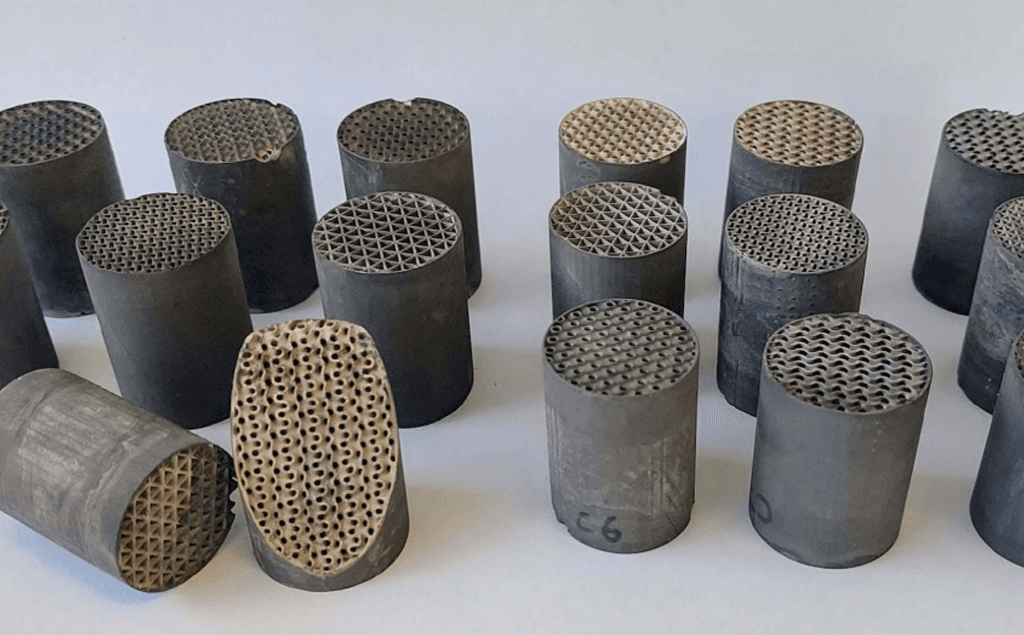
Engineers now use 3D printing to create lattice structures. These structures force exhaust gases to mix more effectively. This ensures that every gas molecule contacts the precious metal catalyst. Unlike traditional ceramic blocks, 3D-printed substrates offer higher thermal conductivity. This feature is vital for the محول حفاز ثلاثي الاتجاهات. It allows the device to reach its activation temperature faster during a cold start.
The Role of Advanced Alloys in Emission Systems
The environment inside a محول حفاز ثلاثي الاتجاهات is extremely harsh. It must withstand temperatures above 900°C. It must also resist chemical oxidation. Additive manufacturing exhaust technology utilizes aerospace-grade superalloys to solve these issues.
- Inconel 625: This nickel-chromium alloy provides superior heat resistance. 3D printing forms Inconel into thin-walled structures. These walls are much thinner than those in cast components.
- Titanium Alloys: Titanium offers extreme weight savings. A titanium-housed محول حفاز ثلاثي الاتجاهات weighs 40% less than a steel one.
- Al-Cr-Fe Powders: Manufacturers use specialized iron-chromium-aluminum powders. These materials enhance the adhesion of the wash-coat. A better wash-coat improves the overall efficiency of the محول حفاز ثلاثي الاتجاهات.
Integration: The Unified Manifold-Converter Design
This section provides the extra technical depth you requested. One major trend in additive manufacturing exhaust technology is part consolidation. Traditional systems use separate manifolds, pipes, and converter housings. These parts require heavy flanges and bolts. They often develop leaks at the joints.
Engineers now print the entire assembly as a single unit. This integrated design optimizes the gas path from the cylinder head to the محول حفاز ثلاثي الاتجاهات. It eliminates unnecessary weight. It also improves thermal management. Heat stays inside the gas stream rather than escaping through heavy metal flanges. This ensures that the محول حفاز ثلاثي الاتجاهات stays at its peak operating temperature for longer periods.
Comparison of Substrate Efficiency
| Substrate Type | Ceramic (Extruded) | Metallic (Wound) | Additive (3D Printed) |
|---|---|---|---|
| مادة | Cordierite | الفولاذ المقاوم للصدأ | Inconel / Titanium |
| Geometry | Standard Honeycomb | Spiral / S-shape | Gyroid / Lattice |
| Surface Area | Baseline | +25% | +75% to +120% |
| سمك الجدار | 0.10 mm | 0.05 mm | 0.03 mm |
| الضغط العكسي | عالي | Moderate | قليل |
| TWC Activation | Slow | Moderate | Extremely Fast |
TPMS Lattices: Maximizing Chemical Reactivity
كفاءة محول حفاز ثلاثي الاتجاهات depends on surface area. More surface area means more reaction sites for the catalyst. Additive manufacturing exhaust technology introduces Triply Periodic Minimal Surfaces (TPMS).
TPMS designs, such as the Gyroid, create a continuous curved path. This path eliminates the “dead zones” found in square honeycomb corners. It creates micro-turbulence in the exhaust stream. Micro-turbulence improves the interaction between gases and the catalyst. Consequently, a smaller 3D-printed محول حفاز ثلاثي الاتجاهات can match the performance of a much larger traditional unit. This allows for more compact engine bays in modern vehicles.
Thermal Management and Cold-Start Emissions
Cold-start emissions represent the largest portion of total vehicle pollution. The محول حفاز ثلاثي الاتجاهات remains inactive until it reaches “light-off” temperature. Ceramic substrates have high thermal mass. They absorb too much heat before they start working.
Additive manufacturing exhaust technology addresses this by using thin-walled metallic lattices. These structures have very low thermal mass. They heat up almost instantly. This rapid heating triggers the محول حفاز ثلاثي الاتجاهات within seconds of engine ignition. This innovation is critical for meeting Euro 7 and China 7 standards. It directly reduces the amount of unburned hydrocarbons released into the atmosphere.
Regional Regulatory Impacts on Exhaust Design
Different markets have unique requirements for the محول حفاز ثلاثي الاتجاهات.
- Europe (Euro 7): Regulations now demand durability for up to 200,000 km. Additive manufacturing exhaust technology provides the structural strength to meet this.
- North America (PART Act): The focus is on preventing precious metal theft. 3D printing allows manufacturers to embed digital watermarks into the housing. This makes the محول حفاز ثلاثي الاتجاهات traceable.
- Asia (China 7): The market demands rapid innovation for hybrid vehicles. 3D printing speeds up the development cycle for new محول حفاز ثلاثي الاتجاهات designs.
Performance Validation Data
Computational Fluid Dynamics (CFD) reveals the advantages of additive manufacturing exhaust technology in a standard 2.0L engine test.
| Metric | Traditional TWC | Additive TWC | Improvement |
|---|---|---|---|
| Gas Conversion (%) | 94.2 | 99.1 | +4.9% |
| ضغط العادم الخلفي | 13.5 kPa | 8.2 kPa | -39.2% |
| Substrate Mass | 1.8 kg | 0.9 kg | -50.0% |
| Total Assembly Mass | 5.8 kg | 3.4 kg | -41.4% |
Future Trends: Generative Design and AI
The future of additive manufacturing exhaust technology lies in Generative Design. Engineers use AI to simulate millions of lattice variations. The AI finds the lightest structure that can withstand specific vibration frequencies.
This prevents the “telescoping” failure common in high-performance metallic converters. We also expect to see the integration of electric heaters within 3D-printed substrates. A heated محول حفاز ثلاثي الاتجاهات eliminates cold-start emissions entirely. This combination will likely become the standard for the next generation of hybrid and internal combustion vehicles.
خاتمة
Additive manufacturing exhaust technology represents a quantum leap in automotive engineering. It transforms the محول حفاز ثلاثي الاتجاهات from a simple brick into a high-tech instrument. By using advanced lattices and aerospace alloys, it solves the weight and emission challenges of the 21st century. This technology reduces backpressure and improves engine efficiency. It ensures that the محول حفاز ثلاثي الاتجاهات reaches its peak performance faster than ever before. As the industry moves toward يورو 7 and beyond, 3D printing will play a central role. It is the key to creating cleaner, lighter, and more powerful vehicles for the global market.