مقدمة
While a محول حفاز ثلاثي الاتجاهات appears deceptive in its simplicity, its internal structure is a product of rigorous, highly controlled engineering. Out on the factory floor, there is zero room for error. Even the slightest slip-up in washcoat application, kiln temperatures, or raw material consistency will instantly tank the converter’s cleanup efficiency.
This is why experienced buyers, recyclers, and automotive suppliers usually pay attention not only to design, but also to how the converter is manufactured.
What a Three Way Catalytic Converter Does
أ محول حفاز ثلاثي الاتجاهات (TWC) is designed for gasoline engines and reduces three major pollutants:
- أول أكسيد الكربون (CO)
- الهيدروكربونات (HC)
- أكاسيد النيتروجين (NOx)
Emission Conversion Overview
| ملوث | Conversion Output |
|---|---|
| أول أكسيد الكربون | ثاني أكسيد الكربون |
| إتش سي | CO₂ + H₂O |
| أكاسيد النيتروجين | N₂ + O₂ |
In real driving conditions, exhaust temperature and airflow constantly change, so the converter must remain stable across different working states.
Why Manufacturing Quality Matters
From a production perspective, three way catalytic converters are highly sensitive to process variation.
Even if two products share the same design, differences in:
- coating uniformity
- precious metal distribution
- substrate density
- thermal curing stability
can lead to very different long-term performance.
This is especially important for OEM-level emission standards.
Substrate Manufacturing (Ceramic vs Metallic)
The process starts with the substrate, often called the “core” or “brick” in factories.
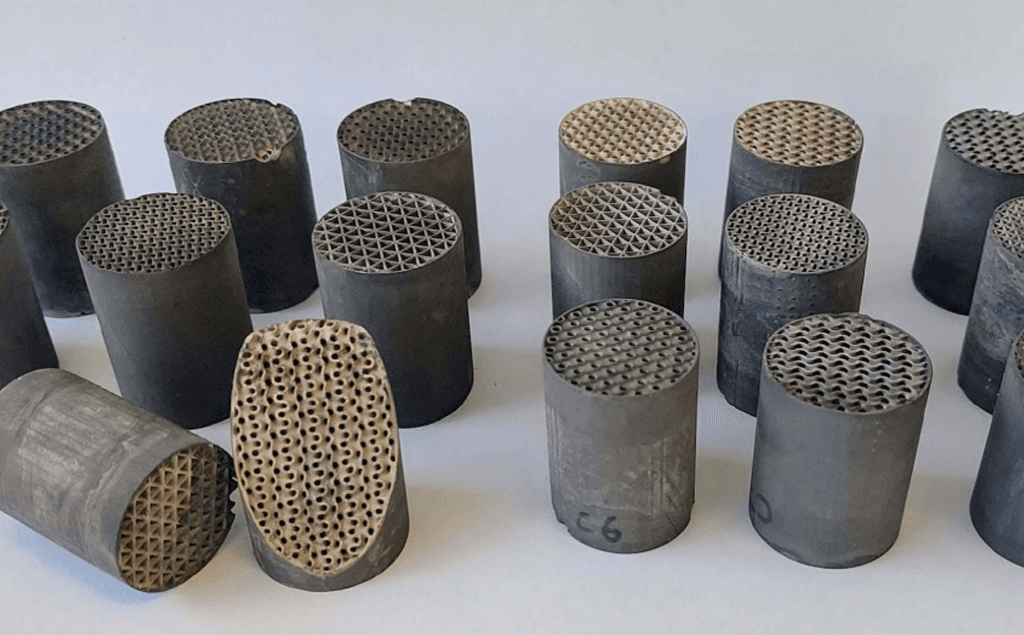
Most passenger vehicles use cordierite ceramic substrates due to their thermal stability and cost efficiency.
Ceramic vs Metallic Substrate Comparison
| يكتب | المزايا | Typical Use |
|---|---|---|
| Ceramic (Cordierite) | Stable, cost-effective, lightweight | Passenger vehicles |
| معدني | Faster heating, higher durability | Performance & heavy-duty |
The honeycomb structure is extruded to create thousands of micro channels, allowing exhaust gases to pass through while increasing surface contact area.
Honeycomb Structure Function
The honeycomb design is one of the most important engineering features in a المحول الحفاز.
It helps to:
- Increase reaction surface area
- Improve exhaust gas distribution
- Reduce flow resistance
- Maintain stable conversion efficiency
Higher CPSI (cells per square inch) generally improves efficiency but also increases manufacturing difficulty.
Washcoat Application Process
After substrate forming, a washcoat layer is applied.
This step is critical because it determines how well precious metals can be supported later.
Washcoat Composition
- Aluminum oxide (Al₂O₃)
- Cerium oxide (CeO₂)
- Titanium dioxide (TiO₂)
Key Role of Washcoat
| وظيفة | تأثير |
|---|---|
| Surface enlargement | More reaction area |
| Metal support | Better catalyst distribution |
| Thermal resistance | متانة محسّنة |
In real factory production, slurry control is extremely important. Slight changes in viscosity can affect coating uniformity across batches.
Oxygen Storage Technology
Modern converters include cerium-based oxygen storage materials.
Their function is simple but important:
- Store oxygen when excess is available
- Release oxygen when needed
- Stabilize reaction under fluctuating engine conditions
This improves performance during acceleration, deceleration, and idle cycles.
Precious Metal Coating (Core Function Layer)
This is the most valuable stage in the entire process.
Three main metals are used:
- البلاتين (Pt)
- البلاديوم (Pd)
- الروديوم (Rh)
Function Breakdown
| Metal | وظيفة |
|---|---|
| البلاتين | CO oxidation |
| البلاديوم | أكسدة الهيدروكربون |
| الروديوم | تقليل أكاسيد النيتروجين |
Palladium is widely used in modern gasoline systems due to cost-performance balance, while rhodium remains critical for NOx control.
Why Rhodium Impacts Recycling Value
Although rhodium is used in small quantities, its impact is significant.
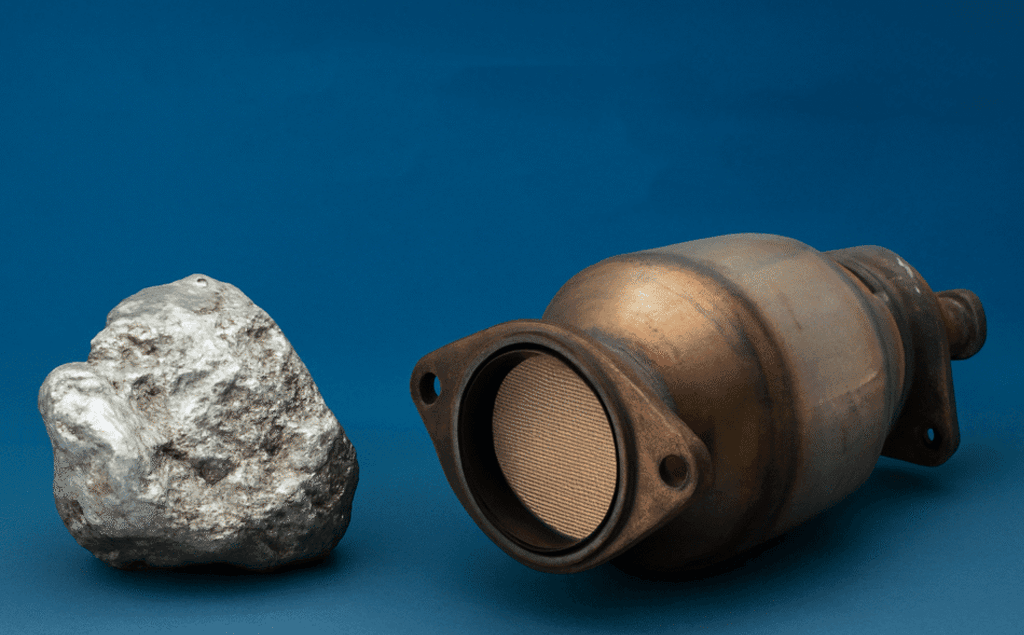
In recycling operations, converters with higher rhodium content often show higher recovery value even if physical size is the same.
This is one reason catalytic converter scrap pricing fluctuates closely with مجموعة البلاتين market movements.
Drying and Thermal Stabilization
After coating, the substrate goes through controlled drying and heat treatment.
This process helps:
- Fix washcoat structure
- Improve adhesion strength
- Reduce coating degradation risk
Thermal Process Stages
| Stage | غاية |
|---|---|
| تجفيف | Remove moisture |
| Curing | Stabilize coating |
| Pre-calcination | Prepare structure |
Temperature curve control is a key factor in production stability.
Calcination Process (High Temperature Stage)
Calcination strengthens bonding between:
- الركيزة
- معطف غسيل
- المعادن الثمينة
It also improves resistance to thermal cycling caused by repeated engine heating and cooling.
Poor calcination control can lead to early coating failure or reduced conversion efficiency.
Assembly and Housing Integration
After thermal processing, the core is wrapped with an insulating mat and installed into a stainless-steel shell.
Mounting Mat Function
| وظيفة | Benefit |
|---|---|
| Vibration absorption | Prevents cracking |
| Thermal insulation | Maintains temperature |
| Position fixing | Stabilizes core |
The housing is then welded and fitted with inlet/outlet pipes and sensor ports.
مراقبة الجودة والاختبار
Before shipment, converters go through multiple inspection steps:
- Dimensional inspection
- Leak testing
- Coating uniformity check
- Sampling performance tests
In real production environments, small defects in coating or welding are often the main cause of early failure in the field.
OEM vs Aftermarket Catalytic Converters
| ميزة | الشركة المصنعة للمعدات الأصلية | ما بعد البيع |
|---|---|---|
| Precious metal loading | Higher | Variable |
| Emission performance | Stable | Inconsistent |
| متانة | Longer | Depends on quality |
| Recycling value | Predictable | Fluctuates |
OEM vs Aftermarket Catalytic Converter,OEM products usually follow stricter manufacturing control systems, resulting in more consistent performance.
Industry Applications and Environmental Impact
Three way catalytic converters play a key role in reducing vehicle emissions globally.
They continuously reduce:
- أول أكسيد الكربون
- الهيدروكربونات
- أكاسيد النيتروجين
Without this technology, urban air quality would be significantly worse, especially in high-density traffic regions.
Full Manufacturing Process Overview
| Stage | الوظيفة الرئيسية | Risk if not controlled |
|---|---|---|
| Substrate forming | Base structure | Cracking / flow imbalance |
| Washcoat coating | Reaction surface | Low efficiency |
| Precious metal loading | Catalytic reaction | Weak emissions control |
| Drying & calcination | Stability | Coating failure |
| Assembly | Mechanical strength | Vibration damage |
Why Catalytic Converter Recycling Matters
End-of-life converters contain valuable platinum group metals:
- البلاتين
- البلاديوم
- الروديوم
Recycling helps recover these metals and return them into industrial supply chains.
This reduces mining demand and supports long-term material sustainability in the automotive industry.
FAQ (SEO Traffic Section)
1. What is a three way catalytic converter made of?
It is mainly made of ceramic or metallic substrate, washcoat materials, and platinum group metals like platinum, palladium, and rhodium.
2. Why is rhodium used in catalytic converters?
Rhodium is used to reduce nitrogen oxides (NOx), which are difficult to control using other metals.
3. What affects catalytic converter performance most?
Substrate quality, washcoat uniformity, precious metal loading, and thermal processing control are the most important factors.
4. Why do OEM catalytic converters perform better?
OEM units usually contain higher and more consistent precious metal loading with stricter manufacturing control.
5.What affects catalytic converter scrap value?
The recycling value of a محول حفاز ثلاثي الاتجاهات mainly depends on how much platinum, palladium, and rhodium it contains, whether it’s an original part, and the current market prices for these rare metals.
خاتمة
The manufacturing process of a محول حفاز ثلاثي الاتجاهات is a multi-stage engineering system involving ceramic forming, chemical coating, precious metal application, and high-temperature stabilization.
Each step directly affects performance, durability, and recycling value.
Whether you’re buying, recycling, or turning wrenches, knowing how these converters are made is the only way to accurately judge their quality and keep low-grade junk out of your shop.