

Request a Quote
Send us your product requirements and we’ll reply within 24 hours.
Pt Pd Rh ceramic honeycomb catalyst substrate designed for automotive catalytic converters, offering reliable catalyst support, efficient exhaust gas flow, and flexible OEM customization.
Our Pt Pd Rh Ceramic Honeycomb Catalyst Substrate is designed as a catalyst carrier for automotive exhaust emission control systems. The honeycomb ceramic structure provides a large surface area for catalytic coatings containing platinum (Pt), palladium (Pd), and rhodium (Rh).
The substrate can be used in catalytic converter manufacturing, catalyst replacement, exhaust system retrofit, and customized emission-control applications. It is available for OEM and bulk orders with customized product configurations and packaging.
For automotive catalytic converter manufacturers and exhaust-system suppliers, the ceramic honeycomb substrate provides a practical foundation for applying precious-metal catalyst coatings and assembling emission-control components.
The ceramic honeycomb substrate can serve as a carrier for precious-metal catalyst formulations based on البلاتين (Pt) والبلاديوم (Pd) والروديوم (Rh).
These platinum group metals are widely used in automotive emission-control catalysts. Pt and Pd are commonly associated with oxidation reactions, while Rh plays an important role in NOx reduction in three-way catalyst systems.
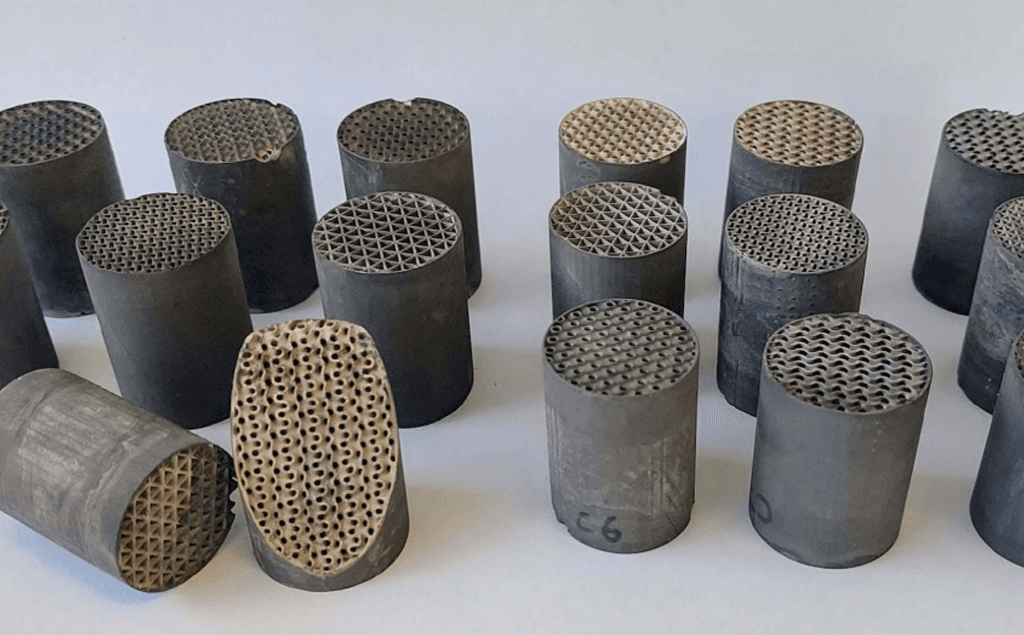
The honeycomb monolith contains multiple parallel gas-flow channels. This structure provides a large contact surface between exhaust gases and the catalyst coating.
A properly designed honeycomb substrate can support effective gas distribution while maintaining relatively low exhaust flow resistance. Honeycomb ceramic monoliths are widely used as catalyst carriers in automotive exhaust treatment.
The substrate is intended for use as an internal catalyst carrier rather than as a complete catalytic converter assembly.
After the appropriate catalyst coating is applied, the ceramic monolith can be integrated into automotive catalytic converters and other exhaust after-treatment systems.
The listed product configuration uses 409L stainless steel for the applicable structural or housing component.
409L stainless steel is commonly used in automotive exhaust applications because of its suitability for heat and corrosion exposure.
We support OEM and customized orders for customers with specific catalyst carrier, packaging, branding, and application requirements.
| المعلمة | مواصفة |
|---|---|
| اسم المنتج | Pt Pd Rh Ceramic Honeycomb Catalyst Carriers & Substrates |
| نوع المنتج | Ceramic Catalyst Carrier / Substrate |
| رقم الموديل | حاملات المحفزات والركائز |
| OE Number | 1601651111372 |
| نوع النواة | Ceramic Honeycomb Substrate |
| Catalyst Compatibility | Pt / Pd / Rh |
| مادة | 409L Stainless Steel |
| نوع الوقود | Dual Fuel |
| موضع | أمام |
| معيار الانبعاث | يورو 5 |
| Structure | Vertical Type |
| Universal Fitment | لا |
| حالة | جديد |
| طلب | التحكم في انبعاثات عوادم السيارات |
| غاية | Retrofit / Upgrade / Replacement / Repair |
| الحد الأدنى لكمية الطلب | 2 pcs |
| ضمان | سنة واحدة |
| الشركة المصنعة للمعدات الأصلية | Accepted |
| Customized Logo | متاح |
| التعبئة والتغليف | Customized Packaging |
| ماركة | محفز ثلاثي الاتجاهات |
| Payment | T/T |
| أصل | شاندونغ، الصين |
Note: Catalyst loading, Pt/Pd/Rh ratio, cell density (CPSI), substrate dimensions, wall thickness, and other technical specifications can be configured according to the application and customer requirements.
أ ceramic honeycomb catalyst substrate is the internal carrier used to support catalytic materials inside an exhaust emission-control system.
Unlike a complete catalytic converter, the substrate itself is the monolithic carrier structure. Its honeycomb channels allow exhaust gases to pass through the catalyst while providing a large available surface for the catalytic coating.
Ceramic honeycomb substrates are commonly manufactured from materials such as cordierite because of their thermal characteristics and suitability for automotive exhaust applications. Commercial catalyst substrates are available in different cell densities, dimensions, shapes, and wall thicknesses depending on the application.
The basic process is:
Engine Exhaust → Honeycomb Catalyst Substrate → Catalyst Coating → Emission Conversion → Treated Exhaust
The ceramic substrate provides the physical structure, while the catalyst coating provides the active catalytic function.
For Pt/Pd/Rh three-way catalyst systems, the coated substrate supports reactions involving major pollutants such as CO, HC and NOx.
Platinum is commonly used in oxidation catalyst formulations and can support the conversion of carbon monoxide and hydrocarbons under suitable exhaust conditions.
Palladium is another important platinum group metal used in automotive oxidation catalysts, particularly in gasoline exhaust applications.
Rhodium is particularly important in three-way catalyst formulations because of its role in NOx reduction.
The actual Pt/Pd/Rh formulation and loading should be selected according to the engine, fuel type, emission requirements, catalyst design, and testing results.
The ceramic substrate can be used as the carrier inside automotive catalytic converter assemblies after the appropriate catalyst coating process.
Pt/Pd/Rh-coated ceramic honeycomb substrates can be used as the monolithic carrier for gasoline three-way catalytic converter systems.
The product is suitable for emission-control projects where a ceramic honeycomb catalyst carrier is required.
The substrate can be considered for customized retrofit, replacement, and exhaust-system upgrade applications.
Catalytic converter manufacturers and catalyst suppliers can use the ceramic monolith as a base material for catalyst coating and subsequent assembly.
The honeycomb structure creates numerous gas-flow channels and provides a large surface area for the catalyst coating.
The open-channel structure allows exhaust gas to pass through the substrate while maintaining a practical balance between catalyst contact and flow resistance.
Ceramic honeycomb substrates can be coated with catalyst formulations containing Pt, Pd, Rh and other catalytic materials depending on the application.
Substrate dimensions, cell density, shape, and other specifications can be selected according to the design requirements of the catalytic converter.
We provide OEM support for customers requiring customized catalyst carriers and substrates.
Substrate dimensions can be discussed according to the customer’s catalytic converter design.
Different cell densities can be selected according to the required exhaust flow, catalyst surface area, and application.
Depending on the converter design, honeycomb substrates can be produced in different shapes, including round, oval, racetrack, and other customized configurations. Commercial automotive catalyst substrates are commonly offered in multiple shapes and cell densities.
Packaging can be customized for distributors, manufacturers, and automotive aftermarket customers.
Customized logos and product branding are available for qualified OEM orders.
Quality control is important because the ceramic monolith must maintain its structural integrity during catalyst coating, assembly, transportation, and operation.
Our quality-control process can include:
For customized projects, technical requirements can be confirmed before production.
The appropriate catalyst substrate should be selected based on the complete exhaust-system design rather than by product name alone.
Important factors include:
| Selection Factor | Why It Matters |
|---|---|
| مادة الركيزة | Determines thermal and mechanical characteristics |
| Cell Density | Influences available catalyst surface area and exhaust flow |
| أبعاد | Must match the catalytic converter housing |
| شكل | Depends on available installation space |
| سمك الجدار | Influences strength and flow characteristics |
| Catalyst Loading | Determines the amount of active precious-metal catalyst |
| Pt/Pd/Rh Ratio | Selected according to catalyst formulation |
| نوع الوقود | Gasoline, diesel, natural gas or other applications may require different catalyst designs |
| معيار الانبعاث | Determines the required emission-control performance |
This information should be confirmed before selecting or customizing a catalyst substrate.
| غرض | Ceramic Catalyst Substrate | Complete Catalytic Converter |
|---|---|---|
| Main Function | Supports catalyst coating | Complete exhaust emission-control assembly |
| Honeycomb Core | نعم | Usually included |
| Pt/Pd/Rh Coating | Depending on configuration | Usually applied to the substrate |
| Stainless Steel Housing | Depending on configuration | نعم |
| Flanges / Hangers | No or customized | Usually included |
| O2 Sensor Ports | لا | Depending on design |
| تثبيت | Requires integration into exhaust assembly | Vehicle installation |
| Main Customers | Catalyst manufacturers / suppliers | Vehicle owners / repair shops / distributors |
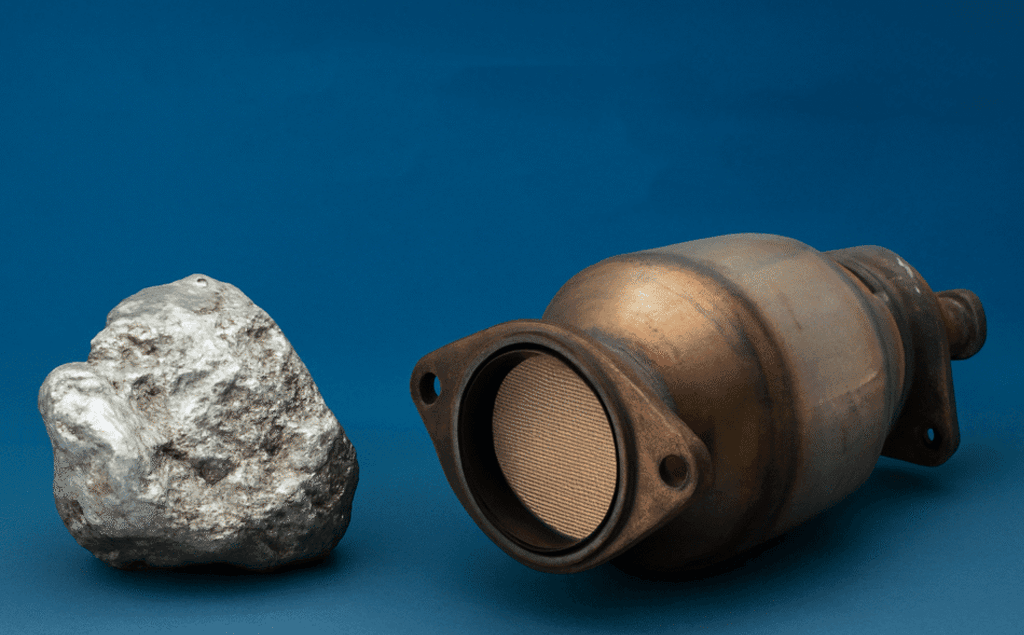
The key distinction is that the catalyst substrate is the carrier, while the complete catalytic converter is the finished exhaust component.
Designed to provide a stable honeycomb structure for automotive catalyst coating and emission-control applications.
Suitable for catalyst systems using platinum, palladium, and rhodium formulations.
Designed for integration into catalytic converters and other automotive emission-control systems.
Supports customized dimensions, configurations, branding, and packaging according to project requirements.
Standard MOQ starts from 2 pieces, making the product suitable for sampling and small-batch purchasing as well as larger OEM projects.
A catalyst substrate is the carrier structure that supports the active catalyst coating inside an emission-control device. In automotive catalytic converters, honeycomb ceramic monoliths are commonly used as the carrier.
It is a ceramic monolith with multiple parallel channels designed to provide a large surface area for catalytic coating while allowing exhaust gases to flow through the structure.
The product is designed for Pt/Pd/Rh catalyst applications. The actual precious-metal loading and ratio should be confirmed according to the specific catalyst formulation and customer requirements.
No. This product is a catalyst carrier/substrate, not necessarily a complete catalytic converter assembly. It can be integrated into a catalytic converter after the appropriate catalyst coating and assembly process.
Yes. OEM customization is available for dimensions, shape, cell density, packaging, branding, and other technical requirements.
The listed MOQ is 2 pieces.
The listed warranty period is 1 year.
The listed product specification is Dual Fuel. Application-specific catalyst design should be confirmed before ordering.
Looking for a ceramic honeycomb catalyst substrate supplier for automotive emission-control applications?
Fengxiang supplies catalyst carriers and substrates for catalytic converter manufacturers, exhaust-system suppliers, distributors, and OEM customers.
اتصال محفز ثلاثي الاتجاهات ل:
MOQ: 2 pcs | OEM Accepted | Customized Production Available | 1-Year Warranty
شارك احتياجاتك الإنتاجية
توفير المواصفات الأساسية (التطبيق، الحجم، معايير الانبعاث) واستلامها خلال 24 ساعة عمل:

Send us your product requirements and we’ll reply within 24 hours.
Tell us your requirements and our team will help you find the right solution.
✓ Custom sizes and configurations
✓ Ceramic or metallic substrate options
✓ Fast quotation for bulk orders
We usually respond within 24 hours.