Введение
An illuminated check engine light brings immediate frustration.Upon pulling diagnostic codes P0420 or P0430, technicians often immediately attribute the failure to the трехкомпонентный каталитический нейтрализатор and recommend a replacement without further troubleshooting.
However, professional automotive diagnostic technicians know a critical industry rule: a трехкомпонентный каталитический нейтрализатор premium component rarely fails on its own.
When a cat fails too early, it’s almost always a downstream reaction to a deeper, unaddressed issue with how the engine is running upstream. If you swap a damaged converter without fixing the root operating issue, the new component will likely fail within months.
We’re looking at recurring converter failures through an engineering lens—uncovering the main upstream culprits and laying out a step-by-step diagnostic checklist for a lasting repair.
Core Function and Structural Design
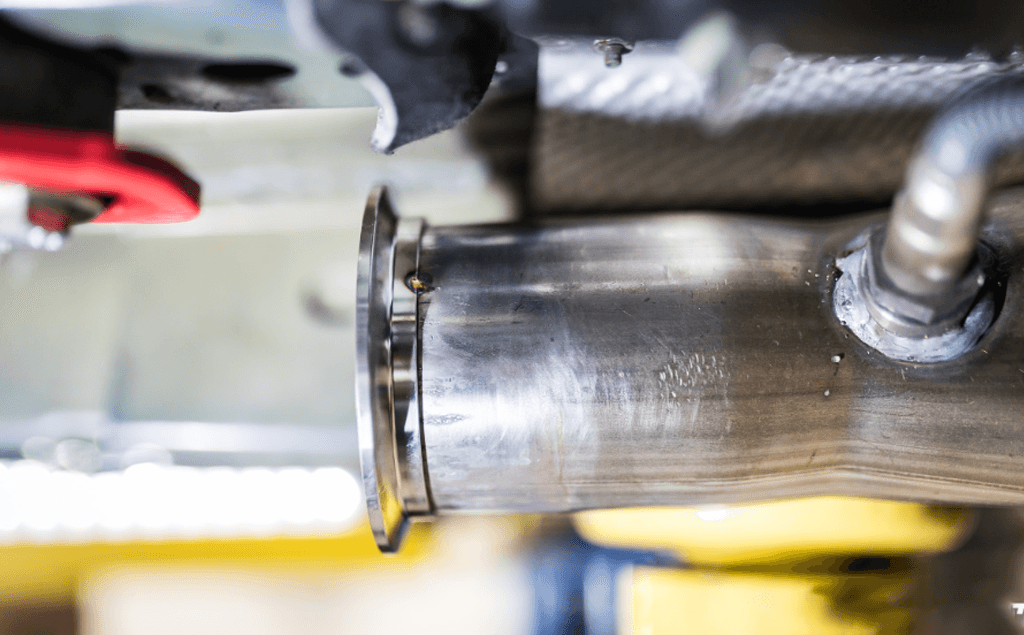
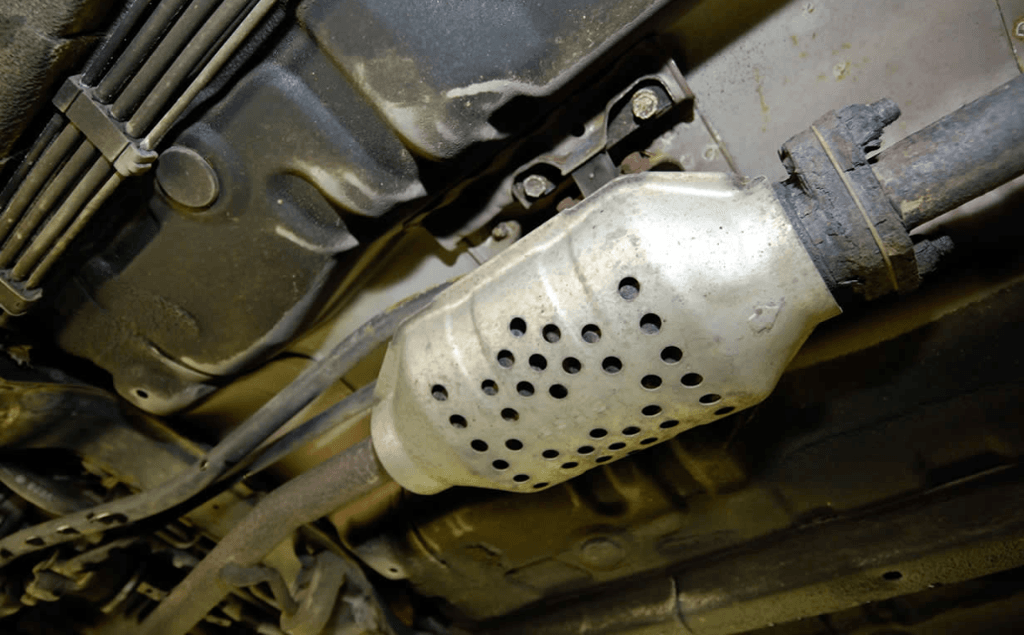
The трехкомпонентный каталитический нейтрализатор serves as an advanced chemical reactor within your vehicle’s exhaust piping, processing toxic gases into safer compounds.
| Targeted Pollutant | Dynamic Chemical Transformation Triggered | Target Conversion Level |
|---|---|---|
| Carbon Monoxide ($CO$) | Driven by Platinum (Pt) / Palladium (Pd): Oxidizes $CO$ into Carbon Dioxide ($CO_2$). | Exceeds 95% efficiency |
| Hydrocarbons ($HC$) | Driven by Platinum (Pt) / Palladium (Pd): Oxidizes unburned raw fuel ($HC$) into Water ($H_2O$). | Exceeds 95% efficiency |
| Nitrogen Oxides ($NO_x$) | Driven by Родий (Rh): Strips and reduces toxic $NO_x$ into harmless Nitrogen ($N_2$) and Oxygen ($O_2$). | Exceeds 95% efficiency |
Catalyst Monolith Substrate Comparison
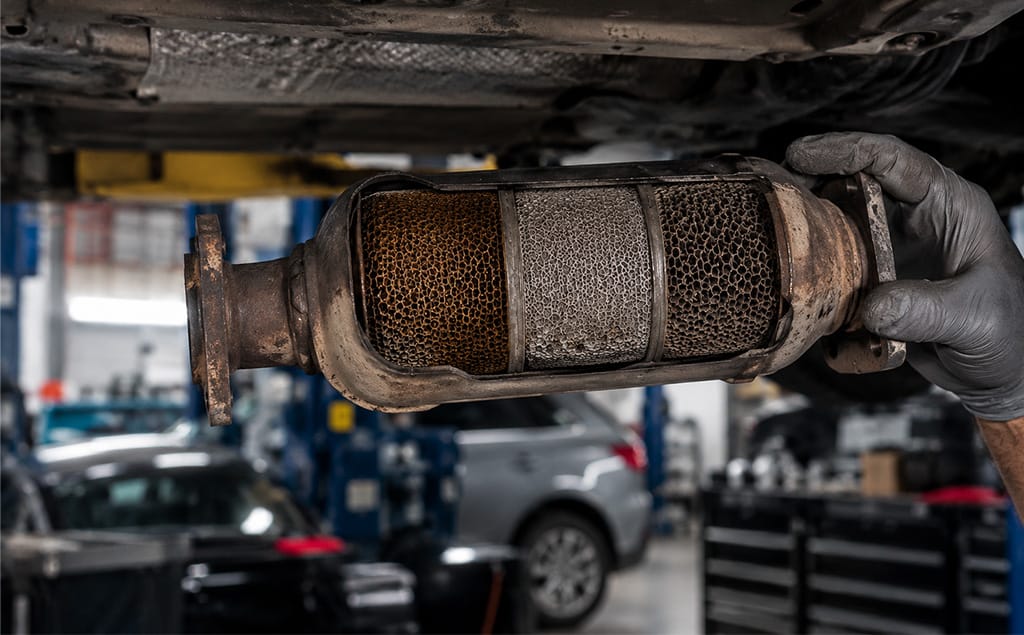
Manufacturers construct the internal honeycomb brick using different core materials depending on the application:
| Performance Trait | Ceramic Monolith Core | Metallic Monolith Core |
|---|---|---|
| Primary Base Material | Cordierite Ceramic Compound | Ultra-Thin Structured Stainless Steel Foil |
| Standard Channel Density | 400 to 600 Cells Per Square Inch (CPSI) | 100 to 300 Cells Per Square Inch (CPSI) |
| Расход отработавших газов | Standard restriction (Ideal for daily drivers) | High flow rates (Ideal for performance cars & heavy trucks) |
| Thermal Shock Resistance | Medium (Can crack under sudden external water splashes) | High (Resists extreme thermal expansion stresses) |
| Вибростойкость | Fragile (Shatters easily from rough road impacts) | Extremely durable (Resists severe off-road vibration) |
Emissions Monitoring and Code Trigger Mechanisms
The Engine Control Module (ECM) monitors system health using two separate oxygen ($O_2$) sensors.
| Sensor Position | Location Relative to Catalyst | Healthy Functional Waveform | Failed Catalyst Waveform (P0420/P0430) |
|---|---|---|---|
| Upstream $O_2$ Sensor | Ahead of converter, near manifold | Rapidly fluctuates between 0.1V and 0.9V as air-fuel ratios adjust. | Rapidly fluctuates between 0.1V and 0.9V (Normal behavior). |
| Downstream $O_2$ Sensor | Immediately behind converter | Steady, flat-lined voltage reading around 0.5V to 0.7V. | Rapidly switches and mirrors the upstream waveform completely. |
[Engine] ──► Upstream O2 Sensor (Rapidly Fluctuating Voltage) ──► [Catalytic Converter] ──► Downstream O2 Sensor (Steady Flat-line)
Bank 1 vs. Bank 2 Target Areas
Diagnostic software localizes faults based on engine cylinder layout:
- P0420 (Bank 1): Affects the cylinder bank containing cylinder #1. This is the only bank present on standard inline 4-cylinder or inline 6-cylinder engines.
- P0430 (Bank 2): Affects the opposite cylinder row on V-configured engines (V6, V8).
Diagnostic Symptoms and Upstream Root Causes
Identifying Engine Fault Signs
The table below connects common secondary vehicle symptoms directly to the upstream engine issues destroying the трехкомпонентный каталитический нейтрализатор:
| Accompanying Vehicle Symptom | Indicated Upstream Failure | Destructive Impact on Catalyst Structure |
|---|---|---|
| Strong “Rotten Egg” Odor | Uncontrolled rich fuel mixture | Excess raw fuel ignites inside, raising temperatures past $1,200^{\circ}\text{F}$ ($650^{\circ}\text{C}$) and melting the core. |
| Spiking Fuel Consumption | Leaking fuel injectors or bad MAF sensor | Floods the exhaust path with raw hydrocarbons, causing rapid thermal catalyst degradation. |
| Visible Black Exhaust Smoke | Running ultra-rich will melt the internal structure on the spot and choke the honeycomb passages with heavy soot. | |
| Visible Blue Exhaust Smoke | Internal engine oil burning | Phosphorus and zinc anti-wear additives form a permanent glassy glaze over precious metals. |
| Visible White Exhaust Smoke | Internal Coolant Leakage: Silicates and corrosion inhibitors compound into heavy, white scale deposits, masking the washcoat and neutralizing its catalytic activity. |
Professional Step-by-Step Diagnostic Procedures
Technicians must isolate the following operational parameters before replacing a suspected трехкомпонентный каталитический нейтрализатор:
| Diagnostic Step | Target Component / Parameter | Professional Testing Procedure | Passing Benchmark Values | Failing Threshold (Replace Component) |
|---|---|---|---|---|
| 1. Module Scan | Concurrent fault data | Scan all modules for stored misfire or fuel codes. | No matching codes present | Active P0300-P0308, P0171, or P0172 codes (Fix these first!) |
| 2. Trim Check | Fuel Delivery Balance | Read Long-Term and Short-Term Fuel Trims via live data stream. | Combined total stays within $\pm 5\%$ | Combined total exceeds $\pm 10\%$ (Indicates severe leak or injector fault) |
| 3. Leak Test | Housing & Gasket Integrity | Pump low-pressure smoke into cold exhaust via smoke machine. | Zero smoke escapes system | Smoke leaks from manifold cracks or sensor bungs (Trips false lean codes) |
| 4. Thermal Test | Exothermic efficiency | Measure surface pipe temperature at catalyst inlet vs. outlet with infrared thermometer. | Outlet reads $100^{\circ}\text{F}$ to $200^{\circ}\text{F}$ hotter than inlet. | Outlet temperature matches or falls below inlet temperature (Dead catalyst) |
| 5. Pressure Test | Physical Core Integrity | Thread mechanical backpressure gauge into upstream $O_2$ sensor port. | Below 1.5 PSI at idle; below 3.0 PSI at 2,500 RPM | Sweeps past 4.0 to 10.0+ PSI (Indicates melted, collapsed, or clogged brick) |
Preventative Maintenance Framework
Vehicle operators can safeguard the трехкомпонентный каталитический нейтрализатор premium performance by following a targeted engine care schedule:
| Target Component | Maintenance Action Required | Recommended Interval | Preventive Protection Mechanism |
|---|---|---|---|
| Ignition System | Рекомендуемое техническое обслуживание: замена свечей зажигания, катушек и проводов каждые 30 000–100 000 миль. Предотвращение пропусков зажигания является обязательным. В противном случае несгоревшее топливо попадает в горячую выхлопную систему и вызывает серьезные повреждения. | ||
| Топливные форсунки | Добавьте высококачественный очиститель топливной системы, содержащий полиэфирамин (PEA). | Используйте каждые 30 000 миль для удаления стойких нагаров с наконечников форсунок. Это поддерживает четкую траекторию распыления и предотвращает переобогащение топливной смеси в двигателе. | |
| Поставка топлива | Покупайте топливо исключительно на сертифицированных заправочных станциях высшего уровня. | Каждая заправка | Сводит к минимуму накопление большого количества углеродистой сажи на клапанах, головках и каналах катализатора. |
| Выхлопные каналы | Двигайтесь непрерывно на постоянной крейсерской скорости по автомагистрали. | 30-45 минут два раза в месяц | Нагревает систему выше 600 °F (315 °C) для достижения состояния "зажигания" и сжигания влаги/сажи. |
Заключение
Постоянно появляющийся диагностический код P0420 или P0430 является срочным предупреждением о том, что проблема с работой двигателя, расположенного выше по потоку, активно повреждает систему выпуска отработавших газов вашего автомобиля. Когда катализатор сгорает раньше времени, это обычно просто сигнализирует о нерешенной проблеме двигателя, будь то постоянные пропуски зажигания, переобогащенная топливная смесь или внутренние утечки жидкости.
Чтобы ремонт каталитического нейтрализатора дал результат, необходимо выявить и устранить первопричину проблемы, прежде чем устанавливать новые детали. Не экономьте на замене — используйте только оригинальные запчасти. УГЛЕВОДИспользуйте соответствующие запчасти и регулярно проводите техническое обслуживание свечей зажигания и топливной системы. Правильное обслуживание гарантирует, что индикатор Check Engine не загорится, ваш автомобиль будет работать как положено, и вам не придется беспокоиться о проверках на выбросы вредных веществ в будущем.