Introduction
Mitigating toxic emissions remains one of the most pressing hurdles for the automotive sector. Engineers solve this problem using the three way catalytic converter. This device sits within the vehicle exhaust system. Essentially a micro-scale chemical reactor, this technology quietly neutralizes harmful tailpipe emissions. Tightening clean-air regulations have effectively mandated its inclusion across almost all modern internal combustion platforms.Understanding the internal components of this device reveals a masterpiece of material science.
This guide explores every layer of the three way catalytic converter. We examine the stainless steel housing. We analyze the honeycomb substrate. We study the microscopic precious metal coatings. We have mapped the collaborative chemistry these materials leverage to drive down air emissions.
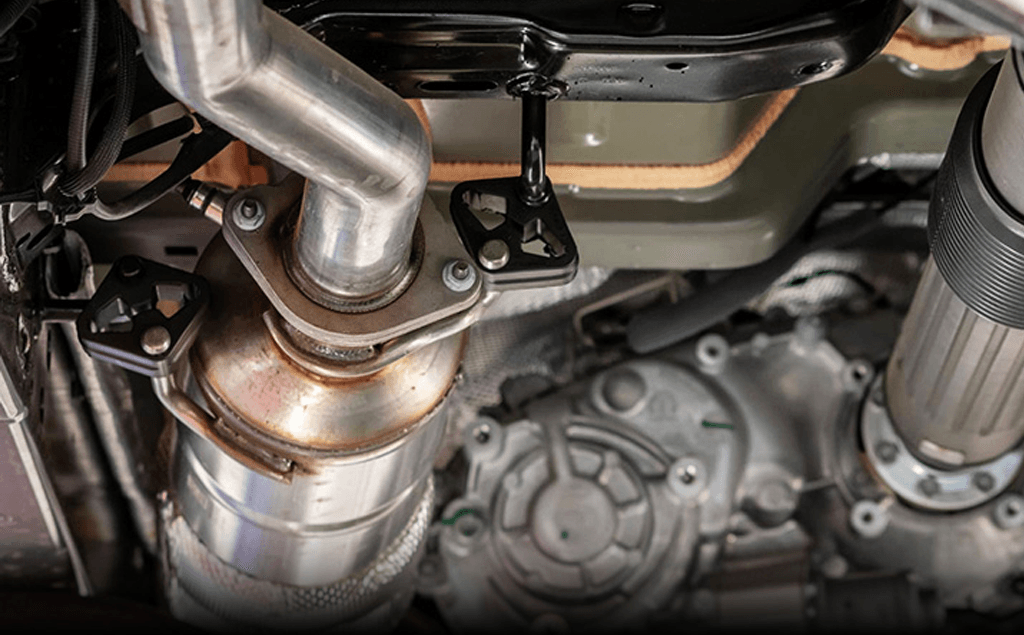
The Exterior: Enclosed in rugged 409- or 304-grade stainless steel, the system remains fully isolated from physical wear under extreme exhaust temperatures that regularly top 800°C.The shell must maintain its structural integrity under these extreme conditions.
The shell protects the fragile internal components from road debris. It also prevents oxidation and rust. A heat shield often covers the shell.This shield protects the vehicle chassis from the intense heat of the catalytic reaction. Engineers design the shell to be aerodynamic. This shape minimizes backpressure. Low backpressure ensures the engine operates efficiently.
The Core: The Honeycomb Substrate
Inside the shell, you find the substrate. “The chemical reaction relies on the structural scaffolding afforded by the substrate.Industry standards generally center on two substrate materials: ceramic and metallic honeycomb.
Ceramic Substrates (Cordierite)
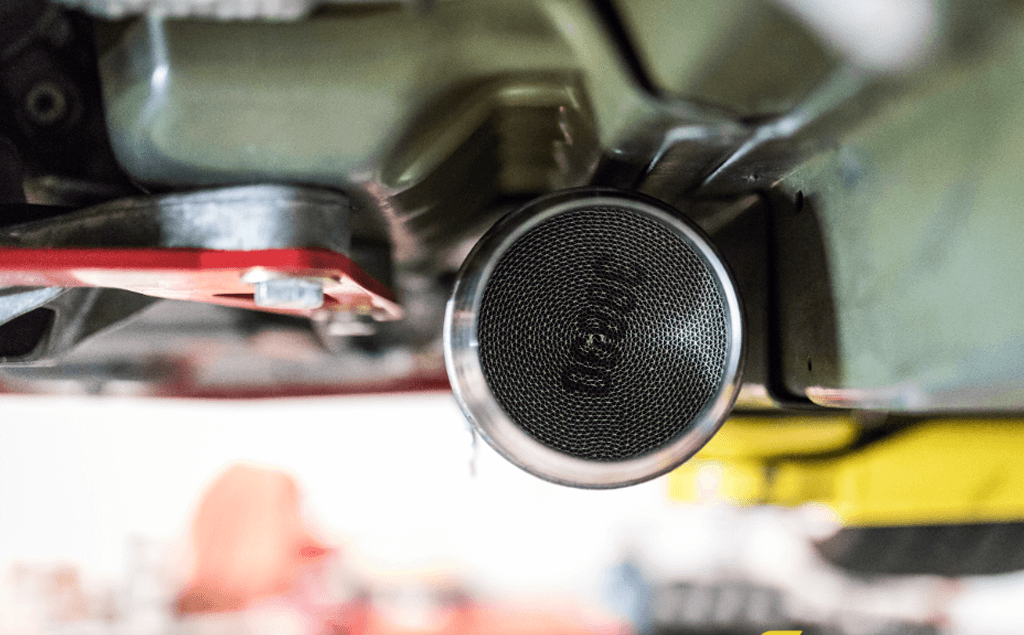
Ceramic blocks consist mainly of Cordierite. Following synthesis from magnesium, aluminum, and silicon, this ceramic is extruded to form a highly ordered honeycomb matrix. The block contains thousands of tiny, parallel channels. These channels look like a bee’s honeycomb.
The ceramic substrate offers several advantages:
- High Thermal Stability: It survives rapid temperature changes.
- Low Thermal Expansion: It does not warp when hot.
- Cost-Effectiveness: It remains cheaper to produce than metal.
Metallic Substrates
Some high-performance vehicles use metallic substrates. These consist of thin ribbons of stainless steel. Engineers wind these ribbons into a spiral or S-shape. Metallic substrates have thinner walls than ceramic ones. The superior thermal conductivity of the metallic substrate is exploited here to achieve optimal channel density within a highly restricted volume.They reach operating temperature faster than ceramic cores. This speed reduces cold-start emissions.
The Washcoat: The Invisible Powerhouse
The substrate itself does not clean the exhaust. Manufacturers apply a “washcoat” to the honeycomb walls. The washcoat consists of a slurry of aluminum oxide (Alumina), silica, and various oxides.
The washcoat creates a rough, porous surface. This porosity increases the effective surface area by a factor of 7,000. The washcoat also contains “Oxygen Storage Components” (OSC). Ceria (Cerium Oxide) is the most common OSC. Ceria absorbs oxygen when the engine runs “lean.” It releases oxygen when the engine runs “rich.” This cycle ensures the chemical reactions have enough oxygen to continue.
The Catalysts: Precious Metals
The most expensive part of a three way catalytic converter is the catalyst loading. Highly dispersed, micro-scale precious metal particles are integrated into the coating to yield maximum active catalytic surface area.The “three-way” name refers to the three pollutants these metals target: Nitrogen Oxides (NOx), Carbon Monoxide (CO), and Hydrocarbons (HC).
- Platinum (Pt): Platinum serves as a primary oxidation catalyst. It adds oxygen to Carbon Monoxide. This reaction creates Carbon Dioxide ($CO_2$). Platinum also attacks unburnt Hydrocarbons. It turns them into water vapor ($H_2O$) and $CO_2$.
- Palladium (Pd): Palladium acts as a versatile worker. It assists Platinum in oxidation.By replacing a portion of platinum with palladium, modern converters achieve significant cost savings while maintaining excellent thermal endurance.
- Rhodium (Rh): Rhodium is the king of reduction. It focuses specifically on Nitrogen Oxides (NOx). Rhodium removes the oxygen atom from the nitrogen molecule. This process yields pure Nitrogen ($N_2$) and Oxygen ($O_2$). Pure Nitrogen makes up 78% of the air we breathe.
Data Comparison: Substrate Materials
This table outlines key differences between the leading substrate materials for three-way catalytic converters.Common ratings include 400 CPSI and 600 CPSI universal catalytic converters.
| Feature | Ceramic Substrate | Metallic Substrate |
|---|---|---|
| Primary Material | Cordierite (Ceramic) | Stainless Steel Foil |
| Wall Thickness | 0.10 mm – 0.15 mm | 0.03 mm – 0.05 mm |
| Thermal Conductivity | Low | High |
| Heat-up Time | Slower | Very Fast |
| Typical CPSI | 400 | 600 – 1000 |
| Durability | Brittle | High Impact Resistance |
The Chemical Reactions: How It Works
The three way catalytic converter performs two simultaneous chemical tasks. These tasks happen in different stages along the honeycomb channels.
Stage 1: The Reduction Reaction
The first stage targets Nitrogen Oxides. The reduction catalyst uses Rhodium and Platinum. Upon contact with the rhodium active sites, NOx molecules undergo selective adsorption, allowing the metal to bind and retain oxygen atoms on the catalyst surface. The nitrogen atoms pair up and leave as $N_2$ gas.
Stage 2: The Oxidation Reaction
The second stage targets Carbon Monoxide and Hydrocarbons. The oxidation catalyst uses Platinum and Palladium. These metals grab the oxygen atoms stored by the washcoat. They force the oxygen to bond with CO and HC.
- $2CO + O_2 \rightarrow 2CO_2$
- $HC + O_2 \rightarrow CO_2 + H_2O$
These reactions require a specific temperature range. Most converters start working at 250 degrees Celsius. This temperature is the “light-off” point.
Detailed Manufacturing Process
The production of a three way catalytic converter involves multiple specialized engineering steps.
- Substrate Extrusion: Manufacturers force a ceramic slurry through a precision die. This creates the honeycomb structure. They then fire the ceramic in a kiln at 1,400 degrees Celsius.
- Washcoat Application: Workers dip the substrate into an Alumina-based slurry. This creates the rough internal surface required for the metal coating.
- Catalyst Impregnation: Manufacturers spray a precise solution of Platinum, Palladium, and Rhodium onto the washcoat. They measure the metal “loading” in grams per cubic foot.
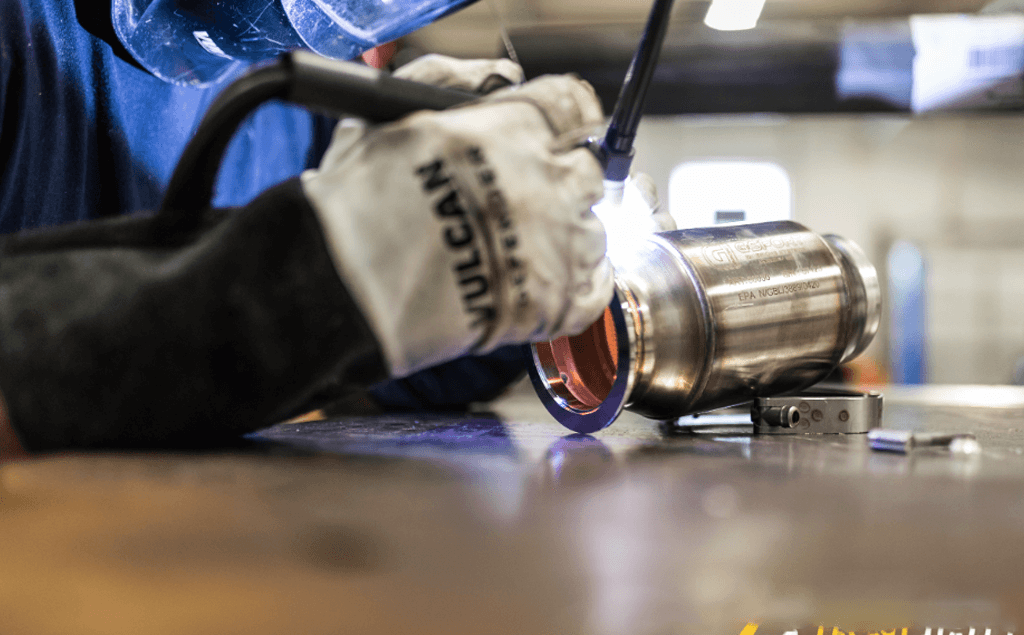
- Canning: Workers wrap the substrate in a ceramic fiber mat. They press the block into the stainless steel shell. Final welding seals the unit.
Global Emission Standards Comparison
Manufacturers must adjust the precious metal loading based on local laws.
| Emission Standard | NOx Limit (g/km) | CO Limit (g/km) | Catalyst Loading Requirement |
|---|---|---|---|
| Euro 4 | 0.08 | 1.00 | Standard Loading |
| Euro 5 | 0.06 | 1.00 | High Rhodium Loading |
| Euro 6 | 0.06 | 0.50 | Ultra-High Pd/Rh Loading |
| China VI | 0.035 | 0.50 | Optimized Oxygen Storage |
Common Failure Points and Maintenance
Even a well-built three way catalytic converter can fail. Understanding these failures helps in vehicle maintenance.
- Thermal Melting: Raw fuel sometimes enters the exhaust. It burns inside the converter. Temperatures exceed 1,200 degrees Celsius. This heat melts the ceramic honeycomb. The engine then loses power due to blockages.
- Chemical Poisoning: Certain additives coat the precious metals. Lead, phosphorus, and sulfur are common poisons. These chemicals block the active sites. The chemical reactions stop entirely.
- Structural Clogging: If an engine burns oil, ash clogs the tiny tubes. This reduces the available surface area for the gases.
Future Trends: Electrification and Euro 7
The future of the three way catalytic converter faces new hurdles. New laws in Europe require lower emissions during cold starts. Engineers now develop “Electrically Heated Catalysts.” These devices use a battery to heat the core before the engine starts. This ensures zero emissions from the first second of operation. Hybrid vehicles also require specialized converters. These units must stay hot during long periods of electric-only driving.
Conclusion
The catalytic converter connects high-performance engineering with environmental protection. It’s encased in a stainless steel shell to shield the high-surface-area honeycomb core inside.The core hosts a sophisticated washcoat. This washcoat holds Platinum, Palladium, and Rhodium. These metals perform the magic of redox chemistry. They turn deadly pollutants into the components of ordinary air. Vehicle owners must maintain their engines to protect this device. A healthy converter ensures a cleaner planet.